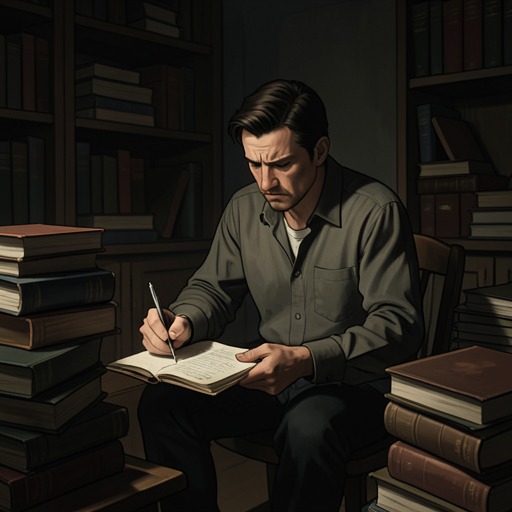
Diotallevi's death
Foucault's PendulumDiotallevi's death is confirmed to Casaubon by Gudrun in a brief telephone call from Paris, turning one fact into the firmest point in his account of a story otherwise clouded by uncertainty. The news also reveals that Diotallevi’s friends failed to attend his funeral, leaving Gudrun to confront their absence and its shame.
Confirmation and Circumstances
At eleven, Casaubon is preparing to leave Paris for the airport when he calls Garamond Press collect; he has no money left. Gudrun answers only after he has called out three times. She is crying, and tells him that Diotallevi died at midnight on Saturday. The timing makes the death coincide with the night of the events Casaubon witnessed at Saint-Martin-des-Champs, though the call itself does not explain a cause of death.
The Funeral and the Absent Friends
Gudrun reports that the funeral took place that morning. None of Diotallevi’s friends attended—not even Signor Garamond, who was said to be out of the country. Those present were Gudrun, Grazia, Luciano, and an unfamiliar man dressed in black, with a beard, side curls, and a large hat; to Gudrun he looked like an undertaker, and she did not know where he had come from. Her account turns the death from private news into a measure of the group’s abandonment and disarray. She asks where Casaubon and Belbo are and what is happening, but Casaubon mutters an inadequate explanation and hangs up when his flight is called.
Fact Amid Uncertainty
Aboard the plane, Casaubon begins listing what he considers incontestable. He accepts Diotallevi’s death without doubt because Gudrun told him: she had never been part of the group’s story and, in his judgment, would not have understood it, so she is the sole remaining source who tells the truth. This confidence in her report contrasts with his uncertainty about what happened in Paris. He allows that the events at Saint-Martin-des-Champs may not have occurred exactly as he perceived them, since music and incense had left him befuddled, while insisting that something did happen. Diotallevi’s death therefore becomes both an established loss and the fixed fact around which Casaubon tries to reason when the rest of his experience remains unsettled.