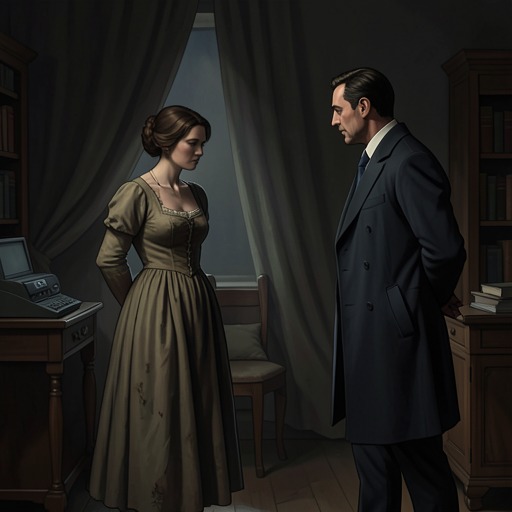
Giulio
Foucault's PendulumGiulio is the child of Casaubon and Lia, named only when Lia gives birth after a pregnancy during which the couple calls the unborn baby “the Thing.” His arrival is decisive because it draws Casaubon away from the Plan and toward an intimate, ordinary reality: rather than a hidden cosmic revelation, the birth makes parenthood and human connection the answer to the mysteries he has been pursuing.
Identity and Before Birth
During the final days of Lia’s pregnancy, Casaubon neglects the Plan and stays with her whenever he can. He is anxious about the approaching birth, while Lia reassures him that the time has not yet come. She is taking a course in painless childbirth, and Casaubon tries to follow the exercises with her. The practical preparation places their attention on a real, imminent event rather than on the increasingly elaborate constructions of the Plan.
Lia declines the opportunity to learn the baby’s sex in advance because she wants to be surprised. Casaubon accepts her choice, touches her belly, and does not try to predict what will be born. The couple calls the baby “the Thing,” a playful name that expresses their uncertainty without turning it into a puzzle to be solved. They agree that the child should be loved even if born with a difference, and Casaubon jokes about imagined musical possibilities before returning to the occult vocabulary of his Diabolicals, who envision the birth as the Great Work, the White, the Rebis, and the androgyne.
Naming and the Plan
The birth exposes the contrast between Casaubon’s invented mysteries and the life about to begin. He imagines that he could have written a book telling adepts that the secretum secretorum need not be searched for: the book of life has no hidden meaning, and its truth is present in the bodies of parents and children. In this imagined alternative, the Unknown Superiors would be Casaubon and Lia, recognizable to their child without recourse to the theories of Joseph de Maistre. Giulio is not yet born in this reflection, but the passage gives his arrival its thematic weight: the child makes the supposedly ultimate secret immediate, embodied, and relational.
Instead, Casaubon and his companions have continued playing games with the Diabolicals and inventing an ever more cosmic plot. Looking back, Casaubon recognizes the cost of that choice. As he waits to discover what will happen beneath Foucault’s Pendulum, the birth stands in painful contrast to the Plan’s manufactured significance: he had a life-changing reality before him, yet remained caught in the mystery he helped create.
Lia chooses the names before the birth: Giulio for a boy and Giulia for a girl, after her grandfather. Casaubon approves. The choice gives the child an ordinary family inheritance, distinct from the grand symbolic identities projected onto the unborn baby. Giulio’s eventual name arrives through Lia’s announcement, not through any revelation supplied by the Plan.
Birth and Relationship to His Parents
When Casaubon reaches the hospital, he is frightened that the baby may be stillborn and that Lia may die. He has been away and worries that his absence is his fault. His frantic arrival is confused: he asks for directions, ends up in the wrong ward twice, and has to be told that many women are giving birth there. The scene replaces abstract speculation with uncertainty about the safety of the two people closest to him.
He eventually finds Lia pale but smiling, with the newborn beside her. Lia tells him the baby is Giulio. Casaubon recognizes him as his Rebis, but immediately distinguishes the real child from the imagined products of alchemical or occult creation: Giulio is whole, with his fingers and toes in their proper places. The language of the Rebis remains, yet the birth gives it an unmistakably human referent—a child made by Casaubon and Lia, not by the Plan’s fantasies.
Casaubon acknowledges that parenthood belongs to both of them, but Lia has borne the labor. He kisses her forehead and credits her, while she replies that she had to do the counting alone. Their exchange restores the birth to the partnership that actually made Giulio possible. The closing emphasis belongs not to Casaubon’s symbolic system but to Lia’s work and the shared, concrete fact of their son’s arrival.
Narrative and Thematic Significance
Giulio’s importance in the supplied scenes lies less in any independent action than in what his birth changes for Casaubon. Before it, the child is an anticipated presence around which Lia and Casaubon make practical and affectionate preparations. At birth, he becomes a person with a name, while Casaubon’s fear of losing Lia and the baby briefly overwhelms his attention to the Plan. The shift makes the child a counterweight to the novel’s pursuit of hidden connections: the most consequential meaning is not concealed in history but present in a family’s care for one another.
Casaubon’s reflection that he should have written a “white book” turns Giulio’s anticipated arrival into a rejected alternative to the Plan. The imagined book would have declared that life required no secret interpretation, and that the apparent figures of cosmic authority were simply the child’s parents. The irony is that Casaubon understands this possibility while still waiting beneath Foucault’s Pendulum, unable to leave the game behind. Giulio’s birth therefore offers a clear human answer to the search for ultimate meaning without suggesting that Casaubon has fully escaped the worldview that made the search so consuming.