Jacopo Belbo
Foucault's PendulumJacopo Belbo is a publisher, a guarded private writer, and one of the three men who invent the Plan by joining fragments of occult history. His transformation is the novel’s central warning about interpretation without limits: a game devised in irony can become a structure of belief, and the man who once insisted on watching from the sidelines ends by refusing to save himself through another fiction.
Identity and Work
Belbo works at Garamond, where his editorial role differs from Diotallevi’s. Diotallevi handles reference books and major projects with long production schedules and sales lives; Belbo chiefly manages university editions. These are comparatively predictable publications—often institutional books or conference proceedings, written by beginners whose professors supply prefaces, corrected by authors who check quotations and footnotes, and sold as textbooks over several years. Their authors receive no royalties, but a few thousand copies generally cover costs. The routine offers Belbo a professional world governed by manageable expectations rather than grand literary ambition.
That publishing world later broadens into the commercial machinery of Project Hermes. Garamond proposes a new branch devoted to books on Hermes, while the associated Manutius operation depends on self-financing authors and minimal overhead. Its staff consists of Garamond, Signora Grazia, a bookkeeper, and Luciano, a disabled shipping clerk. The sales pitch flatters aspiring writers with talk of enthusiastic reports, a prize-worthy book, and the publisher’s personal devotion to the manuscript. The contract, however, protects the publisher: it sets a maximum print run of ten thousand without a minimum, leaves the author’s payment independent of the run despite verbal assurances, and permits unsold copies to be pulped after a year. Belbo belongs to an industry that can manufacture both a book’s apparent distinction and its demand.
From Skepticism to the Plan
Belbo’s habitual skepticism is visible in his conversations with Casaubon and Diotallevi. When an idea sounds familiar, he asks whether it came from Orwell or Koestler, or recalls an analogous episode from the Cultural Revolution. Diotallevi answers with a cyclical theory of history: events repeat, and permutations matter more than history as a linear teacher. Belbo’s joke that Kabbalists do not believe in history keeps distance between him and the system, even as the system’s language begins to shape their shared thinking.
The three turn that method into a creative experiment with Abulafia. They propose feeding it a few dozen claims from the Diabolicals—such as the Templars fleeing to Scotland or the Corpus Hermeticum arriving in Florence in 1460—along with connective phrases such as “It’s obvious that” and “This proves that.” The machine’s rearrangements could be made to look revelatory by filling in the gaps and calling repetitions prophecies. Belbo immediately embraces the idea. Its comic ingenuity lies in exposing how an apparently coherent history can be assembled from arbitrary fragments, but the procedure also gives the fragments an accumulating life of their own.
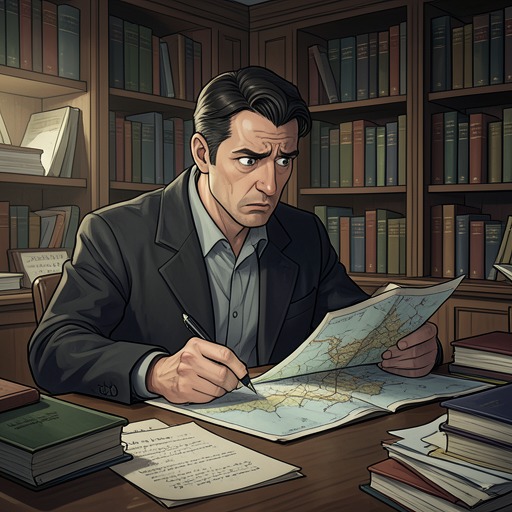
Belbo later contributes fantasies about the Rosicrucian period, including the suggestion that Francis Bacon wrote the manifestoes. He reports only a bare outline to his colleagues, conceals personal references, and lets them think Abulafia supplied the connections. In private, however, he is constructing a richer narrative from quotations and personal myths. He is not simply collecting evidence for the group’s parody: the act of joining other people’s stories has become a way to write his own. The narrator sees him as testing his talent in fiction, or perhaps inserting himself into the Great Story he is distorting.
The distinction between pretending to believe and believing eventually begins to collapse. The men recognize that their associations are unwarranted and console themselves that they are parodying the Diabolicals’ logic. Yet repeated practice makes their minds connect everything with everything else automatically. Belbo’s change is not a sudden conversion founded on new proof. The narrator concludes that Belbo takes the Diabolicals’ universe seriously precisely because he has so little faith: the habit of disbelief has not protected him once the Plan becomes a framework for organizing experience.
Private Writing and Buried Memory
Abulafia gives Belbo a private space beyond the meetings. Its password protects pages of a pseudo-diary, some bearing older dates and others written after the machine’s arrival. He can regard this mechanical play and solitary examination of his errors as something other than creation, because he associates genuine creation with love for another person. The narrator later sees that the files are more than stored research: they hold a private narrative Belbo does not read aloud and a record of thoughts he cannot comfortably present as his own.
The files also register a longing that the Plan cannot satisfy. In the game, Diotallevi participates as if in prayer, but the narrator eventually understands that Belbo plays anxiously, biting his nails and hoping to find one of the unknown addresses he mentions in a file called Dream. The hoped-for destination is a stage without footlights—a substitute theology, the promised appearance of an angel who never comes. Belbo’s participation therefore carries two contrary impulses: he helps invent a system while hoping it might disclose something beyond invention.
His wartime memories sharpen the contrast between that system and an earlier, more definite world. Looking back, the narrator understands that Belbo remembered those days as a time of clarity: a bullet was a bullet, one ducked or was hit, and the opposing sides were marked red and black. A corpse was simply a corpse. That apparent certainty stands against the slippery disappearance of Colonel Ardenti and the ambiguities that gather around the Plan. Belbo’s recollection does not resolve the later mystery; it reveals what he has lost, or believes he has lost, in a present where fact and fiction continually exchange places.
Relationships and Withdrawal
Belbo’s closeness to Casaubon is expressed through collaboration, teasing, and the narrator’s access to his hidden writings. He treats Casaubon as a fellow investigator and as an audience for his Templar jokes, yet keeps the most personal part of his writing private. This uneven access becomes consequential when Belbo’s confidence in the Plan rises: Casaubon is asked to read the disks and judge the evidence, but Belbo’s account reaches him through the machine and the accumulated record rather than through a settled conversation between friends.
His relation to the group’s intellectual play is similarly divided. He can offer a brilliant suggestion, discuss the machinery of historical repetition, and report a fantasy without appearing to take it seriously. But the narrator later recognizes the nervousness beneath his performance. Belbo joins in partly because the Plan might lead to the hidden address or presence he longs for; when it does not, the game has already trained him to seek meaning through its connections. His isolation is thus created not by withdrawing from the group at the outset, but by concealing the difference between what he shares and what he privately hopes the pattern will deliver.
Crisis and Ending
When Belbo is away from the office, Gudrun tells Casaubon that he left for family reasons and took both Abulafia and the printer home to finish work. The unexplained move becomes the first sign that his private activity has acquired urgency. Soon Belbo telephones Casaubon in alarm, insisting that the Plan is real and that they are after him. He says that the disks contain everything that has happened over the past month, written during three days and three nights, and directs Casaubon to an envelope in his desk with two keys: a large one for the country house and a small one for the Milan apartment. The frantic instruction turns the machine into both archive and appeal for help.
Belbo’s fear soon hardens into a trap. After the episode in Piacenza in which he runs over a dog, he retreats into the Plan, where he can decide who acts, how, and when, and believes that defeats cannot reach him. Later, convinced that Aglie believes his story and wants the map, he sees that he has been maneuvered into going to Paris. Since Casaubon has disappeared without leaving an address and Diotallevi is dying, Belbo believes he alone knows that he does not possess the secret he is expected to reveal. The invented map has become dangerous not because it contains a reliable answer, but because others treat it as proof that an answer exists.
At the final ritual, Belbo is brought before the assembled hierophants as a captive, his hands bound behind him and his shirt open. His refusal to surrender a secret intensifies their conviction that he possesses one: the more he denies it, the larger and more authentic the imagined secret becomes. The narrator later understands that Belbo’s claim to possess a secret had given him a moment of power, but that this power depended on the pursuers’ interpretation rather than on any knowledge of his own.
Belbo is offered a possible way out: he could invent a map or use one Casaubon had shown him. The Pendulum is incorrectly hung, so the group would not find the X marking the Umbilicus Mundi; even if they did, it could take decades to discover that it was not the right one. Belbo nevertheless refuses to bow. His final refusal is not a successful revelation of the Plan but a refusal to preserve himself by manufacturing another false answer. Casaubon hopes that, as he dies swaying with the Pendulum, Belbo understands something and finds peace. The novel leaves that peace as a hope, while making the cost of his refusal unmistakable.
Narrative Role
Belbo’s arc links the novel’s formal experiment with its moral danger. The Plan begins as a parody assembled from quotations, historical conjectures, and easy connective phrases; Abulafia makes the process feel both mechanical and inexhaustible. Belbo’s secret files reveal the other side of that construction: the fragments are not merely jokes when he uses them to shape a personal story and search for an absent presence. His career in publishing, his private writing, and his role in the conspiracy all involve making, packaging, or interpreting texts, but none gives him a stable boundary between invention and truth.
The ending reverses his old posture as an observer. Belbo once held himself apart from the world, even treating his computer writing as a game that did not count as creation. By the end, he is at the center of a scene whose meaning has been made by other people’s hunger for a secret. His refusal to provide one cannot undo the Plan or escape its violence. It does, however, mark the last distinction he can maintain between knowing and pretending: the secret the pursuers demand is real to them, but Belbo will not make it real by inventing it.