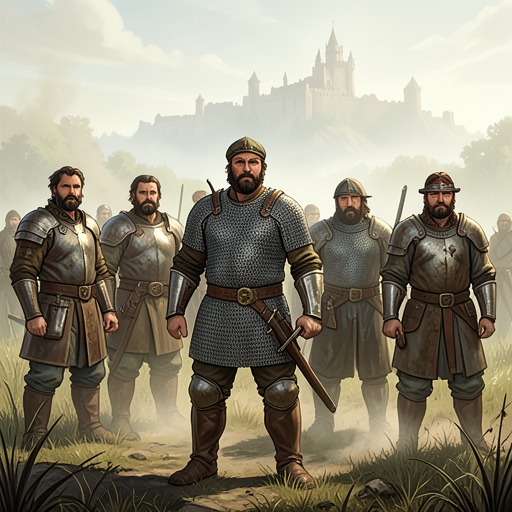
Jerusalem
Foucault's PendulumJerusalem is both a real contested city and the lost sacred center around which the novel’s account of the Knights of the Temple turns. In Casaubon’s historical reconstruction, the city gives the Templars their founding purpose and, after its final loss, leaves them powerful but deprived of the land and cause that had defined them. Later, the name Jerusalem is absorbed into the conspiratorial “Plan,” where it serves not as historical evidence but as a device for linking unrelated movements and blaming Jews for imagined secret designs.
Crusader Kingdom and the Templars’ Foundation
Casaubon begins his account with the First Crusade: Godefroy fulfills his vow at the Holy Sepulcher, Baudouin becomes Jerusalem’s first king, and a Christian kingdom is established in the Holy Land. Holding the city, however, is not the same as conquering the rest of Palestine. The new occupiers and pilgrims face an unstable situation, with the Saracens defeated but not eliminated and the kingdom’s future uncertain.
In 1118, during the reign of Baudouin II, Hugues de Payns and eight companions arrive and establish the nucleus of the Poor Fellow-Soldiers of Jesus Christ. The order combines monastic vows of poverty, chastity, and obedience with a fourth obligation: defending pilgrims. Jerusalem’s king, bishop, and other supporters contribute money and lodging, and the knights are eventually installed in the cloister of the old Temple of Solomon. Their association with that site gives them the name by which they will be known: the Knights of the Temple. Jerusalem is thus not merely a military objective in the story of their beginnings; it is the place where their religious and armed identities are joined.
A Lost Center and a Fading Military Purpose
Casaubon presents the Templars’ first generation as likely idealists drawn to the Crusade, while later recruits may have sought opportunity, adventure, or escape from constricted prospects at home. The new kingdom could appear to them as a place to make a fortune, but the Templar life also meant long stretches in the desert, often among fellow members of the order and few others. The city that had promised a sacred mission stood within a wider and demanding frontier.
The account then moves from the order’s foundation to the long decline of the crusading ideal. In 1244 Jerusalem falls, and Casaubon describes the loss as the definitive end of the war that had begun generations earlier. The Christian campaign has failed; the land is no longer available as the Templars’ intended field of action. Louis IX nevertheless believes another crusade is worth undertaking, and the Templars follow him into defeat because, without a crusade, they can no longer justify the Temple. Their loyalty to the king and to the ideal persists even as the historical purpose that sustained it erodes.
In 1291 Saint-Jean-d’Acre is conquered, its inhabitants are killed, and the Christian kingdom of Jerusalem disappears for good. By then the Templars are richer, more numerous, and more powerful than before, but their power no longer answers to its original setting. The decisive contradiction is geographical as well as institutional: an order born to fight in the Holy Land has no Holy Land left in which to fight.
Memory, Legend, and the Order’s European Exile
After the loss of the crusader territories, the Templars live in splendor in European commanderies and at the Temple in Paris. Casaubon’s account contrasts that present with the Jerusalem-centered world they remember: the church of Saint Mary Lateran, votive chapels, workshops, stables, troops, red crosses on white cloaks, pilgrims, and the movement of envoys, supplies, and instructions. The remembered Temple is at once religious house, military center, logistical network, and treasury. Its detailed material life makes the absent city more than a name on a map; it is the setting of an entire order’s vanished world.
The remembered world also feeds the Templar legend. Casaubon suggests that, in the melancholy of their declining glory, the knights may have listened to the secret doctrines of Muslim mystics and guardians of hidden treasures. He presents that possibility as part of the legend’s emergence, not as proof of a hidden history. The myth of a vast, unused power persists because the Templars’ actual history leaves a conspicuous absence: their wealth and organization survive in Europe while their defining mission has lost its territorial center.
Jerusalem Recast by the “Plan”
The novel later shows the conspiratorial “Plan” turning Jerusalem into a supposed source of secret lineages and political programs. Belbo invents a history in which an alleged Jerusalemite group divides into branches, including one that supposedly reaches Russia. Within this fiction, the Paulicians are made to oppose the imagined Jerusalemites and to discredit Jews, neo-Templars, and Baconians. The account exposes the mechanism of conspiracy-making: an invented connection is treated as an explanation, and the resulting explanation is then used to assign responsibility to real communities.
The same process is applied to the Protocols of the Elders of Zion. The conspirators interpret its twenty-four declarations as a program for controlling world power, manipulating revolution, fomenting war, and governing through intermediaries. Their interpretation does not establish a real Jewish organization or plan; it dramatizes how a fabricated text can be read as confirmation of accusations already circulating. The novel gives this material a particularly serious consequence when a character recasts the Holocaust as a search for a hidden message supposedly carried by a Jerusalemite representative. In that delusion, Jerusalem has been converted from a historical place into a conspiratorial cipher, and the machinery of genocide is falsely made to serve the fantasy of an occult quest. The episode demonstrates the moral danger of the “Plan”: its compulsive urge to connect everything can absorb atrocity into fiction and turn antisemitic fabrication into a spurious explanation of historical violence.
A Place in History and a Place in Invention
Jerusalem holds two sharply different roles in the novel. In Casaubon’s account of the Templars, it is a concrete city whose loss ends a military and religious undertaking; the order’s later wealth cannot restore its original purpose. In the modern conspiracy narrative, it is made into an imagined command center from which secret groups supposedly shape history. The first role is grounded in defeat, displacement, and memory; the second is created through speculation that disguises accusation as historical discovery.
This contrast also clarifies the novel’s treatment of sacred history. Jerusalem’s religious and political importance makes it especially tempting to use as a universal explanation, but the “Plan” turns that importance into a tool for false connection. The city itself does not validate the plots attached to it. Rather, the novel shows how the longing for an all-encompassing account can take the real losses associated with Jerusalem and repurpose them as evidence for a conspiracy that has been invented.