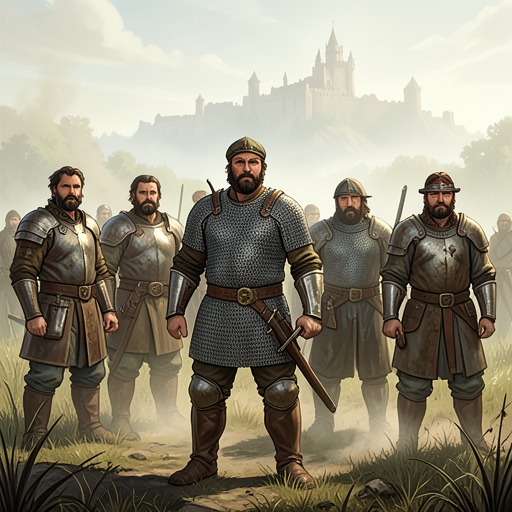
Louis IX
Foucault's PendulumLouis IX appears as the saint-king who continues to believe in the crusade after generations of failure. His faith gives the Templars a renewed purpose, but it also binds them to a campaign in which religious conviction, royal ambition, and the pursuit of glory repeatedly override caution.
The King and the Crusading Ideal
In the narrator’s historical account, Louis persists in the crusading cause despite two centuries of dreams undone by defeat. The Templars are ready to follow him: without a crusade, their military vocation would have no justification. Their loyalty is therefore not merely personal service to a king; it is bound to the ideal on which the order’s identity rests.
Louis leads an attack on Damietta from the sea. Before landing, he tells his followers that they will be invincible if united in charity, and that defeat would make them martyrs while victory would magnify God’s glory. The landing succeeds, and the enemy abandons the city. Louis hesitates to enter, fearing treachery, but there is none; he takes Damietta and converts its mosques into churches. The episode establishes both his religious certainty and the way conquest is immediately given a sacred meaning.
The Egyptian Campaign and Its Reversal
After taking Damietta, Louis must choose whether to march on Alexandria or Cairo. Alexandria is the strategically wiser objective, but Robert d’Artois urges an advance on Cairo, the heart of Egypt. The Templars initially counsel caution, yet grow eager for battle. When the king orders his army to avoid isolated skirmishes, the marshal of the Temple disregards the prohibition and attacks a Mameluke squadron.
The ensuing advance toward Mansura turns discipline into rivalry. After the Christian force crosses the river, the Templars form its vanguard, but Robert and his men pursue the fleeing enemy without waiting for the rest of the army. The Templars join the assault to avoid dishonor. Robert then presses toward the city despite the Templars’ efforts to restrain him, accusing them and the Hospitalers of withholding their strength and claiming that he has shown what a man with blood in his veins can do. Stung by the charge, the Templars follow him into Mansura and pursue the enemy to the far wall. The Christians are then caught disorganized as their opponents regroup; Robert is killed, along with many knights, including 280 Templars.
The campaign ends in broader defeat. The army suffers from disease and lack of provisions, Louis’s forces are routed, and Damietta is lost. The queen negotiates with the enemy and pays 500,000 livres tournois to ransom the king. The scale of the reversal contrasts sharply with the confidence of the landing and the rhetoric of holy victory.
Royal Authority and the Templars
On his return to Saint-Jean-d’Acre, Louis is welcomed in a procession by the city’s clergy, women, and children, though the military campaign has failed. The Templars attempt to negotiate with Damascus without the king’s consent. Louis, angered at being bypassed, repudiates the grand master before the Muslim ambassadors. The grand master must retract his promises, kneel, and beg the king’s pardon.
The episode complicates the image of the king as a purely devotional leader. The Templars have fought, and the account stresses their selflessness, yet Louis publicly reasserts his authority over them. Their military commitment to the crusading ideal does not protect them from royal control. The narrator links this humiliation to the later fate of the order: half a century afterward, Louis’s successor Philip will send the Templars to the stake.
Narrative Significance
Louis’s role is presented through the tension between faith and political consequence. His insistence on another crusade sustains the Templars’ purpose, but the campaign’s reversals expose the danger of treating religious conviction as a substitute for strategic judgment. The novel’s account also places the king’s piety beside his exercise of power: the same ruler who frames the expedition as service to God disciplines the Templars when they act independently.
The episode contributes to the book’s wider treatment of how historical defeats become material for later legends about the Templars. Their failed campaigns and the disappearance of the Christian kingdom leave an order still powerful but deprived of the Holy Land for which it was created. Louis’s crusade is thus both a concrete military disaster and part of the history from which the novel’s later interpretations and myths take shape.