Rebis
Foucault's PendulumRebis is the alchemical image of a perfected, androgynous union that Casaubon attaches to Lia’s pregnancy and, finally, to their son Giulio. Its decisive significance lies in the collision between an abstract occult ideal and a particular living child: the imagined culmination of the Great Work is born not from secret knowledge or manipulation, but from Lia’s body and labor. The child’s arrival briefly gives Casaubon a way out of the Plan’s interpretive machinery, even as his language continues to turn intimate life into myth.
The Child as the Great Work
Casaubon contrasts the alchemical Rebis with the grotesque, laborious transformations other occultists imagine taking place inside a vessel. Asked what those people thought was in it, he recites their images of melancholy, black lead, Saturn’s oil, purifications, pulverizations, and a stinking sepulcher. He then objects that they fail to see what is ripening there: their “Thing,” white, pink, and beautiful. In this exchange, pregnancy becomes the answer to a tradition of seeking hidden meaning in obscure matter. The vessel does not conceal a cipher; it carries a developing human body.
Casaubon insists that the child’s formation can be known in bodily terms, naming its nerves, muscles, eyes, spleen, and pancreas. His playful anxiety about the possibility of two heads gives way to an equally playful willingness to love the child regardless, including the imagined prospect of a four-handed pianist. The jokes do not erase the seriousness of the hope beneath them: the child is not required to conform to an ideal before being loved. Yet Casaubon immediately folds that hope back into esoteric language, announcing that his Diabolicals also know the child will be the Great Work, the White, the Rebis, the androgyne.
The name itself remains open until the child arrives. Casaubon and Lia agree that a boy will be Giulio and a girl Giulia, honoring Lia’s grandfather. The naming gives the pregnancy a place in a family relation, while the Rebis gives it a cosmic one. These meanings coexist, but they are not equivalent: Giulio is a child expected by two parents, whereas the Great Work is a symbolic role that Casaubon lays over him.
Pregnancy Against the Plan
Casaubon later imagines the alternative he failed to choose: writing a “white book,” a grimoire for initiates explaining that life contained no secret meaning waiting to be uncovered. The secretum secretorum, he says, no longer needed to be sought; its supposed revelation was already present in the bodies of women, in hospital rooms, on straw pallets, and on riverbanks. Stones in exile and the Holy Grail would be nothing more than newborns, still attached to their umbilical cords, receiving the doctor’s slap. In this counter-myth, birth strips esoteric emblems of their distance and returns them to bodily fact.
That realization does not stop Casaubon and his companions from playing the game. He recalls that they insisted on showing the Diabolicals that, if a cosmic plot had to exist, they could invent one more cosmic than any other. The Rebis therefore carries an unresolved double meaning. It expresses Casaubon’s glimpse of a world in which life needs no hidden code, but also becomes another emblem available to the Plan’s appetite for total explanation. His regret is sharpened by the setting in which he remembers it: he is now waiting to see what will happen beneath Foucault’s Pendulum, while the intimate truth of the child has become entangled with the invented conspiracy.
The Birth and Its Material Reality
In a conversation with Salon, Casaubon hears a different kind of cosmic speculation: the pyramids as probes or antennas, a fusion nucleus at the earth’s center, and telluric currents arranged in orbits. The claim that the earth’s hidden forces might explain sacred places and straight routes makes the landscape another body to be deciphered. Casaubon listens, but his attention turns inward to the child. He pictures Giulio or Giulia planted like Lucifer at the center of Lia’s womb, upside down and struggling upward, destined to emerge from the viscera rather than enter the world with a bowed head in secrecy. The image makes birth both a physical passage and a reversal of the occultist’s preference for hidden depths: the child rises into visibility.
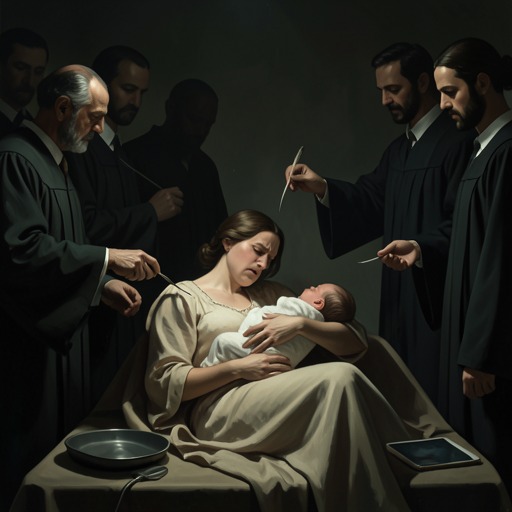
The birth scene replaces that anticipated symbolism with a simple identification. Casaubon finds himself in a room where Lia, pale but smiling, wears a white cap with her hair lifted beneath it. Beside her is the child. Lia tells him that the baby is Giulio. Casaubon calls him his Rebis, but the description immediately insists on bodily completeness: he was made without dead-body fragments or arsenic soap, and all his fingers and toes are in the right places. The contrast sets the newborn against the artificial or grotesque products of alchemical fantasy. This is no manufactured homunculus but a whole child, present in the room with his mother.
Lia, Authorship, and the Limits of the Symbol
Casaubon asks to see the baby completely, including his genitals, and kisses Lia on her bare forehead. He tells her that the credit is hers and that everything depends on the vessel. His remark preserves the alchemical metaphor while reversing its usual distribution of authority: the “vessel” is not an inert container awaiting an adept’s work. Lia has carried and delivered the child; the symbolic achievement depends on her body and effort. Her blunt response—that the credit is hers because she had to count alone—corrects Casaubon’s ceremonial language with the unromantic fact of labor.
Rebis thus marks both an insight and a relapse. Casaubon sees that the life he had treated as a possible cosmic sign is already meaningful without interpretation, and the child’s fingers and toes provide a concrete measure against fantasies of the monstrous or artificial. Yet he cannot entirely stop naming Giulio through the Great Work. The scene’s force comes from that tension: the alchemical image is not simply discarded, but is made answerable to a real birth, a mother’s labor, and a child who exists before any system can explain him.