Saint-Martin-des-Champs
Foucault's PendulumSaint-Martin-des-Champs is the former priory church at the heart of the Conservatoire des Arts et Métiers, and the setting where the narrator’s encounter with the Pendulum becomes a meditation on motion, measurement, and the desire for an unmoving center. The church’s sacred architecture and its crowded display of machines place the instrument between the history of worship and the history of technology; in the narrator’s imagination, its measured swing opens onto an immense, speculative account of the universe.
Setting and Exhibits
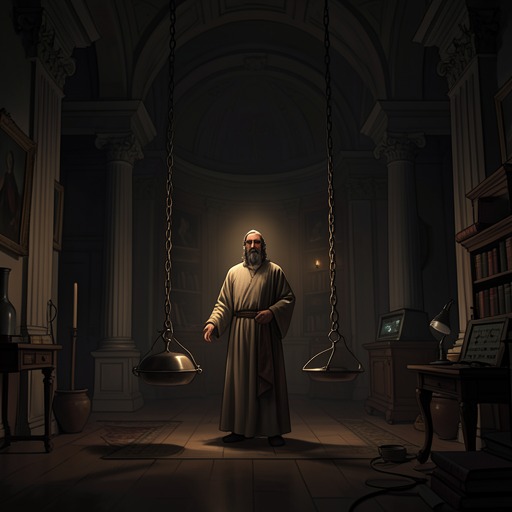
To reach the church, a visitor crosses an eighteenth-century courtyard and enters a former abbey church incorporated into a later museum complex. Its effect comes from juxtaposition: the soaring forms of the sacred interior meet the material remains of modern invention. Bicycles, horseless carriages, and automobiles line the floor, while aircraft hang above them. Some objects are intact but worn and corroded; others have been reduced to skeletons of rods and cranks. The machinery’s stillness makes it seem less like a procession of triumphant inventions than a collection of bodies whose former motion has been arrested.
The church’s interior gathers objects whose meanings refuse to settle into a single register. In the choir, the Pendulum stands between a model of the Statue of Liberty, designed by Bartholdi, and a statue of Pascal. Mechanical components crowd the space around it: magnetos, transformers, turbines, converters, steam engines, and dynamos. Beyond the Pendulum, the ambulatory holds Assyrian idols and other ancient objects. The result is not a clean division between religion and science, old and new, but a dense encounter among them. The church’s architectural setting makes technological exhibits look at once like instruments, relics, and the remains of a vanished world.
The Pendulum in the Choir
The narrator first sees the Pendulum in the choir, its sphere hanging from a long wire set into the ceiling and swinging with an apparently serene regularity. He reflects on the relation between the length of the wire and the period of the swing, and on the mathematical constants that make the motion intelligible. A magnetic device in the floor drives a cylinder concealed inside the sphere, maintaining its motion. In his account, this mechanism does not cancel the law the Pendulum displays; it enables the demonstration to continue.
The narrator’s attention moves from the working instrument to the patterns it might leave. If the sphere’s tip grazed damp sand, he imagines, successive furrows would alter their direction and form a widening radial figure. That imagined trace becomes a mandala, a star, and then a record of migrations across immense stretches of time and space. The church’s controlled demonstration thus becomes, in the narrator’s mind, a map of movement extending far beyond the room. The shift matters because the Pendulum remains a scientific object while the narrator makes its motion bear the weight of a far larger story.
Motion and the Fixed Point
At four in the afternoon on June 23, the Pendulum slows at one end of its swing before falling back toward the center and gathering speed. The narrator treats this visible rhythm as a point of departure for considering how its plane of oscillation appears to turn with the Earth. He imagines that prolonged observation could create the illusion of a full revolution in thirty-two hours, and contrasts this with the idealized case at the Pole, where the cycle would take twenty-four. He also wonders whether the same experiment in the Temple of Solomon would have disclosed anything different, before suggesting that Saint-Martin-des-Champs might itself be the true Temple.
The church’s significance in this passage lies in the contrast between what moves and what appears not to move. The Earth, Paris, and the observer all turn, while the Pendulum’s plane seems to preserve its direction. The narrator locates an imagined fixed point along the wire’s extension, beyond the choir’s ceiling and toward distant galaxies. The measured instrument becomes the material occasion for an experience of absolute immobility: a center around which the universe can be thought to move, though it has no ordinary body, location, or measurable qualities.
Place and Interpretation
The church supplies a physical framework for the narrator’s effort to read connections into heterogeneous things. The Pendulum’s orderly swing stands among machines made to move, objects made to represent authority, and ancient images whose original worlds are remote from the museum visitor. Their coexistence does not prove the secret unity the narrator senses; rather, it gives his interpretive imagination a stage on which scientific law, sacred space, and historical fragments can seem to converge.
That tension makes Saint-Martin-des-Champs more than a backdrop. The former priory’s architecture gives the Pendulum the aspect of a sacred center, while its place within the museum keeps the instrument visibly tied to material mechanisms and public demonstration. The scene holds both possibilities in view: the Pendulum can disclose the Earth’s rotation through a reproducible experiment, and it can also become, for the narrator, an emblem of a cosmic guarantee. The church’s importance lies in the distance between those meanings—and in how readily the narrator’s search for a fixed point bridges it.