The secret as existential necessity
Foucault's PendulumThe secret as existential necessity is the conviction that existence depends on a truth still hidden beyond ordinary appearances. In the novel, that conviction begins as a promise of meaning and becomes a dangerous engine: the less substantial the secret, the more completely believers can invest it with purpose, authority, and power.
A Secret Beyond Revelation
The Masters’ supposed wisdom is framed not as possession of a definite answer but as knowledge that a secret exists. The claim that revealed religions have not disclosed the ultimate truth places it perpetually beyond reach. Its value lies in continued expectation: if everything were exactly as it appeared, the drive to go on living would lose its animating mystery. The secret therefore sustains desire by remaining unavailable.
This logic has no final revelation to deliver. A secret that is exposed becomes small, while the promise of something beyond it can be renewed without limit. Meaning is deferred from one sign to another: an orchid points to the testicles, which point to a zodiacal sign, an angelic hierarchy, a musical scale, and relations among the humors. Initiation consists in continuing to make connections, not in arriving at a last explanation. The secret’s inexhaustibility is thus inseparable from its emptiness.
How the Plan Manufactures Meaning
The three researchers’ invented Plan gives this open-ended appetite a practical form. They join disparate materials through analogy and resemblance, at first treating their associations as parody. Repeatedly practicing the habit of connecting everything, however, blurs the distinction between pretending to believe and actually believing. Casaubon recognizes that exposure to the Diabolicals’ way of thinking has altered all three men: he becomes addicted to the game, Diotallevi corrupted by it, and Belbo converted. Their intellectual capacity to distinguish metaphor from literal truth weakens as the Plan acquires the appearance of a system.
The Plan’s persuasive force depends on making accidental or unrelated material look like evidence of an already existing design. Aglie demonstrates the method through numerical readings of measurements. He recites supposed correspondences in the Great Pyramid, then turns to a street kiosk and assigns historical and cosmic significance to its dimensions. Yet he also punctures the authority of such demonstrations: exact calculation yields 3.1417254 rather than the rounded 3.14, and Piazzi Smyth’s disciple Flinders Petrie reportedly caught him altering a granite wall so that the measurements would fit. The performance shows how numerical precision can lend an air of proof to a system whose interpretive rules permit almost any result.
Elsewhere, the same appetite transforms scientific language into a mask for occult claims. Electricity, radioactivity, and atomic energy are presented as inadequate substitutes for a forgotten force that the initiate seeks; Aglie names telluric currents as a possible description. In the Plan’s elaborated cosmology, the Earth’s currents shift with celestial and seasonal cycles, and the Templars’ supposed objective becomes finding the world’s critical point, the Navel of the World, from which those currents could be commanded. The sequence turns measurement and physical theory into signs of a hidden power, without establishing that the proposed power or system is real.
From Private Game to Public Belief
The Plan crosses from invention into apparent reality when its targets recognize their own fragments of mythology in it. Casaubon explains the transformation through the example of a paying author who discovers an existing publishing scheme and decides it must have been what he had always been seeking. In the same way, the Diabolicals identify pieces of their disordered beliefs as moments in the researchers’ constructed web. They do not merely accept the Plan as real; they persuade themselves that they have belonged to it all along.
That acceptance gives the fiction consequences beyond its authors’ intentions. A secret society may, Casaubon suggests, have branches throughout the world whose plot is to spread the rumor that a universal plot exists. The recursive claim captures how conspiracy belief feeds itself: suspicion of a hidden design becomes proof that there must be a design, while the absence of evidence can be treated as evidence of concealment. Casaubon also offers a more grounded account of this impulse. People blame an external plotter for failure, and dictatorships invoke an enemy to bind followers together. In either case, conspiracy supplies an agent and a cause where the truth may be confusion, misjudgment, or responsibility.
The researchers’ fabrication therefore becomes operative because other people act on it. Once the Diabolicals seek the map and organize their beliefs around the Plan, the invention is no longer merely a joke among its makers. Its reality lies not in a verified hidden design but in the conduct it produces. The secret’s promise of order can thus generate actual danger even when its supposed content has been made up.
Belbo and the Power of Withholding
The final confrontation makes the secret’s emptiness a source of immediate power. Belbo claims to possess a secret, and the Diabolicals try to extract it. His refusal magnifies their belief: the more he denies having anything to disclose, the more they conclude that the secret must be genuine and immense. Their reasoning makes the claim impossible to disprove, since silence confirms the mystery while disclosure would end it.
Aglie’s interest is not only in learning the supposed truth. If Belbo tells everyone, the secret will cease to distinguish its possessors; if he tells Aglie alone, Aglie can preserve the aura that sustains his identity as the immortal Saint-Germain. His power depends on deferral. He attempts to draw Belbo into a private revelation and, when that fails, provokes him into a more emphatic refusal. The secret is valuable to Aglie precisely because it remains undisclosed.
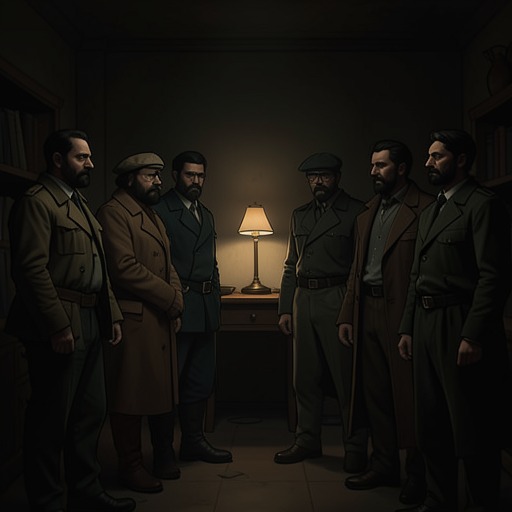
Casaubon consequently understands the nocturnal rite as the climax of a centuries-long search whose object has also served as its binding force. The Diabolicals fear both that the answer will disappoint them and that knowing it will abolish the condition that unites them. In this formulation, the secret is existentially necessary not because it contains a truth capable of saving its seekers, but because the pursuit keeps their longing, identity, and collective purpose alive. Its revelation would not complete the search; it would expose how much of the search depended on never reaching an answer.