Vladimir Rakosky
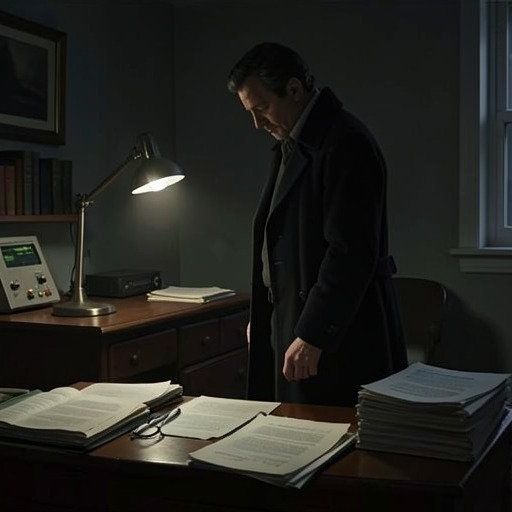
Foucault's PendulumVladimir Rakosky is the distinguished scholar whom Colonel Ardenti presents as a trusted authority on the secret he claims to have discovered. Ardenti says Rakosky edits Les Cahiers du Mystere, has taken an interest in his work, and advised him to delay publication; police checks, however, find that the passport used under Rakosky’s name was stolen and that no one in Paris has heard of him. His uncertain existence makes him less a fully encountered character than a hinge between Ardenti’s purported evidence and the novel’s escalating suspicions.
Ardenti’s Claimed Contact
In recounting his research to the staff of Garamond Press, Ardenti says he has met the greatest expert on his subject, though the man could not answer his questions and promised to write a preface. Ardenti describes him as a cautious scholar who urged him to resolve controversial points before showing his work to a publisher. At the same time, Ardenti admits that he disregarded this advice and came to Garamond without telling Rakosky, impatient to advance his task.
The name is disclosed only after Ardenti has defended his decision to confide in the scholar. He contrasts Rakosky with Edouard Ingolf, whom he calls a bungler, and insists that his new contact does not leap to conclusions. The confidence is revealing: Ardenti invokes Rakosky’s caution as a guarantee of credibility while himself pressing ahead with claims that have not been established. The promised preface lends the secret an appearance of scholarly scrutiny, but the story supplies no independent confirmation of either the relationship or the endorsement.
The Police Inquiry
When Jacopo Belbo later tells De Angelis what Ardenti had said, he recalls a hazy account of treasure evidence found in France and a man who feared that earlier discoverers had mysteriously disappeared. Ardenti had made disclosure of his documents conditional on receiving a publishing contract, which Belbo could not promise without first seeing them. The men had only vaguely agreed to meet again. In this account, Rakosky appears as the proposed preface-writer who advised Ardenti to postpone publication—and as someone Ardenti had not told about his appointment at the publishing house.
De Angelis’s inquiries initially seem to give the name substance. A Vladimir Rakosky is registered at the Principe e Savoia under a French passport; the hotel description appears to match, and an airline passenger list places that name on the first flight to Paris that morning. De Angelis alerts Interpol and asks Paris to check. Yet the identification never becomes a verified meeting between the men: the records establish only that someone used the name and traveled under the corresponding passport.
The Paris reply overturns that provisional lead. No one there knows Rakosky, and the passport number had been stolen two years earlier. De Angelis concludes that Monsieur Rakosky does not exist and suspects the magazine Ardenti named may prove equally fictitious. The result is not a solved disappearance but a further gap in the evidence: police can identify the false credential, but the supplied account does not establish who used it or what happened to Ardenti.
Documentary Doubt and the Plan
Rakosky’s role sits within an already fragile chain of documents. Ardenti says that, while searching Edouard Ingolf’s books, he found a handwritten sheet marked “Provins 1894.” He secretly pockets it, tells Ingolf’s daughter he found nothing of interest, and later presents a photocopy rather than an original. When Casaubon points out that Ingolf’s parchment was itself a copy, Ardenti insists that Ingolf’s transcription must be true because he sees no alternative. The claim of a careful scholar’s advice cannot repair these breaks in custody or establish the text’s authenticity.
Ardenti’s decipherment likewise depends on successive interpretive decisions. He reads a coded text through systems attributed to Trithemius and arrives at a line about thirty-six invisibles divided into six groups, which he treats as a headline announcing an organization. Later, Lia offers a mundane reversal: the phrasing belongs to a seventeenth-century Rosicrucian context, so the message may have been written after Trithemius; Ingolf, fascinated by hermetic codes, may have encoded a sentence himself as an exercise. That alternative does not prove how the document was made, but it exposes how readily an assumed ancient source and a preferred historical pattern can reinforce one another.
By the time Jacopo Belbo encounters a manuscript linking Aglie’s name to the many aliases attributed to the Comte de Saint-Germain, Rakosky has been folded into an even larger imagined pattern: Belbo thinks of Ardenti’s Rakosky as a reincarnation of Rachkovsky and, ultimately, of Saint-Germain. The passage immediately undercuts this escalation. Belbo recognizes that the apparent confirmations belong to a growing whirlwind of falsehoods, and that even the name he has seized upon may be false. Rakosky’s narrative function is therefore inseparable from uncertainty: he helps make Ardenti’s secret seem connected to a world-spanning tradition, while the stolen passport and shifting identities show how little that appearance can establish.