Arrested Time
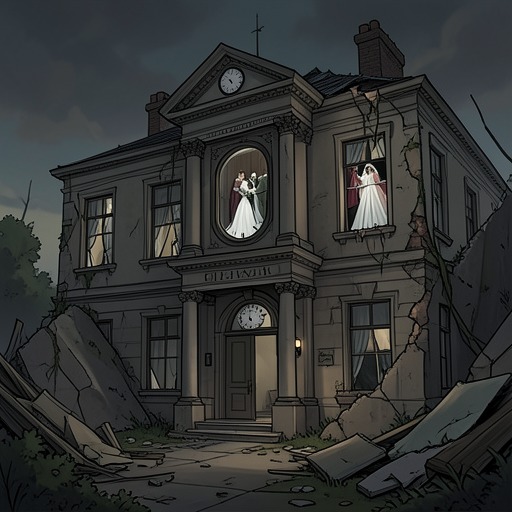
Great ExpectationsArrested Time names the suspension of ordinary life at Satis House, where Miss Havisham’s wedding-day abandonment is made visible in stopped clocks, sealed rooms, and decaying bridal relics. The house appears to stand outside time, but its stillness is not peace: it preserves a wound and makes Pip encounter that wound through repeated visits, remembered scenes, and a final eruption of fire.
The house held in darkness
Pip first enters by a side door because chains bar the great front entrance. Inside, passages and stairs are dark; a candle provides the only light as Estella leads him through the house. The entrance makes the place feel shut away from ordinary life before he has seen its rooms.
In Miss Havisham’s chamber, Pip notices that both her watch and a clock have stopped at twenty minutes to nine. The precise shared time turns a private object into a sign of the house’s governing condition: the clocks record the moment around which its life has been organized, rather than marking any passage beyond it.
The feast room extends that arrested moment into the material surroundings. Daylight is excluded; a fire smokes reluctantly in a damp grate, and dust, mould, and decay cover what had once been handsome furnishings. A long table still bears its cloth as if a feast had been prepared when the house and clocks stopped together. Cobwebs conceal the centrepiece, while spiders, mice, and beetles occupy the abandoned room. The unfinished feast remains in place, but the living gathering it implies has vanished.
Repetition as a household routine
The stillness is maintained not only by objects but by repeated action. After Pip’s return to the house, a wheeled garden chair has been placed on the landing. He begins coming every other day at noon to push Miss Havisham around her room, across the landing, and around the feast room, sometimes for as long as three hours. The journeys recur over a period of eight or ten months, tracing the same limited circuit through spaces marked by the old catastrophe.
Miss Havisham’s annual birthday custom offers another measure of time that does not release the house from its past. She gives Pip a guinea and tells him to return on his next birthday; when he first tries to refuse the money, she angrily asks whether he expects more. The years outside continue to accumulate, while the house’s repeated gestures and unaltered appearance make change seem excluded within it.
The wound behind the stopped clocks
The history of the stopped time reaches back to Miss Havisham’s wedding day. As Herbert explains it to Pip, the wedding was fully prepared: the dresses had been bought, the tour planned, and the guests invited. The bridegroom did not appear. He sent a letter that ended the marriage, which Miss Havisham received at the hour and minute later fixed on the clocks: twenty minutes to nine.
After recovering from a severe illness, Miss Havisham laid the house waste and never again looked upon daylight. Herbert knows this account only in part, having pieced it together because his father avoids discussing it. The gap in what can be known matters: the preserved rooms display the consequences of the abandonment, while the letter’s contents and the full history remain unavailable. Arrested Time is thus both a visible memorial and a silence organized around an absent event.
Returns, memory, and rupture
Pip later returns to the familiar rooms, where Miss Havisham asks him to wheel her about as in earlier days. The request makes the old routine recur even as Pip has grown older and the relationship between him and Estella has changed. On a later night in the house, Pip cannot sleep in the separate building across the courtyard. He sees Miss Havisham moving through the passage with a candle and hears her low, unceasing cry as she walks between the feast room and her own room. The familiar architecture becomes a route through grief, and the scene makes the cost of remaining enclosed in the past audible as well as visible.
The stillness finally gives way to fire. When Pip looks into the room where he has left Miss Havisham, he sees her catch fire and run toward him, her faded bridal dress blazing around her. He smothers the flames with his coats and the tablecloth; the struggle scatters the decayed objects, and the dress is reduced to patches of tinder. The incident does not undo the past or restore the house. Instead, the burning bridal relic converts its long-preserved image into an immediate danger, bringing the suspended history into the present through physical action.
Narrative significance
Satis House makes psychological history architectural. Darkness, damp, the stale feast, and the stopped clocks give Miss Havisham’s abandonment a setting that Pip can enter, revisit, and carry in memory. The house’s repeated routes and ceremonies create the impression that time has stopped, while the narrative’s returns to it show that the past is never simply inert: it governs present habits and can erupt unexpectedly.
The contrast between the house and the world beyond it sharpens the motif. Pip and everything outside Satis House grow older, yet he remembers the place as standing still. That discrepancy makes Arrested Time both Miss Havisham’s condition and a structure of Pip’s recollection: the house repeatedly draws his later life back toward the scene that first shaped his shame, longing, and expectations.