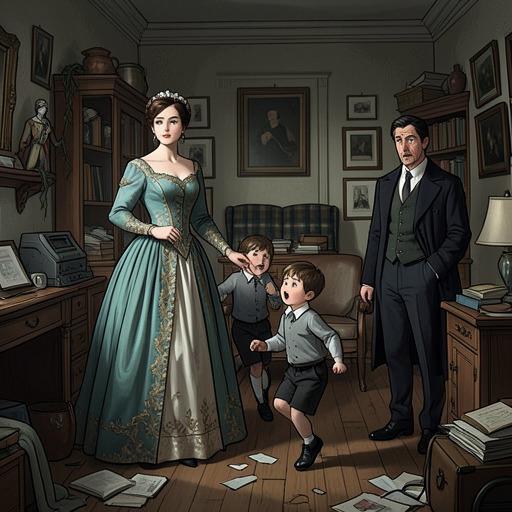
Belinda Pocket
Great ExpectationsBelinda Pocket, usually called Mrs. Pocket, is Matthew Pocket’s wife and the daughter of a deceased man whose imagined claim to a baronetcy shaped her upbringing. Taught to expect a title rather than practical responsibility, she becomes the comic and troubling embodiment of inherited social pretension: her dignity is carefully maintained, but her household depends on others to notice and manage the realities she overlooks.
Identity and Background
Belinda is the only daughter of a man who convinced himself that his own father would have become a baronet but for the personal opposition of some powerful figure. The supposed obstruction might have come from the Sovereign, the Prime Minister, the Lord Chancellor, or the Archbishop of Canterbury; the account treats the grievance as so fanciful that even its precise villain is uncertain. Her father’s own knighthood, meanwhile, is attributed to a grandiloquent address on vellum at the laying of a building’s first stone and the presentation of a trowel or mortar to a royal personage.
That invented family distinction determined Belinda’s education. Her father ordered that she be raised as someone who must, by nature, marry a title, and protected her from acquiring what he regarded as plebeian domestic knowledge. This upbringing succeeds in preserving her status-conscious expectations, but not in preparing her for independent life. She grows up highly ornamental and entirely helpless, a description that links her cultivated appearance directly to her lack of practical ability.
Marriage and Social Position
Belinda meets Matthew Pocket when both are young. Matthew is still uncertain whether his future lies in becoming Lord Chancellor or a bishop, and the narrative makes his ambition part of the marriage’s social comedy. The two marry without her father’s knowledge, anticipating the future before Matthew’s career has resolved itself. Her father has little to give or withhold beyond his blessing, but after a brief struggle he settles that blessing upon them and tells Matthew that his daughter is a treasure for a prince.
Matthew has spent their married life trying to invest this supposed princely treasure in the ways of the world, with little return. Belinda is pitied for having failed to marry a titled man; Matthew, in turn, attracts a peculiar, forgiving reproach for never becoming one. Their household thus remains shadowed by the same unrealized aristocratic promise that shaped her childhood. The joke is not simply that the title never arrives: it is that both spouses continue to be judged against a social future that was never more than expectation.
Household and Character in Action
When Pip is welcomed into the household, Belinda is reading and responds that she has welcomed him. She then asks whether he likes the taste of orange-flower water, a question unrelated to any matter at hand. The episode establishes her conversational detachment: she can perform the gestures of polite hospitality without showing much connection to the person or practical circumstances before her.
At dinner, her inattention becomes consequential. Belinda discusses two baronetcies with Bentley Drummle while eating sliced orange steeped in sugar and wine, forgetting that the baby is sitting on her lap with a pair of nutcrackers. The danger is noticed instead by Jane, one of the little girls, who quietly takes the weapon away after perceiving that the baby could injure its eyes. Belinda has not recognized either the danger or the child’s protective action.
When Belinda finishes her orange and sees Jane intervening, she rebukes the girl for daring to act and orders her back to her seat. Jane explains, in her lisping way, that the baby would have hurt its eyes. Matthew supports his daughter, asking Belinda how she can be so unreasonable when Jane has only protected the baby. His protest makes the contrast plain: the household’s safety depends on a child’s alertness, while its adult mistress treats the child’s intervention as an affront.
Belinda insists that she will not allow anyone to interfere with her. She frames Jane’s response as an insult to her authority rather than a necessary act of care, and invokes her own position as her grandfather’s granddaughter. Her appeal to rank is especially sharp beside the immediate domestic facts: the baby has been at risk, and Jane has acted responsibly. Belinda’s inherited sense of distinction does not merely coexist with helplessness; in this scene, it prevents her from accepting help.
Relationships and Narrative Significance
Belinda’s marriage to Matthew is marked by his efforts to manage the practical consequences of her upbringing. At the dinner table, he challenges her judgment and voices despair at the possibility that an infant might be hurt while no one is allowed to step in. Yet his protest does not change her position. She turns instead to the claim that even the cook has recognized her as someone born to be a Duchess, using another person’s flattery as support for a rank she never attained.
Her relationship with Jane reveals the costs of her mistaken priorities within the family. Jane’s action is small and protective; Belinda’s answer turns it into a breach of deference. Matthew’s intervention gives the child’s practical care a voice against Belinda’s insistence on status and authority. The scene’s comic exaggeration—an endangered baby, the nutcrackers, and a mother preoccupied with baronetcies—also carries a serious distinction between social appearance and the daily responsibilities that appearance cannot replace.
For Pip, the household offers an early view of genteel aspiration detached from competence. Belinda’s family history explains why she persists in imagining herself through titles, while her conduct shows the emptiness of that inherited ideal when set against ordinary need. The episode does not suggest that she abandons her expectations; she ends by appealing again to her supposed aristocratic standing, as Matthew collapses onto the sofa in theatrical despair. Her character is therefore built around a stable contradiction: she has been trained to inhabit the image of a future duchess, but remains dependent on others to manage the present.