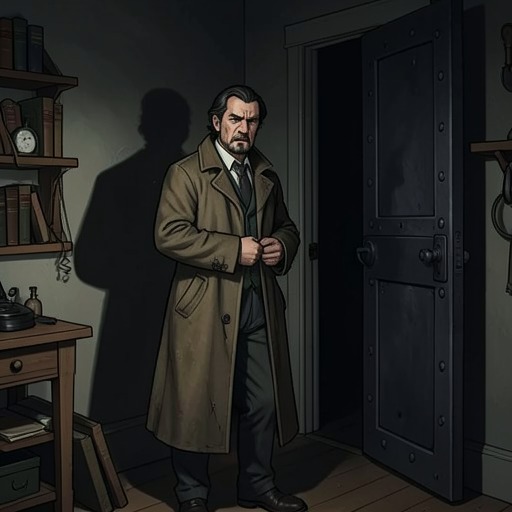
Don't go home
Great Expectations“Don't go home” is the warning Wemmick sends Pip in a note, redirecting him from an unknown danger at home and governing the anxious night that follows. Repeated until it seems to fill the room and Pip’s thoughts, the phrase becomes more than an instruction: it gives fear the force of an imperative even before Pip knows what has happened.
The Warning and Its Immediate Effect
A watchman brings Pip a note addressed to Philip Pip, Esquire, and asks him to read it by his lantern. In Wemmick’s handwriting, the message consists of three words: “DON'T GO HOME.” Pip obeys at once, turning from the Temple gate and hiring a late hackney chariot to take him to the Hummums in Covent Garden.
The warning withholds its reason. Wemmick’s instruction supplies no explanation of what has occurred or who may be at risk, so obedience precedes understanding. Pip knows only that he must not return; uncertainty, rather than any visible pursuer, drives the scene.
A Phrase That Takes Over the Night
At the Hummums, Pip lies awake in a ground-floor room, exhausted and unable to settle. Its strange shadows and small sounds sharpen his unease: the round holes in the night-light’s tin tower resemble staring eyes, and he imagines the warning written in each one. The phrase persists through the night’s fancies and noises as if it were a bodily pain.
Pip’s mind repeatedly circles the questions the note leaves unanswered: why he must stay away, what has happened at home, when he can return, and whether Provis is safe. Even thoughts of Estella and their parting that day cannot displace the command. When exhaustion finally lets him doze, he imagines it as a verb conjugated through different persons and tenses, transforming a short note into a rule he cannot escape.
Action, Suspense, and Meaning
The warning changes Pip’s course immediately. He plans to see Wemmick before anyone else, reasoning that this is a matter for Wemmick’s private, Walworth judgment rather than his professional manner. At eight the next morning, Pip reaches Wemmick’s Castle and enters while Wemmick is making tea with the Aged. The night’s suspense thus leads directly to a meeting, though the phrase itself has supplied no answer.
As a piece of narrative, the command works by withholding the crucial information while making its urgency unmistakable. Its repetition binds the threatening uncertainty of home to Pip’s isolation in the unfamiliar room; the more he tries to think around it, the more completely it directs his attention. The phrase’s force lies in that tension between a clear prohibition and an unknown cause.