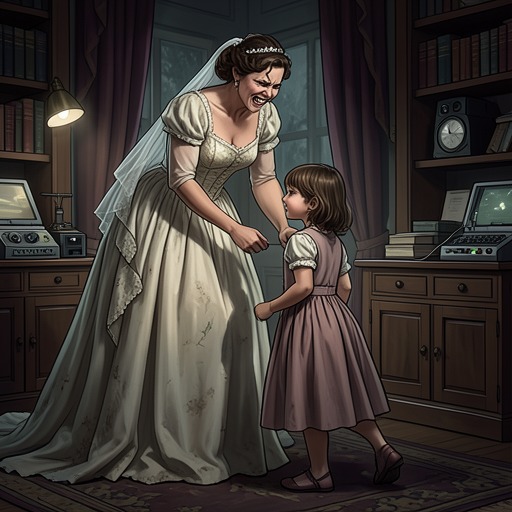
Estella confronts Miss Havisham about her upbringing
Great ExpectationsEstella confronts Miss Havisham about her upbringing in a scene that makes the adopted daughter’s emotional reserve legible not as an inexplicable personal failing, but as the result of the lessons imposed on her. Estella acknowledges what she owes Miss Havisham while refusing the demand that gratitude should produce a capacity for love she was never taught to develop. Her calm account of that contradiction leaves Miss Havisham facing the consequences of her own design.
The First Open Opposition
The confrontation occurs during a visit to Satis House, beside the fire in Miss Havisham’s room. Until then, the narrator had never seen the two women openly opposed. Miss Havisham holds Estella’s arm and hand; Estella, who has often endured this fierce affection without returning it, gradually disengages herself. When Miss Havisham asks whether she is tired of her, Estella replies that she is tired of herself. Miss Havisham calls her ungrateful, and the disagreement brings their long-standing imbalance into the open: one demands a response that the other has been trained not to give.
The scene takes place among the signs of Miss Havisham’s arrested life. The stopped clock, bridal remnants, cobwebs, and neglected room surround the exchange, while the women’s conflict concerns the history that has formed their present. Miss Havisham’s grasp on Estella is at once physical and emotional; Estella’s gradual withdrawal is the first visible refusal to treat that attachment as a bond she can simply reciprocate.
Estella Names Her Making
Estella answers the charge of coldness by placing its origin with Miss Havisham. She says that she is what Miss Havisham has made her and assigns her adoptive mother both the credit and the blame for the result. This is not a claim that Estella has no responsibility for her actions. Rather, she rejects the notion that the qualities Miss Havisham cultivated can later be separated from the woman who cultivated them and judged as though they had arisen independently.
Estella distinguishes material and practical gratitude from emotional feeling. She says she owes Miss Havisham everything, and that all she possesses is at her adoptive mother’s command, but she cannot supply gratitude and duty in a form that demands a feeling she was never given. Miss Havisham insists that she did love Estella, describing her attachment as bound up with jealousy and pain. The disagreement therefore turns on different meanings of love: Miss Havisham measures her intense devotion by what she felt, while Estella points to what she was taught to feel and express.
Estella also refuses the suggestion that she has simply forgotten or betrayed her upbringing. She recalls her childhood lessons and asks when she has been unfaithful to them. When Miss Havisham laments Estella’s pride and hardness, Estella asks who taught and praised those qualities. Her argument makes the contradiction precise: the traits Miss Havisham once encouraged become intolerable only when directed toward the person who encouraged them.
The Daylight Analogy and Its Limits
To explain why Miss Havisham cannot reasonably expect a different response, Estella constructs an analogy with daylight. If a child were kept entirely away from it and then suddenly asked to understand it, Estella suggests, the result would not be what the teacher desired. She sharpens the comparison: if the child had instead been taught from the beginning that daylight was an enemy that would destroy her, she could not be expected to turn naturally toward it on command. The example describes Estella’s emotional education through a familiar opposition between exposure and deprivation: she was instructed to resist the very kind of feeling Miss Havisham now demands from her.
Estella concludes that she must be taken as she has been made. Neither the success nor the failure of that education belongs to her alone; together, both constitute the person before them. The analogy does not erase Estella’s agency, but it challenges Miss Havisham’s attempt to enjoy the results of her teaching while disowning their costs. Estella’s composed manner, set against Miss Havisham’s increasingly distressed appeals, gives the explanation the force of a judgment delivered without anger.
Collapse and Aftermath
Miss Havisham offers no answer to Estella’s account. She moans, pushes back her grey hair, and eventually sinks to the floor among the faded bridal relics. Estella remains standing by the chimney-piece. Pip leaves the room after trying to draw Estella’s attention to Miss Havisham, then spends more than an hour walking through the courtyard, brewery, and ruined garden with a depressed heart. When he returns, Estella is sitting at Miss Havisham’s knee, mending one of the old garments; the dispute has not dissolved their connection, though it has exposed its painful terms.
The confrontation also changes how the relationship can be understood. Miss Havisham’s affection is real to her, but its intensity does not undo the formative lessons that Estella identifies. Estella’s words separate feeling from obligation: she can recognize what she owes and remain present, yet cannot manufacture the emotional response her upbringing excluded. The scene thus makes the consequences of Miss Havisham’s influence explicit and leaves her confronted with the distance between the daughter she fashioned and the loving return she hoped to receive.