First Stage of Pip’s Expectations
Great ExpectationsFirst Stage of Pip’s Expectations is the narrative marker closing the first phase of Pip’s life, as he leaves his apprenticeship and home for London. Its decisive significance lies in the change it records: the boy who once saw the forge as a path to independence has come to feel ashamed of his background, and his departure carries both the promise of advancement and the cost of estrangement.
The Marshes and Pip’s Early Sensibility
Pip’s story begins in the marsh country, about twenty miles from the sea as the river winds. In the churchyard, he learns from the tombstones that his parents, Philip Pirrip and Georgiana, are dead, as are his five infant brothers. Beyond the graves lie the flat marshes, the river, and the distant sea. The landscape establishes the modest, exposed world from which his expectations will carry him away.
Pip’s account also connects his later sensitivity to childhood experience. His sister’s harsh and unpredictable upbringing taught him to perceive injustice acutely; he felt that being brought up by hand did not give her the right to raise him by jerks. Looking back, he associates this solitary sense of unfairness with his moral timidity and sensitivity. That early vulnerability helps explain why social humiliation and the prospect of a different life weigh so heavily on him.
Shame and the Altered Meaning of Home
By the fourth year of his apprenticeship to Joe, Pip has begun to imagine that Miss Havisham will make his fortune when his time is out. His apprenticeship does not simply end when its term expires: it is brought to a premature close as his expectations redirect his life. In retrospect, he describes the shame of feeling ashamed of home as miserable, even while recognizing the ingratitude it may involve.
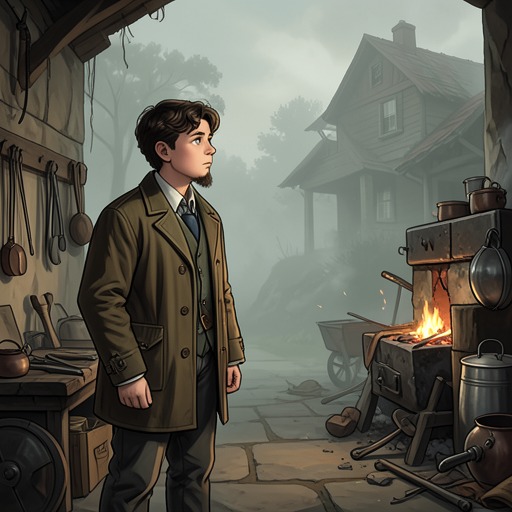
Home had been difficult because of his sister’s temper, but Joe had made it meaningful to him. Pip had imagined the best parlour as an elegant saloon, the front door as a solemn portal, the kitchen as a respectable room, and the forge as the road to manhood and independence. Within a year, those familiar places seem coarse and common to him, and he cannot bear the thought of Miss Havisham and Estella seeing them. The change is not presented as a simple consequence of one person’s influence: the older Pip says its causes need not be apportioned between himself, Miss Havisham, and his sister. What matters is that his values have changed, and that social aspiration has unsettled his attachment to home.
Departure and the Threshold of London
At the close of the first stage, Pip has left his home town and is travelling toward London. He had been moved by parting from Joe and considered walking back when the coach changed horses, but the opportunity passed; as the mists rose, he continued onward. The mist marks a threshold rather than a clear resolution: the world is spread before him, but what his new life will demand remains uncertain.
The journey takes about five hours. The coach reaches London shortly after midday, and Pip is struck by the metropolis’s immensity, even as he recognizes that it appears ugly, crooked, narrow, and dirty. Mr. Jaggers has given him an address in Little Britain, near Smithfield and the coach office. The move from the marshes to the crowded city turns a social ambition into a change of place, placing Pip within the urban world where his new status and its complications will unfold.
The First Stage in the Larger Arc
The stage division gives Pip’s departure structural force: his former life as Joe’s apprentice is set apart from the London phase that follows. Yet the boundary does not erase what he is leaving. His thoughts of returning, his remorse over ingratitude, and his altered view of the forge show that advancement has already produced an inward separation from the people and place that formed him.
The later course of the story revises the promise attached to this transition. Pip’s expectations do not make social status a reliable measure of character or happiness. After his financial prospects collapse, he sells what he owns, arranges time to repay his creditors, and joins Herbert abroad; he works for Clarriker and Co., lives frugally, pays his debts, and keeps up a correspondence with Joe and Biddy. The contrast between the hopeful departure and this more responsible life makes the first stage a measure of his development: the movement away from home begins in shame, while maturity brings renewed care and enduring connection.
The novel’s final image returns to the language of mist, but changes its emotional charge. When Pip and Estella leave the ruined place together, the evening mists rise, and he sees no shadow of another parting. This does not undo the uncertain departure that ended the first stage; it answers its image of separation with the possibility of continued friendship. The arc thus moves from ambition that estranges Pip from home toward a quieter understanding grounded in obligation, work, and human ties.