Gao Weixiang
Great ExpectationsMiss Havisham’s first appearance makes heartbreak visible in a room where bridal preparations have never been completed and time seems to have stopped. A wealthy recluse in a barred, disused house, she receives Pip amid faded wedding finery and decay; her emphatic declaration that her heart is broken leads directly to her use of Estella as an instrument against him. The scenes establish her not only as a figure of arrested grief but as someone who turns private injury into a pattern of emotional control.
Identity and Introduction
Pip first approaches Miss Havisham’s house accompanied by Mr. Pumblechook, who has spent breakfast testing him with arithmetic. The house itself announces a world set apart: it is old brick, gloomy, protected by iron bars, and partly sealed behind walled-up windows. A barred courtyard delays entry, while the large brewery beside the house stands idle, apparently unused for a long time. The neglect is not confined to the building in which Miss Havisham lives; it reaches the signs of work and production around it.
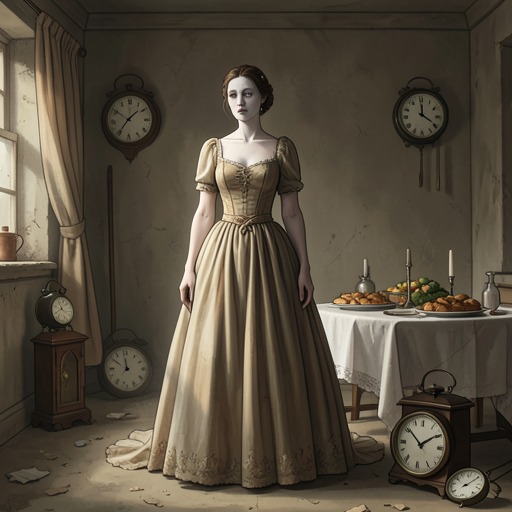
Inside, Pip is led to a candlelit dressing-room with no visible daylight. At its center sits Miss Havisham, her elbow on the table and her head resting on her hand. Her white satin, lace, silk, shoes, veil, and bridal flowers have all faded toward yellow. The bridal arrangement is incomplete: one shoe is on her foot and the other lies on the table, her veil is only partly arranged, and her watch and chain have not been put on. Trunks, less splendid dresses, jewels, lace, gloves, flowers, and a prayer-book remain scattered around the dressing-table. The room preserves preparations for an occasion that has not advanced into ordinary life.
Pip registers the woman and her clothing through their shared decay. The dress hangs loosely on a figure that has shrunk from the rounded shape it was made to fit; the bridal flowers and fabrics have lost their brightness, while her sunken eyes retain a striking gleam. The scene makes her first impression inseparable from the room’s material evidence: she appears as the living occupant of a bridal tableau long abandoned to age.
The Broken Heart and Its Staging
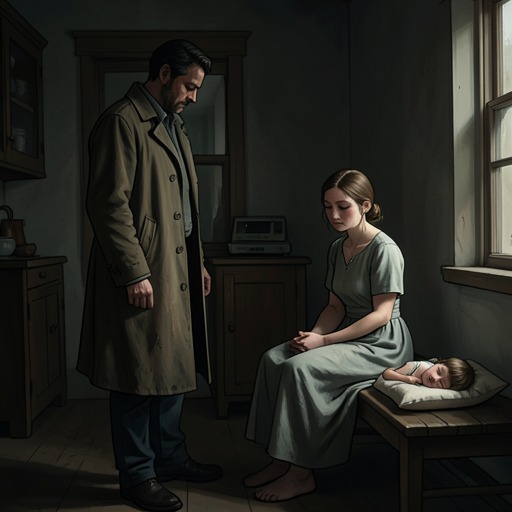
Miss Havisham names her injury with a deliberate gesture. When asked what Pip touches, she answers that it is her heart; when he says it is broken, she repeats the word with emphasis, an eager look, and a strange smile that carries a note of boastfulness. She keeps her hands there briefly, then lowers them slowly, as if they were heavy. Her declaration conveys pain, but the way she stages and emphasizes it also makes the wound part of her identity and her authority over the scene.
She soon says that she is tired, wants diversion, and has done with men and women, then orders Pip to play. The change from declaring heartbreak to demanding entertainment is stark: feeling is not offered as a plea for comfort, but made the prelude to an arrangement in which a child must perform for her. Her isolation therefore does not amount to withdrawal from other people. She uses her enclosed world to bring others into roles she has chosen for them.
Estella and Emotional Manipulation
Miss Havisham summons Estella and tests a jewel against the young woman’s bosom and brown hair. She tells her that the jewel will be hers one day and that she will use it well, joining the promise of future possession to an immediate instruction: Estella is to play cards with Pip. The gesture links wealth and appearance to Miss Havisham’s shaping of Estella, while the game becomes the means by which Pip is placed in their company.
Estella objects that Pip is a common labouring-boy. Miss Havisham’s response, which Pip thinks he overhears, makes the encounter more disturbing: Estella can break his heart. The instruction turns Pip’s social difference into part of the planned amusement and gives the meeting an unequal emotional design. Miss Havisham has arranged the circumstances; Estella is to act; Pip, who does not understand the plan, is exposed to its consequences.
The episode anticipates the wider pattern of Miss Havisham’s influence without making her an all-powerful director of other people’s lives. Here, what the evidence establishes is precise: she commands Estella to play with Pip, presents the jewel as a future possession, and frames the boy’s heart as something Estella may break. Her own professed brokenness becomes a source of power over someone else’s feelings.
The House, Stopped Time, and Decay
On a later visit, Estella takes Pip through a long passage running along one side of the square basement of the manor. At its end, daylight returns in a small paved courtyard beside a detached house that appears once to have belonged to a manager or head clerk of the now-extinct brewery. A clock in the outer wall has stopped at twenty minutes to nine, matching the clock in Miss Havisham’s room and her watch. The same hour persists across the house and its outbuilding, as though the suspension of her bridal preparations has become a condition of the estate itself.
The returning daylight does not dissolve the sense of neglect. From the window of a gloomy, low-ceilinged room, Pip looks onto a miserable corner of the garden: cabbage stalks lie in rank ruin, and a clipped box tree has grown out of shape. A light fall of overnight snow remains only in the cold shadow of that corner; the wind catches it up and throws it against the window. Miss Havisham is not described as present in this episode, but the repeated stopped time, extinct brewery, and unmaintained garden extend the atmosphere associated with her first appearance. Her world’s stillness is architectural as well as personal.
Narrative Role and Significance
Miss Havisham’s introduction binds character, setting, and action into a single design. The barred house excludes ordinary daylight and access; the unfinished wedding clothes preserve the signs of bridal preparation; and the stopped clocks fix that suspended condition at twenty minutes to nine. These details make her past legible through objects and surroundings rather than through a full account of what happened to her.
Her broken-heart declaration then turns the static tableau into an active plot mechanism. She does not merely inhabit a decaying space: she directs Pip and Estella within it, using a card game and the promise of a jewel to establish a relationship marked by unequal knowledge and planned emotional injury. The disused brewery and neglected garden broaden the image of arrested life beyond the dressing-room, while her order to make Pip play shows how the past continues to act on the present. In these first scenes, Miss Havisham’s decisive significance lies in this conjunction: she is at once the visible emblem of time held still and the person who sets an emotional harm in motion.