Magwitch and Compeyson's criminal partnership and trial
Great ExpectationsMagwitch and Compeyson’s criminal partnership and trial establish the unequal terms on which the two men are judged: Compeyson’s education, respectable appearance, and cultivated manner help him present as a gentleman, while Magwitch’s poverty and criminal record make him appear the more culpable defendant. Their shared prosecution for passing stolen banknotes culminates in sharply different sentences, and their antagonism carries from the courtroom to the prison ships and the marshes. The episode supplies the history behind their later pursuit of one another and shows how social standing can shape the apparent meaning of evidence.
Partnership and Criminal Methods
Magwitch recalls meeting Compeyson at Epsom races, where a local landlord introduced them. Their contrast was visible from the outset: Compeyson wore a fine suit and a watch, chain, ring, and breast-pin, while Magwitch appeared poor and ragged. Compeyson had been educated at a public boarding school and understood the manners of genteel society; Magwitch, by contrast, had grown up with little education and a history of imprisonment. Compeyson’s smooth presentation thus preceded the partnership in which he would exploit Magwitch’s vulnerability.
Compeyson recruited Magwitch as his man and partner, but the arrangement was unequal. The enterprise included swindling, forged handwriting, and passing stolen banknotes. Compeyson devised schemes, protected himself from their consequences, and retained the profits, while Magwitch was drawn into the exposed and dangerous work. He describes himself as perpetually indebted to Compeyson and under his control. To bind him, Compeyson made him swear on Magwitch’s black book, the same book Magwitch later used when he swore another person to secrecy.
The partnership’s criminal history also included Arthur, a sick associate connected to an earlier fraud against a wealthy woman. Magwitch says Compeyson’s ruthlessness and his own failure to learn from Arthur’s fate formed part of the background to his involvement. He does not recount every scheme, but identifies the essential pattern: Compeyson’s learning and craft gave him the advantage, while Magwitch bore the risks and the accumulating legal danger.
Prosecution and Unequal Sentences
After several encounters with suspicion and conviction for lesser offenses, Magwitch and Compeyson were committed together for felony over the circulation of stolen notes, with further charges pending. Compeyson proposed separate defenses and no communication between them. Magwitch was so poor that he sold nearly all his clothes to obtain legal representation from Jaggers. The case placed the two men side by side, but their very different resources and public reputations shaped how the prosecution and defense presented them.
Magwitch remembers how their appearance worked against him before the jury: Compeyson looked like a gentleman in black clothes, with curly hair and a white handkerchief, while Magwitch looked like a common criminal. Witnesses repeatedly identified Magwitch as the person who had appeared in the transactions and received the money. In Compeyson’s defense, his counsel emphasized the contrast between a younger, well-brought-up man who was seldom seen in the dealings and an older, poorly educated man who was repeatedly seen in them. The argument turned social description into an account of relative guilt.
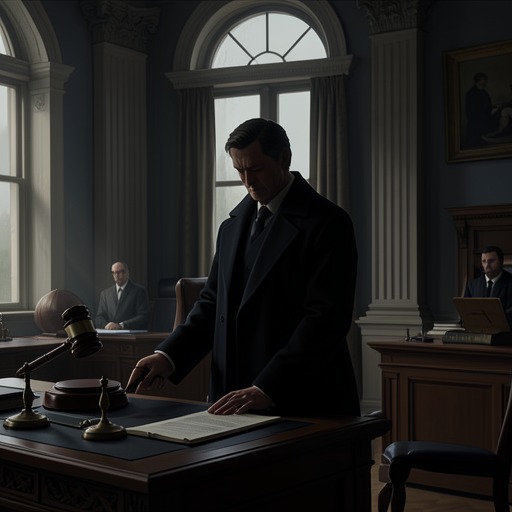
Character evidence deepened that distinction. Compeyson could point to schooling, schoolfellows, and respectable clubs and societies; Magwitch’s prior trials and familiarity with prisons and lockups were used against him. Compeyson’s lawyer could address the court with polished speech, while Magwitch could offer little more than his blunt assertion that Compeyson was a rascal. The jury recommended Compeyson to mercy on grounds of good character and bad company, while Magwitch received a guilty verdict. Compeyson was sentenced to seven years; Magwitch received fourteen, and the judge characterized him as an old offender likely to worsen. Their shared charge therefore produced not a shared outcome, but a punishment divided along lines of reputation, education, and persuasive courtroom performance.
Prison Ships, Escape, and Renewed Pursuit
The rivalry persisted after conviction. Magwitch and Compeyson were held on the same prison ship, but Magwitch could not reach Compeyson for a long time. Eventually he came up behind him, struck him to make him turn, and tried to attack him; guards intervened and seized Magwitch. He escaped from the ship’s confinement and reached shore, hiding among graves. There he encountered the young Pip, an earlier meeting that connects the history of the partnership to the later story of Magwitch’s return.
Magwitch later understood that Compeyson had also escaped onto the marshes. He hunted him down and attacked him, then chose to bring him back rather than allow him to remain at large. Magwitch says he would have towed Compeyson by the hair if necessary to get him aboard without the soldiers. The action reverses the men’s earlier relationship: after Compeyson had repeatedly kept Magwitch exposed to danger, Magwitch became the pursuer and ensured that his former partner was returned to custody.
The legal consequences again differed. Magwitch was put in irons, tried a second time, and sentenced to transportation for life. Compeyson, whose respectable character continued to work in his favor, received a comparatively light punishment. Magwitch eventually escaped that life sentence by returning to England, where the law made his unauthorized return a capital offense. His return is therefore not a separate history from the partnership: it reopens the conflict with Compeyson and carries the earlier disparity in punishment into the danger of his final attempt to reach England.
Narrative Consequences and Significance
The account is Magwitch’s retrospective testimony to Pip. Its sequence moves from recruitment and criminal work to prosecution, prison-ship conflict, escape, and renewed pursuit. The remembered trial is especially consequential because it explains why Magwitch regards Compeyson not simply as a former partner but as the beneficiary of a system that repeatedly judged them differently. The later revelation that Compeyson was in pursuit of Magwitch gains context from their history of shared crimes and unequal sentences.
The episode’s central contrast is between legal evidence and the social meanings attached to it. Witnesses and transactions may establish who appeared in particular dealings, but the trial also gives weight to clothing, education, reputation, and speech. Compeyson’s cultivated identity helps make him seem redeemable; Magwitch’s poverty and prior convictions help make him seem irredeemable. The novel does not erase Magwitch’s own participation in crime, but it presents the disparity in their treatment as an outcome of class-coded judgments as well as individual actions. Their partnership thus becomes both a personal tale of exploitation and revenge and an account of how the criminal justice process can translate social advantage into a difference in punishment.
The episode also clarifies the stakes of Magwitch’s later return. He has built a life and achieved prosperity in New South Wales, yet the sentence of lifelong exile bars him from coming back to England. He returns despite knowing that the law makes his presence a capital offense, and his history with Compeyson forms part of the danger surrounding that choice. The former partners’ story therefore links the courtroom’s unequal verdicts to the later pursuit that threatens Magwitch’s life and places Pip in the position of protecting him.