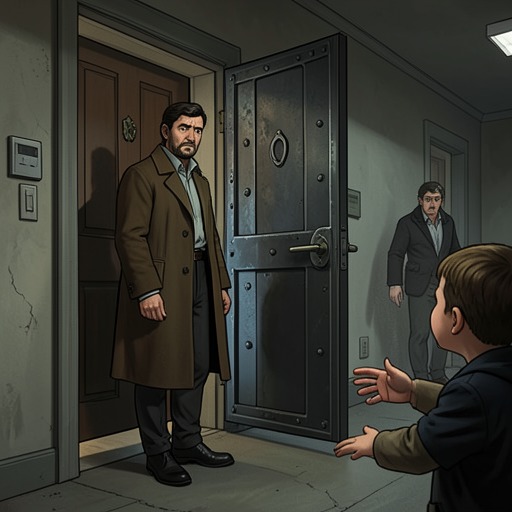
Magwitch's condemned-prisoner status
Great ExpectationsMagwitch's condemned-prisoner status turns the wealth and future he once secured for Pip into a question of law, loss, and care. Having returned from New South Wales despite lifelong exile, he is arrested, tried, and sentenced to death. His worsening illness makes that sentence less a distant legal threat than the immediate condition of his final weeks, during which Pip's role changes from beneficiary and reluctant protector to daily visitor and companion.
Identity and Legal Background
Magwitch's status as a condemned prisoner follows from a legal restriction already made plain when he reappears in England: he had been transported for life, and return could bring the death penalty. Mr. Jaggers had warned him in New South Wales that presenting himself in Britain would be a felony liable to the law's extreme penalty. Magwitch nevertheless came back, telling Pip that he had come to stay and would have risked even greater danger for the chance to see him. The old fugitive's decision thus sets personal attachment against a legal order that treats his return itself as a capital offense.
The status also reverses the secret arrangement behind Pip's expectations. Mr. Jaggers had required Pip to accept that the benefactor's identity would remain undisclosed and that he must not inquire into it. When Magwitch reveals himself, the secret resolves, but his return makes the fortune precarious: the Crown can forfeit a convicted criminal's property. Pip's hopes of inheritance and Magwitch's freedom are bound together in a predicament neither can undo by affection or good intentions.
Arrest and Trial
After the attempted escape, Magwitch is taken to the Police Court. His commitment for trial is delayed because the authorities need an old prison-ship officer to establish his identity. Nobody doubts who he is, but the expected witness, Compeyson, is dead, and no suitable officer is then available in London. Mr. Jaggers represents Magwitch and refuses to admit anything on his client's behalf; he tells Pip that once the witness appears, the case will be settled almost immediately.
The delay lasts three days. When the prison-ship witness arrives, Magwitch is committed for trial at the next Sessions, due in a month. Mr. Jaggers seeks a postponement when that time comes, evidently because Magwitch is unlikely to survive much longer, but the application is refused. The trial proceeds at once. The evidence for the defense includes Magwitch's later industrious and lawful life overseas, yet it cannot erase the central fact that he has returned to the country from which he was exiled. Under the rule described in the proceedings, conviction follows.
The death sentence is delivered as part of a public sentencing day on which thirty-two men and women are brought before the judge. Magwitch is seated because he can scarcely keep his breath, while Pip stands close outside the dock and holds the hand he reaches out to him. The judge recounts Magwitch's long history of offending, imprisonment, escape, exile, and eventual return, presenting his lawful life abroad as a temporary reform ended by his return to Britain. The account frames the sentence as the consequence of both his legal status and his new offense; his resistance during capture and the death of his denouncer further aggravate the case. Magwitch accepts the sentence, acknowledging the judge's authority while distinguishing it from the sentence he believes he has already received from God.
Imprisonment and Decline
Between committal and the Sessions, Magwitch is gravely ill. Two broken ribs have injured one lung, leaving him in increasing pain and making speech difficult. Because he is too ill for the common prison, he is moved to the infirmary after a short time. His condition also prevents the authorities from putting him in irons, although he is regarded as a determined prison-breaker. The infirmary allows Pip to visit him, opportunities that would otherwise have been unavailable.
Pip sees him every day, but only briefly. The intervals between visits are long enough for even small changes to show in Magwitch's face, and Pip sees no improvement: he grows weaker from the day the prison door closes behind him. Magwitch accepts his condition without complaint. At times Pip senses that he considers whether he might have become a better man under different circumstances, but Magwitch neither uses that possibility to excuse his past nor tries to alter the record of it. When others refer to his desperate reputation, he looks trustingly toward Pip, as though relying on the childhood memory of a small kindness that Pip had shown him.
After sentencing, the prison visits become shorter and more closely supervised. Pip worries that the authorities suspect him of bringing poison and offers to be searched before sitting beside the bed. The officers are doing their duty, but are not harsh; other sick prisoners and the prisoners who attend them also report Magwitch's worsening condition. As his ability to speak fails, he answers Pip with slight pressures of the hand, and Pip learns to understand them. After ten days, his eyes brighten when Pip enters, a brief sign of recognition within the steady decline.
Pip's Care and Magwitch's Death
The prisoner's legal status does not extinguish the personal bond that has developed between the two men. Pip stays beside Magwitch during the trial and continues to visit him as his health deteriorates. By the final stage, the visits are not merely an effort to comfort a benefactor: they are the central act of care Pip can offer a man whose freedom and property have been taken by the law and whose life is nearly over.
Magwitch's last exchange with Pip is largely silent. After his final words, he smiles and indicates that he wants Pip's hand placed on his breast; Pip does so, and Magwitch lays both his own hands over it. When the allotted visiting time ends, the governor allows Pip to remain. Magwitch looks at him affectionately, and, with a final faint effort helped by Pip, raises the hand to his lips before letting it fall back onto his breast. His expression settles, and his head drops quietly. Pip responds with a prayer for mercy, understanding the death not as a reversal of the sentence but as the end of the condemned man's suffering and of their time together.
Significance
Magwitch's imprisonment exposes the conflict between his genuine transformation overseas and a legal identity that remains fixed by his criminal past. His lawful work and success in New South Wales do not protect him once he crosses back into Britain; in court, the fact of his return outweighs the evidence of his later conduct. The public sentencing scene makes that legal judgment visible, placing Magwitch among a crowd of condemned people while Pip witnesses the procedure at close range.
The story also changes the meaning of Magwitch's wealth. His fortune had seemed to promise Pip social advancement, but the return that reveals its source threatens Magwitch with death and makes the inheritance liable to forfeiture. As Magwitch weakens, Pip's attention turns away from expectation and toward the man himself: he visits, holds his hand, and withholds the knowledge that the expected fortune has failed. The condemned prisoner's final act of affection closes the arc not with restored freedom or wealth, but with a personal connection that persists when both have been lost.