Miss Havisham is jilted at the altar
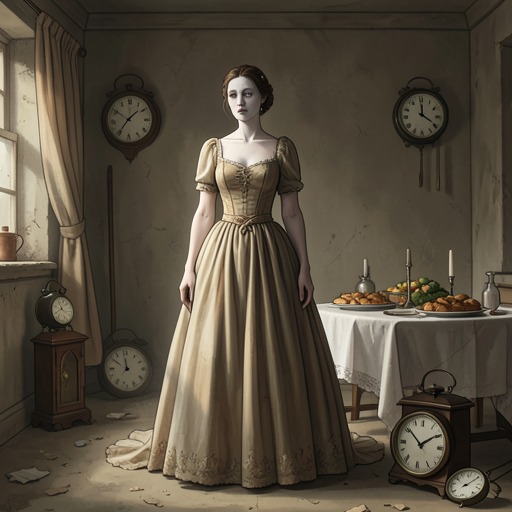
Great ExpectationsMiss Havisham is jilted on her wedding day when her bridegroom fails to appear and sends a letter ending the marriage. The abandonment becomes the defining wound of her life: at twenty minutes to nine she stops the clocks, withdraws from daylight, and allows Satis House to decay around the remnants of the expected feast. The event is disclosed retrospectively, through Herbert’s account, while the stopped clocks and the house’s dark, airless rooms make its consequences tangible in the present.
Causes and Background
The wedding had been arranged in detail: the day was fixed, the dresses bought, the wedding tour planned, and the guests invited. The bridegroom did not come. Instead, he sent a letter that Miss Havisham received while dressing for the marriage, at the exact hour and minute at which she later stopped all the clocks. Herbert knows only that the letter heartlessly broke off the marriage; its further contents remain unknown to him.
The abandonment is connected to a suspected conspiracy, but the account marks this as supposition rather than established fact. It was believed that the man who had won Miss Havisham’s confidence acted with her half-brother and that they shared the profits. Herbert speculates that the bridegroom may already have been married and that her humiliation may itself have formed part of her half-brother’s scheme. These uncertainties leave the betrayal’s precise mechanics unresolved, even as its consequences are unmistakable.
The Wound Made Visible
After recovering from a serious illness, Miss Havisham laid the house waste and never again looked upon daylight. The scale of her withdrawal is conveyed through the rooms Pip later enters: the passages are dark, the front entrance is chained from outside, and a candle is needed to lead visitors through the house. In her room, both her watch and a clock have stopped at twenty minutes to nine, turning the moment of the rejected wedding letter into a permanent measure of time.
The feast chamber gives the halted celebration a physical form. Daylight is excluded; the fire struggles against the damp, and dust and mould cover objects that are dropping apart. A long table remains laid as if a feast were still pending, its centrepiece obscured beneath cobwebs. The wedding was prevented from beginning, and the room preserves that arrested expectation as a spectacle of decay rather than a completed celebration.
Disclosure and Aftermath
The story reaches Pip not as a direct account from Miss Havisham, but as Herbert’s reconstruction of what he has pieced together. Herbert says his father avoids the subject and that he was told only what he needed to know when Miss Havisham invited him to visit. This limited, secondhand disclosure preserves gaps in the history: the letter’s full contents are unknown, and the alleged conspiracy remains a report of what was supposed.
The injury also shapes later encounters at Satis House. When Pip stays there, Miss Havisham sends him and Estella to walk in the neglected garden and later asks him to wheel her about as in earlier times. On another night, Pip cannot sleep in the separate building across the courtyard. Near two o’clock he sees Miss Havisham moving through the passage with a bare candle and hears her low cry as she crosses the rooms; he remains unable to leave or return until daylight appears. The scene does not undo the past, but shows its continuing hold over her movements and the house.
Still later, when Pip returns and looks into her room, he sees Miss Havisham seated by the fire in her ragged chair. A blaze suddenly springs up, and she runs toward him, her faded bridal dress burning. The dress that had belonged to the wedding day becomes part of a real emergency in the present: Pip smothers the flames with his coats and a tablecloth. The fire is not the original abandonment, but it gives the long-preserved bridal relics a violent, material ending.
Narrative Significance
The event is both a plot revelation and the key to reading the time and appearance of Satis House. The stopped clocks, extinguished daylight, chained entrance, and untouched feast turn private grief into an environment Pip must physically enter. Because the betrayal is explained after he has already encountered these signs, the account retrospectively connects the strange house to a specific hour and a failed marriage.
The narrative also maintains a distinction between what is known and what is inferred. The bridegroom’s absence and letter, the stopped clocks, and Miss Havisham’s subsequent withdrawal are reported as facts; the letter’s contents and the alleged financial conspiracy remain uncertain. That boundary keeps the explanation from becoming a complete account of the betrayal. What is clear is its lasting consequence: the wedding day does not simply end for Miss Havisham but persists, materially and psychologically, in the rooms, relics, and repeated returns that shape Pip’s experience of Satis House.