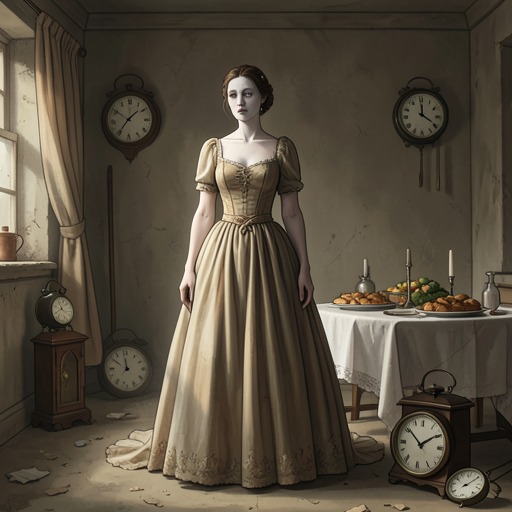
Miss Havisham's command to love Estella
Great ExpectationsMiss Havisham’s command to love Estella is both an instruction to Pip and a projection of Miss Havisham’s own wounded ideal of devotion. By urging him to love Estella whether she favors or wounds him, she presents love as unconditional submission; Pip takes the command into his private thoughts and begins to imagine that Estella is destined for him, although nothing in the instruction promises that she will return his feelings.
The Command and Its Occasion
Miss Havisham draws Pip close while she sits in her chair and asks how Estella treats him. Before he can answer, she repeats the imperative: he must love Estella if she favors him, if she wounds him, or even if she tears his heart to pieces. The command does not depend on Estella’s conduct. Instead, it makes endurance of pain part of the love it prescribes, and Miss Havisham intensifies that prospect by warning that the hurt will deepen as Pip grows older and stronger.
Her insistence is physical as well as verbal. Pip feels the muscles of the thin arm around his neck swell with the vehemence of her words. Miss Havisham says that she adopted, bred, and educated Estella to be loved, and that she developed her into what she is for that purpose. The declaration makes Estella’s upbringing sound like preparation for someone else’s devotion, while leaving Estella’s own wishes outside the terms of the command.
Miss Havisham’s Model of Love
Miss Havisham explains “real love” as blind devotion, self-humiliation, utter submission, and a willingness to trust and believe against oneself and the whole world. She identifies that definition with her own experience. The instruction is therefore not a neutral piece of advice: it carries the authority of a woman who has been hurt and now describes love through the language of surrender to the person who wounds it.
The repeated word acquires a bitter contradiction. Miss Havisham says “love” again and again, yet Pip feels that it sounds almost like a curse, as if the word were “hate,” “despair,” or “revenge.” That contrast reveals the force concealed in her apparently affectionate counsel. She does not simply encourage Pip’s attachment; she directs him toward a kind of love whose defining proof is continued devotion in the face of rejection and injury.
As she speaks, Miss Havisham rises suddenly in her bridal dress and strikes at the air, as though she might strike herself against the wall and fall dead. Pip catches her around the waist and draws her back down into the chair. The brief outburst makes her definition of love inseparable from the suffering behind it: her abstract account erupts into physical desperation, and Pip is left to receive both the command and the emotional violence that accompanies it.
Pip’s Response and Misreading
Later, after spending an evening with Estella, Pip lies in a room at the Boar while his guardian sleeps in the adjoining room. Miss Havisham’s words return to him, and he repeats them to his pillow, changing the imperative into a declaration that he loves Estella. The phrase has moved from Miss Havisham’s mouth into Pip’s own private language; repetition turns her counsel into a script through which he understands his feelings.
Pip’s response quickly expands beyond love into expectation. He feels gratitude at the thought that Estella might be destined for him, recalling that he was once only a blacksmith’s boy. But he also fears she is not grateful for that supposed destiny and wonders when she will become interested in him, or when he will awaken the heart he imagines sleeping within her. The distinction matters: Miss Havisham commanded Pip to love Estella, not Estella to love Pip. His hope of a shared future is his own inference, not a promise contained in the command.
Consequences and Significance
The command gives Pip a pattern for interpreting rejection as a reason to persist rather than a limit to his attachment. Its language casts being wounded as compatible with, even integral to, devotion. At the same time, the scene exposes the danger of confusing an imposed ideal with a mutual relationship: Miss Havisham speaks of Estella as someone fashioned to be loved, while Pip turns that claim into a belief that Estella may belong to his future.
The passage also sets the command against a quieter failure of feeling in Pip himself. He remembers that Joe had brought tears to his eyes only a day earlier, but those tears dried quickly; Pip had kept away from Joe because he knew Estella would look down on him. While Pip celebrates what he takes to be a high and great love, his conduct shows him withdrawing from the loyal friend whose affection is already present. Miss Havisham’s imperative thus helps organize Pip’s longing, but it also sharpens the contrast between his idealized pursuit of Estella and the gratitude and attachment he neglects at home.