Miss Havisham’s stopped clocks
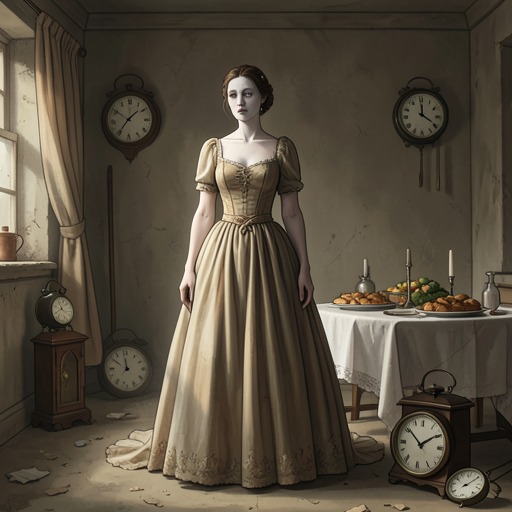
Great ExpectationsMiss Havisham’s stopped clocks, both set at twenty minutes to nine, make the suspended time of Satis House visible. They mark the moment Miss Havisham received the letter that broke off her marriage, and their continued presence turns that wound into the organizing principle of the house: while its rooms and objects decay, its defining moment remains fixed.
Appearance and Setting
When Pip first enters Miss Havisham’s house, he comes by a side door because the great front entrance is chained shut. The passages and staircase are dark, and a candle provides the only light. In the room where Miss Havisham sits, Pip notices that both her watch and a clock have stopped at twenty minutes to nine. The clocks are not an isolated curiosity: darkness and enclosure shape his first impressions of the house, where daylight seems excluded and ordinary time has already given way to a still, uncanny atmosphere.
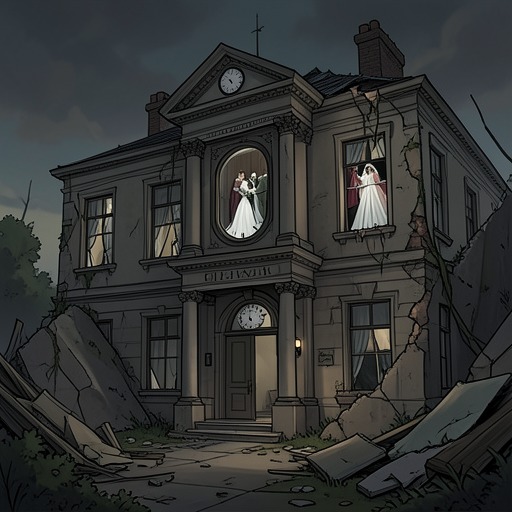
The feast-chamber gives this stillness a material setting. Its daylight is shut out; its damp, airless interior is lit only faintly by candles. Dust and mould cover the room’s deteriorating furnishings, while a long table remains spread as if a feast had been interrupted. The clocks’ fixed hour belongs to this larger tableau of abandoned preparations: time has stopped not only on the dial but across a house whose wedding setting was left behind.
The Hour’s History
Years later, Herbert explains the event behind the clocks. Miss Havisham’s wedding day arrived after the dresses had been bought, the journey planned, and the guests invited, but the bridegroom did not come. Instead, he sent a letter that broke off the marriage. Pip identifies the moment she received it as twenty minutes to nine; Herbert confirms that this was the exact hour and minute at which she subsequently stopped all the clocks.
Herbert knows only part of the story. After recovering from a serious illness, Miss Havisham laid the house waste and never again looked upon daylight. He also reports the supposition that the man who won her confidence acted in concert with her half-brother and that they shared the profits, while making clear that he cannot establish the details. The clocks therefore record a precise moment, but not a complete account of the betrayal that made it meaningful.
Repetition and Narrative Significance
The fixed hour becomes a recurring measure of Satis House’s refusal to change. On his annual visits, Pip finds the old house and its yellow, dimly lit room apparently unchanged, with Miss Havisham still in her chair. He imagines that the stopped clocks have stopped Time in the place: the world outside grows older, while the house remains suspended. This contrast also marks Pip’s own development. As he grows older beyond its walls, he continues to hate his trade and feel ashamed of home, linking the house’s arrested past to the class aspirations that shape his youth.
The clocks do not stop the story’s events; instead, they make the gap between measured time and lived time palpable. Pip later returns to Satis House, where Miss Havisham’s daily life still unfolds among the decaying bridal remains, and the old rooms continue to exert their hold on him. When her dress catches fire beside the hearth, the fixed domestic scene is violently interrupted by real danger. Pip sees her running toward him in flames and struggles to smother them with his coats and the tablecloth. The clocks’ hour remains a relic of the original catastrophe, while the fire brings the long-preserved bridal past into a new, destructive present.
Symbolic Function
The clocks are both objects within the house and a compact account of its history. Their exact setting ties the frozen rooms to the moment Miss Havisham’s expected marriage became abandonment; their stillness also helps explain why the house appears resistant to daylight, ordinary use, and change. By making a psychological wound legible on familiar instruments of measurement, the clocks turn private grief into an atmosphere Pip can encounter, revisit, and remember. Their power lies in the contradiction they embody: time continues outside Satis House, but within it the objects insist that one moment has not ended.