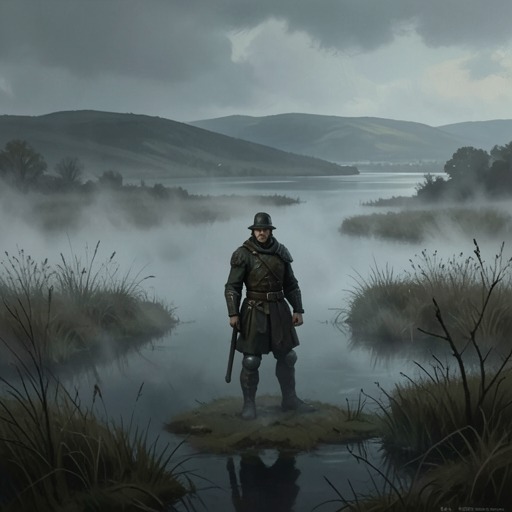
Mist as a Motif
Great ExpectationsMist is a recurring motif in Great Expectations, linking Pip’s marshland childhood to the darkened rooms of Satis House, the uncertainty of his ambitions, and the emotional changes marked by leaving and returning. Its meanings do not remain fixed: at different moments it obscures the way forward, gives shape to estrangement and regret, or rises to reveal a world in which reconciliation need not mean another departure.
The marsh landscape and Satis House
Mist enters the motif through Pip’s encounters with Satis House. He and Estella pass into the house through a side door while the great front entrance is secured by chains; dark passages and a staircase are lit only by a candle she carries. Inside, the stopped clocks register the hour as twenty minutes to nine, and a later visit leads Pip into a room where daylight is excluded. Damp smoke hangs in the air like the marsh mist, while candles faintly disturb the darkness and dust, mould, and cobwebs cover a feast table that seems to have been abandoned when the house and its clocks stopped together. The image connects the marshes’ obscured horizon to Satis House’s sealed, arrested world: both make it difficult for Pip to see beyond the present conditions surrounding him.
That association becomes explicit when Pip leaves Miss Havisham’s rooms. He wonders how his character could fail to be influenced by the surroundings and describes emerging from the misty yellow rooms into natural light with his thoughts as dazed as his eyes. The mist here is not only weather. It names the confusion produced by a world whose strange pressures have altered his sense of himself and his prospects. The recurring contrast between enclosed darkness and the outside air makes perception itself part of the motif: what Pip can see, and how clearly he can understand his circumstances, changes as he crosses between spaces.
Apprenticeship, distance, and departure
As Pip begins his apprenticeship to Joe, mist becomes a figure for the narrowness of the future he fears. On Sunday evenings in the churchyard, he compares his perspective with the windy marsh view: both are flat and low, and beyond them lie an unknown way, dark mist, and then the sea. The landscape offers no clear map of what follows. Pip’s discontent is real, but his retrospective account distinguishes it from Joe’s influence: he credits Joe’s honest work and steady example with keeping him from running away and helping him work with tolerable zeal, even when the apprenticeship goes against his own aspirations.
The motif gathers emotional force when Pip leaves home for London. At first, he thinks departure easier than expected and imagines that it would have been embarrassing for Joe to throw an old shoe after the coach in full view of the High Street. But the village is quiet, and light mists rise as if to show him the wider world. Their appearance makes the contrast between the small place where he has been innocent and the unknown world ahead newly vivid; Pip breaks into tears by the finger-post and says goodbye to Joe as his dear friend. He later reflects that crying has made him more aware of his ingratitude and more gentle. As the coach travels on and the mist rises completely, the world lies spread before him. The movement from obscured landscape to apparent openness marks a threshold in his life, but does not resolve the uncertainty: his new world is visible as a prospect, not yet understood.
Mist, memory, and regret
The motif returns in a scene that folds Pip’s present back into his earlier life. After watching a performance of George Barnwell, he walks home at night with Wopsle. Beyond town, a heavy, wet mist blurs the turnpike lamp until its rays seem almost solid, and the two notice that the fog has risen with a change of wind from the direction of the marshes. This is literal weather, but it also carries the familiar atmosphere of uncertain perception into a moment shaped by the play’s story of crime and punishment. The scene’s misty visibility prepares the encounter with Orlick, who is standing by the turnpike house in the hope of company.
Years later, when Pip has fallen ill and Joe is caring for him, the collapse of his great expectations is likened to the marsh mists dissolving before the sun. That image makes the loss of his imagined future both a revelation and a change in scale: the expectations that once seemed to define his prospects disappear, while Joe’s practical kindness becomes newly perceptible. Pip is still unable to understand whether Joe knows how poor he has become, but he recognizes that his own earlier coldness has given Joe reason to fear that Pip will cast him off as prosperity returns. The mist’s disappearance thus accompanies not a simple triumph, but a painful clearing of self-knowledge.
The ruins and a changed ending
On a later return, Pip finds that Satis House and the brewery have been demolished. Only the old garden wall remains; ivy has taken root again among low mounds of ruin, and a rough fence encloses the cleared space. A cold, silvery mist veils the afternoon before the moon rises. Yet the mist does not erase Pip’s knowledge of the place: he can trace where the house, brewery, gate, and casks once stood. Memory gives the vanished buildings a legible outline even as the actual landscape has changed beyond recovery.
In the ruined garden, Pip meets Estella. Their encounter transforms the motif’s association with return. At the end, they rise from a bench, affirm that they are friends, and leave the ruined place together. The evening mists are rising, recalling those that lifted when Pip first left the forge, but Pip sees no shadow of another parting. The echoed image does not promise that uncertainty or loss has vanished; rather, it marks a changed relation to them. Early in the story, rising mist opens an unknown world and carries Pip away from home. At the close, the same movement accompanies a meeting after the old world has literally disappeared, allowing the possibility of friendship without claiming certainty about the future.
Across these episodes, mist binds landscape to consciousness without reducing every appearance to a single symbol. It can cloud a lamp, mirror a low and anxious outlook, surround a house that resists change, or rise as Pip crosses a threshold. Its recurring contrasts—darkness and natural light, obscurity and apparent openness, departure and return—give the motif its structural force. The final echo of the mists at Pip’s departure revises rather than cancels the earlier scene: the world remains open and unknowable, but Pip can now face it without imagining that every bond must end in estrangement.