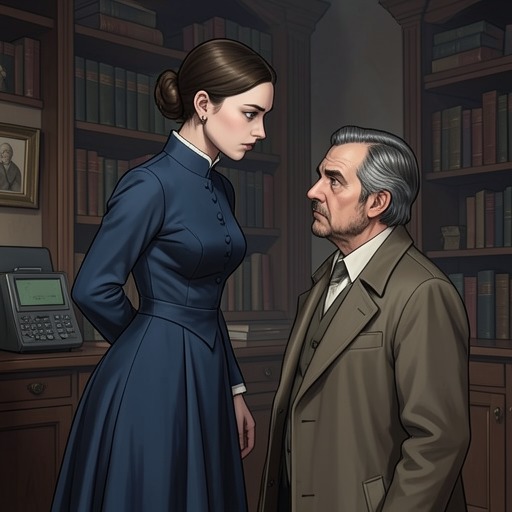
Pip and Estella
Great ExpectationsPip and Estella’s relationship is a long attachment shaped by class shame, emotional distance, and the difference between hope and mutual affection. Her first contemptuous judgment changes how Pip sees himself; years later, though he recognizes that she cannot love him and learns she intends to marry Bentley Drummle, his devotion persists. The relationship therefore links his early desire to become a gentleman with a painful education in the limits of expectation and the endurance of feeling.
First Encounters and Class Shame
At their first meeting in the rooms of Miss Havisham, Estella objects to being asked to play cards with Pip, dismissing him as a common labouring boy. During their game she mocks his card names, rough hands, and thick boots. Pip had not previously thought of his hands as a source of shame. Under Estella’s contempt, however, he begins to judge them as inferior, and the judgment spreads from his appearance to Joe’s education and his own upbringing: he wishes Joe had been brought up more genteelly so that Pip might have been as well.
The humiliation continues when Estella brings him bread, meat, and beer without looking at him, treating him, in Pip’s perception, like a disgraced dog. He is hurt and angry, and tears come to his eyes. Estella appears pleased that she has caused them; Pip holds them back and looks at her, while she leaves with a gesture of contempt. Miss Havisham observes the asymmetry between them, asking why Pip says nothing about Estella when Estella says hard things about him. His answer is that she is very pretty. Even while he feels spurned and wishes to go home, attraction is already taking hold alongside shame.
Afterward, Pip examines his hands and boots in the courtyard as vulgar accessories and resolves to ask Joe why he taught him to call the cards Jacks rather than knaves. This is more than a passing embarrassment: Estella’s treatment gives Pip a new measure by which to condemn the home and working life he had previously accepted. He later describes the day as one that made great changes in him, a first link in a chain that altered the course of his life. In retrospect, he recognizes that the change was made, without settling how much responsibility belonged to himself, Miss Havisham, or his sister.
Attraction, Expectation, and Distance
The childhood encounter becomes the origin of an attachment Pip later describes as resistant to reason, promise, peace, hope, and happiness. He does not claim that Estella possesses ideal qualities; he says that he loves her because he finds her irresistible. The distinction matters: the force of his feeling does not depend on believing that she is perfect, and his awareness that it brings pain does not restrain him.
When Estella asks whether she is pretty, Pip answers honestly and she strikes him. He declares that he will never cry for her again, but the adult narrator recognizes the promise as false: even then, he was inwardly crying for her, and he would suffer further because of her. Later she allows him to kiss her cheek. He values the permission intensely, yet experiences the kiss as a token given to the coarse, common boy rather than as an expression of tenderness. The closeness is real as an encounter but does not signal that their feelings are equal.
When Pip sees Estella again as a young woman, he is struck by how much more beautiful and womanly she has become. He feels that he has not advanced with her, but has fallen back into the coarse and common boy she once scorned; the old class disparity returns with renewed force. Estella tells him that she has no heart and has never bestowed tenderness anywhere. Miss Havisham, meanwhile, urges Pip to love her, explaining that she adopted and educated Estella to be loved. That instruction intensifies Pip’s hope, but it is not evidence that Estella reciprocates it.
Familiarity Without Favour
As an adult, Pip spends time with Estella in Richmond and at social outings, including picnics, plays, operas, concerts, and parties. He takes her and the Brandley family on the water and sees her often, but the company brings him no happiness. He describes the central strain of their connection as familiarity without favour: he may call her by her name and hear her call him by his, yet that ease does not place him among those she loves or chooses.
Estella uses Pip to tease other admirers, while the familiarity between them becomes, for him, another way she can slight his devotion. He feels furthest from the hope he longs for precisely when he is nearest to her in daily life. Even the first time she calls him by name becomes something he treasures because he believes she knows he will treasure it. He also senses that she makes herself attractive to him, but this does not comfort him: he fears that she holds power over his heart by choice, not through any tenderness that would prevent her from hurting him.
Estella challenges the premise behind Pip’s hopes by asking whether he wants her to deceive and entrap him. Her question makes plain the conflict between his desire and her warnings. When Pip later confesses that he has loved her long and dearly, she tells him that she understands the words only as a form of speech: they awaken nothing in her, and she has already tried to warn him. She then reveals that she is going to marry Bentley Drummle. She offers her hand and asks whether they will part on that understanding, calling him a visionary boy or man. The announcement confirms that the future Pip imagined with her is not the future she intends.
Persistent Attachment and Retrospective Understanding
Pip’s response to Estella’s impending marriage is not to deny the depth of his attachment. He tells her that she has become part of his existence and character, present in the prospects and places through which he has lived, and part of both the good and evil in him. His speech describes the scope of his own inward experience; it does not establish that Estella shares it. The relation remains unequal even at its most intimate and eloquent.
For a time, Pip avoids newspapers and asks Herbert not to speak of Estella because he fears confirmation that she is married. He knows his hope has been torn away, yet keeps hold of what he calls its last small remnant. The contradiction shows how feeling outlasts the evidence against it: his expectation has failed, but he cannot simply choose to stop caring. Later, when he asks Miss Havisham what she has done to injure him, he says that he would have loved Estella under any circumstances. That admission rejects the idea that Miss Havisham’s design alone created his love, while leaving intact the harm caused by the false hopes attached to it.
Much later, Pip learns that Estella survived and tells Magwitch that she is alive, a lady, very beautiful, and loved by him. The report places his enduring feeling beside his changed understanding of the past: he had once believed that Miss Havisham’s intentions meant Estella was meant for him, but recognizes that this expectation was a dream. He had also believed himself near the center of the life at Satis House, only to understand that he had been used as a convenient object in Miss Havisham’s designs. Even so, the discovery that his hopes were mistaken does not erase his affection.
Significance of the Relationship
The relationship begins the process by which Pip turns class difference into self-reproach. Estella’s insults lead him to scrutinize his hands, boots, speech, and upbringing, and to wish that Joe had been formed by gentler social circumstances. Pip later grows gloomy as Joe and Biddy return to cheerful ease, and suspects that beneath dissatisfaction with his fortune lies dissatisfaction with himself. His pursuit of Estella is thus entangled with a wish to escape the identity she first taught him to regard as common.
The adult narrator distinguishes the life Pip actually shared with Estella from the future he projected onto her. Miss Havisham’s command to love Estella, Estella’s repeated warnings, and Pip’s own idealizing persistence are separate forces, not proof of a promised union. The relationship’s lasting significance lies in that tension: Pip’s love becomes a durable part of his character, while Estella’s inability to return it and her intended marriage make clear that feeling alone cannot turn longing into mutual commitment.