Pip and Joe Gargery
Great ExpectationsPip and Joe Gargery are bound first by life in the same household and by a private fellowship formed under the hard authority of Mrs. Joe Gargery, but their relationship becomes the novel’s measure of the difference between social gentility and moral worth. Joe offers the child protection, affection, and a place at the forge; as Pip grows ashamed of his home and pursues a higher status, that loyalty becomes a source of guilt rather than comfort. Their separation is not caused by a failure of love: it comes from Pip’s changing sense of himself, while Joe continues to meet him with patience and kindness.
Identity and Early Bond
Joe is a blacksmith whose forge adjoins the wooden house where he lives with Mrs. Joe Gargery and her much younger brother, Pip. Mrs. Joe is more than twenty years older than Pip, and her claim to have brought him up “by hand” reflects the harshness of her authority. Pip imagines that she may have made Joe marry her by hand as well. In contrast, he remembers Joe as fair-haired, blue-eyed, mild and good-natured, a man of great physical strength who is also easily overpowered at home.
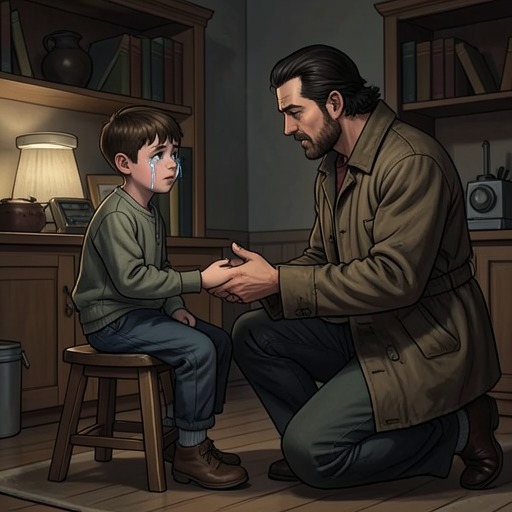
Their kinship is emotional as well as domestic. Pip and Joe regard themselves as fellow sufferers, and Joe shares confidences with the child when Pip enters the kitchen after visiting the churchyard. When Mrs. Joe discovers Pip behind a door and applies Tickler, she throws him toward Joe; Joe catches him and quietly shields him by fencing him in with his leg. The small act establishes a pattern: Joe cannot prevent every punishment, but he makes what refuge he can.
Joe’s care is often practical and understated. When company makes his influence in the household still weaker, he nevertheless tries to comfort Pip in his own way, including spooning gravy into the child’s plate at dinner. His attachment predates Pip’s memories of him as a protector. Joe tells Pip that when he asked Mrs. Joe to marry him, he also asked her to bring the child to the forge, saying there was room for him there. Pip later dates a new admiration for Joe from hearing this account. They remain equals in their daily companionship, but Pip becomes conscious that he looks up to Joe in his heart.
Trust, Conscience, and the Forge
The intimacy between them also gives Pip a conscience to betray. After Pip has been unexpectedly cleared of the pilfering, relief does not make him confess. He feels little tenderness of conscience toward Mrs. Joe, but his love for Joe makes silence more difficult. Seeing Joe look for his file brings the truth back to mind. Pip fears that confession would make Joe think him worse than he is and cost him the confidence that sustains their evenings together by the fire. The narrator recognizes that this fear, rather than a lack of affection, keeps Pip quiet.
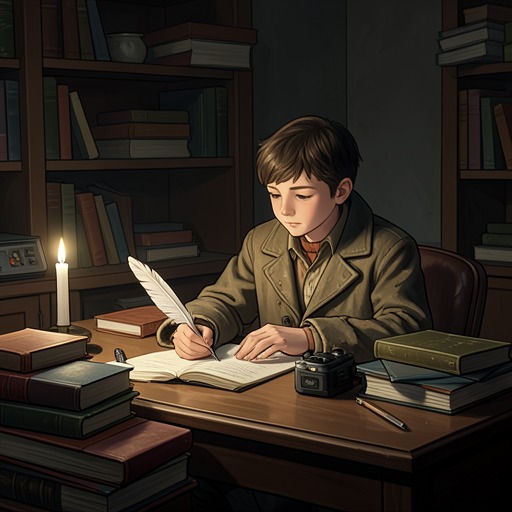
Pip’s own limited education becomes another occasion for their closeness. When he writes a message on a slate and hands it to Joe, there is no practical need for a written exchange because they are sitting together alone. Yet Joe receives the slate and its message as a marvel of learning. His response expresses pride in Pip’s abilities without turning education into a reason for superiority or distance.
When Pip later lies about what happened at Miss Havisham’s house, Joe’s response joins moral instruction to affection. He tells Pip that lies remain lies, and that dishonesty will not make him less common. Joe instead calls him unusual in smallness and scholarship, then urges him to go straight: if he cannot become uncommon honestly, crookedness will not achieve it. His plain counsel offers a different standard of worth from the status Pip imagines he may gain through Miss Havisham’s favour. Joe does not shame Pip for wanting to rise; he warns that deception cannot make the rise honourable.
Expectations and Growing Estrangement
Pip’s anticipated advancement exposes the difference between his attachment to Joe and his growing investment in class. When the household speculates about what Miss Havisham might do for him, Mrs. Joe hopes for property and Mr. Pumblechook imagines a premium for a genteel trade. Joe suggests, with comic modesty, that Pip might simply receive one of the dogs that fought over the veal cutlets. Pip is overtaken by penitence at Joe’s helpless amazement, but not at the reactions of the other adults. His unequal remorse shows that Joe remains the person whose opinion matters most, even as Pip begins to imagine a future away from him.
The narrator later identifies a decisive change in himself, while acknowledging that its causes cannot be neatly apportioned among his own character, Miss Havisham, and his sister. As Pip becomes accustomed to his expectations, his conduct toward Joe grows a source of chronic unease. He knows he has not been fully honest with himself about their effect. At night he imagines that he might have been happier and better had he never encountered Miss Havisham and had instead grown up content to be Joe’s partner at the honest old forge. The domestic fires at the forge and in the kitchen become, in memory, a standard against which the ambitions that estranged him are measured.
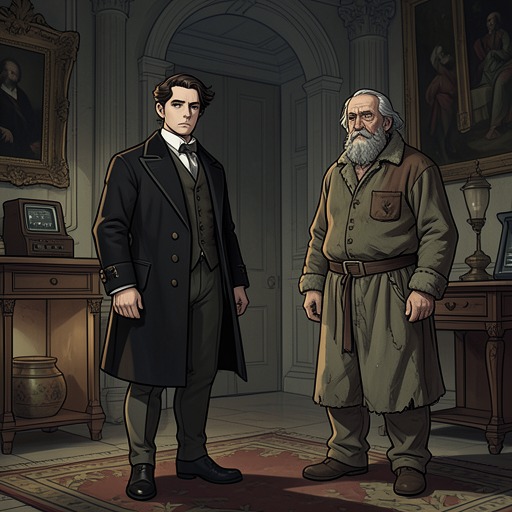
That estrangement is visible when Joe comes to see Pip in London. Pip receives word on Monday that Joe is coming the next day, and looks forward to the visit not with pleasure but with disturbance, mortification, and a sharp sense of incongruity. He would rather pay money to prevent it. He is especially anxious that Bentley Drummle, whom he despises, might see Joe, though he has less objection to Joe being seen by Herbert Pocket or Herbert’s father. The narrator later condemns the meanness of worrying most about the judgment of the person he holds in contempt.
Pip’s discomfort makes Joe more formal. In recounting how he came to London, Joe calls Pip “Sir” when politeness replaces the affection in which he calls him by name. He explains that Miss Havisham sent word through him that Estella had returned and wished to see Pip. Joe repeats the message in painstaking, ceremonious fashion, even comparing his statement that he is in correspondence with Pip to the words he used when he married Mrs. Joe. Pip is impatient and out of temper, failing to understand that his own ease could have made Joe more at ease. Joe, meanwhile, responds to that coldness with added consideration.
Parting, Return, and Reconciliation
At their parting, Joe explains the distance between them without accusing Pip of deliberate cruelty. Their lives have taken different paths, he says, and divisions among people must be met as they come. He is not ashamed of his work, but feels out of place in his clothes and away from the forge, kitchen, and familiar country surroundings. His dignity does not depend on dressing like a gentleman. Pip recognizes the simple dignity in him as Joe touches his forehead gently and leaves. Pip hurries after him into the neighbouring streets, but Joe is gone.
Pip’s later understanding of their bond deepens through bereavement and return. At Mrs. Joe’s funeral, Joe sits apart as chief mourner, clasping Pip’s hand when Pip speaks to him. Once the visitors and funeral workers have left, the three of them—Pip, Joe, and Biddy—share a cold dinner in the best parlour, where Joe’s careful use of the knife, fork, and saltcellar leaves them constrained. The familiar ease returns more readily after dinner: Pip persuades him to take his pipe, walks with him by the forge, and sits beside him on the great stone outside. Joe’s compromise between Sunday clothes and working clothes makes him look natural again, like the man Pip knows.
Pip resolves that he will not leave Joe alone, and says that he intends to come down often. Joe never turns this promise into a demand. In the morning, Pip watches unseen through a wooden window as Joe works at the forge, his health and strength apparent. When Pip tells him that he is leaving, Joe answers that it is never too soon and never too often, welcoming visits rather than claiming them. As Pip walks away through rising mist, he suspects that he will not return; the foreboding makes the kindness of Joe’s welcome more poignant, not less sincere.
The relationship is finally recast through Pip’s recognition of what he owes Joe. When Pip’s expectations have failed and he is ill, Joe cares for him. Pip sees that the hunted and shackled Magwitch, whom he had once regarded with repugnance, has shown him more constancy than Pip showed Joe. His gratitude to Magwitch is measured against his own neglect of the blacksmith. Later, Joe and Biddy handle the subject of Pip’s poverty with tact: Joe dismisses it delicately, while Biddy has already understood the situation and prepared him. Pip is deeply moved, though he cannot tell whether Joe knows that his great expectations have dissolved.
Joe’s steadfastness makes the relation more than a story of childhood comfort followed by adult regret. Pip’s ambitions repeatedly distance him from the person who first gave him a place, trusted him, and offered honest counsel; yet Joe’s affection does not depend on Pip’s rank, wealth, or ability to repay him. The forge and its fires stand for a life Pip once undervalued and later recognizes as a source of companionship and moral steadiness. Their bond survives Pip’s shame and absence because Joe continues to welcome him, while Pip’s remorse allows him, at last, to understand the cost of having mistaken social elevation for becoming better.