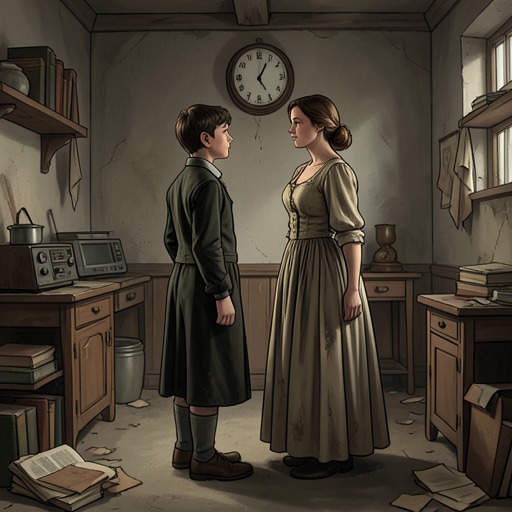
Pip and Miss Havisham reconcile
Great ExpectationsPip and Miss Havisham reconcile through an exchange that joins moral acknowledgment to practical generosity. She admits that her resentment led her to shape Estella into a means of revenge, and asks Pip to record his forgiveness; Pip, recognizing his own errors and need for forgiveness, grants it. She also authorizes nine hundred pounds toward a business arrangement that will help Herbert, making their renewed understanding consequential beyond their private relationship.
Background and the harm acknowledged
Pip’s view of Miss Havisham had long been entangled with his hopes about his future and Estella. Before learning the truth, he imagined that Miss Havisham intended to bring them together and cast him as the romantic hero who would restore the dark, decaying house. Looking back, Pip clarifies that his love for Estella was not based on an illusion that she was perfect: he found her irresistible despite knowing that the attachment worked against his reason, peace, and happiness. That retrospective correction matters to the reconciliation. Pip can recognize the power Miss Havisham exercised over him without treating his own interpretation of her intentions as fact.
The revelation that his expectations had not been arranged for him by Miss Havisham shattered that imagined future. He had believed Estella was meant for him and that his suffering at Satis House served some design; instead, he understood himself to have been used as a means of provoking Miss Havisham’s grasping relatives and as a model on which Estella could practise emotional coldness. He also saw his treatment of Joe as part of the cost of his mistaken hopes. The later meeting takes place after Pip has begun to understand both the injury Miss Havisham inflicted and the damage his own ambitions did to his relationships.
Miss Havisham’s confession gives that history a more complicated account than simple accusation. She says that at first she intended to spare Estella the misery she herself had known. As Estella grew beautiful, however, Miss Havisham’s conduct worsened: she used praise, jewels, instruction, and her own history as a warning to form the girl. She acknowledges that she took Estella’s heart away and put ice in its place. Pip does not deny the harm; he tells her that Estella would have been better left with a natural heart, even if it were vulnerable to being hurt.
The request for forgiveness
In the meeting, Miss Havisham says she wants to return to a subject Pip raised on his previous visit and show that she is not wholly without human feeling. She asks whether he can believe there is anything human in her heart. Her attempt at contact is tentative: she reaches out with a trembling hand, then draws it back before he can understand or receive the gesture. The hesitation makes the scene an effort at reconciliation rather than an easy restoration of intimacy.
Miss Havisham also asks whether there is anything she can do for Pip personally. He tells her there is not, while thanking her for the question and the tone in which she asks it. This distinction keeps the reconciliation from becoming a bargain in which financial assistance buys absolution. Pip’s answer acknowledges the significance of her changed manner without claiming that she can undo what happened.
To ask for forgiveness, Miss Havisham writes on a set of ivory tablets mounted in tarnished gold. She explains that the written authority will allow Pip to receive money for his friend at his own discretion, and that the document is meant to prevent suspicion that he is profiting from the payment. She asks him, if he can ever write beneath her name, to put that he forgives her, even if the answer comes long after her broken heart is dust. Pip answers that he can do so now. He admits that his life has been blind and ungrateful, and says that he needs forgiveness and guidance too much to remain bitter toward her.
Miss Havisham then kneels at Pip’s feet and weeps, a response that astonishes him because he has never seen her cry before. He tries to help her rise; she holds his hand and continues crying. The changed posture and tears do not cancel her responsibility, but they give visible form to a remorse that had previously remained locked in the habits of her grief.
Money, secrecy, and Herbert
The reconciliation also takes shape through an act of assistance directed toward Herbert. Pip explains that he had hoped to complete a purchase from his own means but had been disappointed. He cannot disclose the full circumstances because they involve another person’s important secrets. Miss Havisham asks how much is needed: nine hundred pounds. She offers the money for that purpose, provided Pip keeps her secret as faithfully as he has kept his own.
Pip agrees. Miss Havisham has no money at Satis House, so she prepares written authority for the payment rather than handing him cash. Although she offers to send it directly if he would prefer Mr. Jaggers not to know, Pip says he has no objection to receiving it through him. The document makes the money available for Pip to use at his discretion for his friend, while explicitly guarding against the appearance that the funds are a personal reward to Pip.
This assistance connects the emotional turn to the practical future Pip is trying to secure for Herbert. Miss Havisham cannot repair Pip’s past or give him what he once imagined she would arrange, but she can help him act generously toward someone else. Her authorization therefore marks a change in how her wealth functions in this relationship: instead of serving the fantasies and manipulations associated with Pip’s expectations, it supports his independent effort on a friend’s behalf.
Responsibility and moral change
Pip’s response is compassionate without being exculpatory. He recognizes that Miss Havisham took an impressionable child and tried to shape her into an instrument of resentment and wounded pride. He also considers the consequences of Miss Havisham’s seclusion and prolonged grief, but understanding how her mind and life became enclosed does not erase the harm she did. His forgiveness follows acknowledgment, not denial.
Miss Havisham names that harm repeatedly, asking herself what she has done. She says that she did not understand it until Pip spoke to Estella and Miss Havisham saw in him a reflection of what she herself had once felt. Her remorse is thus linked to a belated recognition of the emotional life she suppressed in Estella. The repeated question conveys the distance between the original act and the later comprehension of its consequences.
The scene’s resolution is therefore limited but real. Pip can forgive Miss Havisham in the present, and she can use her resources to help Herbert, but neither act returns Estella to the childhood or natural emotional development she lost. Their reconciliation does not restore the imagined future Pip once projected onto Miss Havisham’s intentions. It replaces that fantasy with a clearer exchange: she acknowledges what she did, he answers with forgiveness, and both accept that the past cannot simply be undone.