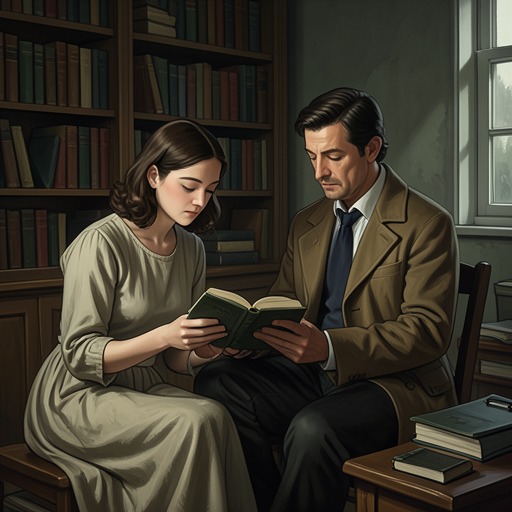
Pip leaves for London
Great ExpectationsPip leaves his home for London at the threshold of his great expectations, but the departure is not a clean break or a simple triumph. In the brief walk from the village to the coach, his excitement at becoming a gentleman collides with his attachment to Joe and Biddy; tears make visible the shame and ingratitude that ambition has taught him to suppress. The journey marks the end of the first stage of his expectations while revealing how profoundly his hopes have already estranged him from home.
Causes and Background
Pip’s departure follows his reception of great expectations and the prospect of gentlemanly education. He is instructed to keep the identity of his mysterious patron secret, and his response to the news is less uncomplicated happiness than discomfort: as Joe and Biddy congratulate him and wonder aloud at his becoming a gentleman, Pip grows gloomy and feels offended by their affectionate looks. He cannot yet explain his unease, but the adult narrator recognizes that dissatisfaction with his own self may have accompanied his new fortune.
The estrangement has been forming since Pip’s first visit to Miss Havisham’s. He had entered a dark house by a side door, following Estella through unlit passages by candlelight, then noticed that the watches and a clock stood stopped at twenty minutes to nine. In another room, the feast table lay beneath dust, mould, and cobwebs, as though the house and its clocks had halted together. These details belong to the world that shaped Pip’s imagination of wealth and refinement. His later hopes attach themselves to Estella and to a life beyond the forge, even as the narrator makes clear that his romantic expectations were his own construction, not a promise made to him.
At home, this new ideal has changed the meaning of familiar things. Pip recalls having once regarded the best parlour as a grand saloon, the front door as a solemn portal, the kitchen as a respectable room, and the forge as the road to independence. Within a year, those same places seem coarse and common, and he would not have Estella see them. The retrospective account refuses to place the change entirely on Miss Havisham or Pip’s sister: whatever its causes, the transformation has taken place within Pip. His departure therefore begins not with a settled rejection of home, but with a painful consciousness that he has learned to be ashamed of it.
The Farewell at Home
On the morning he leaves, Pip delays upstairs, repeatedly unlocking and strapping his small portmanteau rather than going down. Breakfast is hurried and tasteless. At last he announces that he must be off, kisses his sister and Biddy, embraces Joe, and walks out carrying his bag. The domestic farewell is affectionate, but the gestures do not undo the distance his expectations have opened between them.
When Pip looks back, he sees Joe throw an old shoe after him and Biddy throw another. He stops to wave his hat; Joe raises his strong right arm and calls a husky farewell, while Biddy puts her apron to her face. Pip has already judged that it would not do to have an old shoe thrown after the coach in sight of the High Street. His concern with appearances briefly makes leaving seem easy: he whistles and tells himself he is making nothing of it. The contrast between that performance and the family’s unguarded affection prepares the emotional reversal that follows.
Tears at the Finger-Post
The village is quiet, and the light mists rise as Pip walks away. Their rising seems to expose the scale of the world beyond the place where he has been innocent and small; that prospect breaks through his briskness. At the finger-post at the village’s end, he lays a hand on it and says farewell to his dear friend. The scene turns departure from a journey toward opportunity into a recognition of what Pip is leaving and how poorly he has valued it.
Pip’s tears bring a moral change as well as an emotional release. The adult narrator rejects the shame attached to crying and describes the tears as rain falling on the dust that blinds the heart. After crying, Pip feels more sorry and more conscious of his ingratitude, and gentler than before. He understands that, had he cried sooner, Joe could have accompanied him. The insight arrives too late to alter the morning’s parting, but it exposes the cost of Pip’s self-consciousness: he has treated tenderness as an obstacle to the gentlemanly appearance he hopes to acquire.
The Journey and Its Turning Point
Once aboard the coach and clear of the town, Pip repeatedly considers getting down when the horses are changed and walking home. He imagines a man approaching who resembles Joe and feels his heart leap, then immediately recognizes the impossibility of Joe’s being there. The repeated changes of horses carry the decision forward while leaving Pip emotionally suspended between return and departure. When it has become too late and too far to go back, he continues on; the mists have risen, and the world lies spread before him.
The departure closes the first stage of Pip’s expectations, but its ending is deliberately double. The open world signifies the reach of his new prospects, while the farewell at the finger-post preserves the home and friendship his ambition has made him undervalue. Later, when he discovers that Miss Havisham did not intend him for Estella and that his benefactor is the convict, Pip understands the moral depth of the abandonment more sharply: he had deserted Joe for expectations that were not what he imagined. When illness later leaves him dependent on Joe, Joe’s kindness and tact revive the tenderness that the departure had strained. The first journey to London thus begins Pip’s rise in status and establishes the measure by which that rise will be judged: not by appearances or fortune, but by his treatment of the people who loved him before he was a gentleman.
Narrative Significance
The adult Pip presents the departure as one of those memorable days that forms the first link in a long chain of consequences. That retrospective framing gives the scene a significance beyond the practical fact of leaving home. The boy departs imagining that he is moving toward distinction; the narrator shows that the journey also carries the consequences of shame, self-deception, and ingratitude. His tears do not stop the coach or reverse the separation, but they change his understanding of it.
The scene also makes the novel’s first major transition legible in emotional rather than merely geographical terms. London is the destination, yet the decisive movement occurs at the village edge, where Pip recognizes Joe and Biddy as beloved just as he leaves them behind. The mist’s lifting offers a view of what lies ahead, but it does not erase the tenderness or moral debt of what lies behind. The first stage ends with Pip going forward and, for a moment, seeing the loss built into his ambition.