Pip’s fever and recovery
Great ExpectationsPip’s fever and recovery turn physical dependence into a moral reckoning. As illness blurs his sense of identity and time, Joe becomes the constant presence by which he finds his way back; Pip’s gratitude and shame make visible the friendship that his pursuit of gentility had strained. The recovery does not erase that breach, but it gives him a chance to recognize Joe’s care and his own responsibility for their distance.
Illness and disorientation
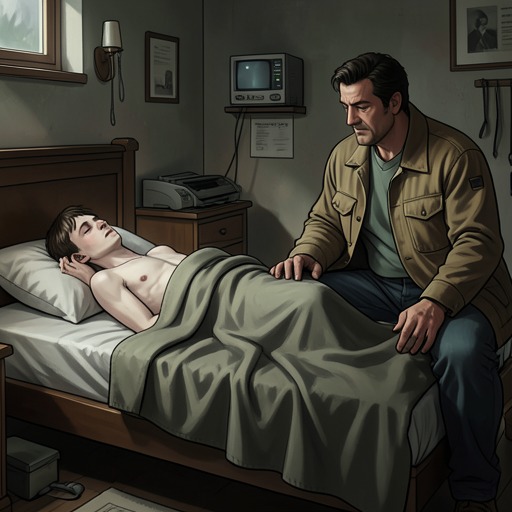
Pip recalls that he had a fever, suffered greatly, and was avoided during the illness. Its duration seemed interminable, and his sense of self became confused: he imagined himself as a brick fixed in a wall or a steel beam in a vast machine, even as he pleaded to be released from those impossible forms. At times he mistook people trying to help him for murderers, then recognized their good intentions and collapsed into their arms. The account presents illness as a breakdown in ordinary identity and perception, rather than as a straightforward passage of time.
Amid these changes, one recognition remained steady. Whoever came to Pip eventually seemed to become Joe: at night in the bedside chair, by day at the window, or offering him a drink. When Pip finally asked whether it was Joe, his old friend answered in the familiar voice. The moment marks a return to recognition, but also reveals how deeply Joe’s care has become the emotional anchor of Pip’s recovery.
Joe’s care and Pip’s remorse
Joe responds to Pip’s recognition by laying his head beside him and putting an arm around his neck, overjoyed that his friend knows him. Pip asks Joe to be angry, to rebuke him for ingratitude, or even to strike him; Joe instead insists that they have always been friends. His tenderness makes Pip’s remorse more acute precisely because Joe does not demand an apology or impose a reckoning.
Pip lies too weak to rise and go to Joe, and whispers a blessing for the man he calls gentle. When he next sees Joe, Joe’s eyes are red, but Pip is holding his hand and both are happy. The scene gives their reconciliation a physical form: Joe’s hand, his presence at the bedside, and Pip’s inability to do more than hold on to him. Care precedes any full accounting of the past.
Recovery and renewed dependence
As Pip improves, Joe continues to care for him in the old, protective manner. He talks with the familiar simplicity and confidence of their earlier life, and Pip feels almost like a child again. Joe also takes practical steps to protect him, engaging a housekeeper after discovering that the laundress had been taking household goods. The episode situates emotional recovery within ordinary acts of attention and responsibility.
When Pip is well enough to go out, Joe wraps him up, carries him to an open carriage, and places him inside. They travel together into the country on a Sunday. The scene recalls Joe’s earlier care for Pip as a child, but now the remembered pattern carries a sharper meaning: illness has returned Pip to dependence and allowed him to experience, in his own need, the generosity he once failed to value.
Gratitude and the friendship’s strain
The recovery does not immediately restore their relationship to its former ease. Joe gently declines to press Pip about matters he had kept private as a child, and Pip is deeply moved by the tact with which Joe and Biddy have prepared for the conversation. He nevertheless cannot tell whether Joe understands how completely Pip’s great expectations have dissolved. The uncertainty preserves an important difference between them: Joe’s kindness is plain, while Pip’s shame and loss remain difficult to articulate.
As Pip grows stronger, Joe grows less at ease. During Pip’s weakness and dependence, the old affectionate names and habits return; as his strength comes back, Joe gradually loosens his hold on that intimacy. Pip recognizes the reason in his own past conduct: he had given Joe cause to fear that prosperity would make him cold and that he would cast his friend off. Recovery therefore brings more than renewed health. It exposes the damage Pip’s former aspirations did to trust, and leaves him with the responsibility of showing that his renewed gratitude can endure beyond the sickroom.
Narrative significance
The episode reverses the earlier movement by which Pip’s expectations drew him away from home and from Joe. During the fever, Pip cannot sustain the self-image of the aspiring gentleman; he depends on the blacksmith he once judged through the standards of gentility. The contrast gives Joe’s devotion its full force and makes Pip’s regret part of the recovery rather than a separate reflection after it.
The story’s retrospective narration also distinguishes the bewilderment of the sick Pip from the later understanding of the narrator who remembers it. The illness is described through fractured images and repeated confusion, while the recovery gains coherence through Joe’s unchanging presence. That contrast makes the episode a moral turning point: Pip comes back to himself through another person’s constancy, and learns that his old friendship cannot simply be resumed as though his conduct had left it untouched.