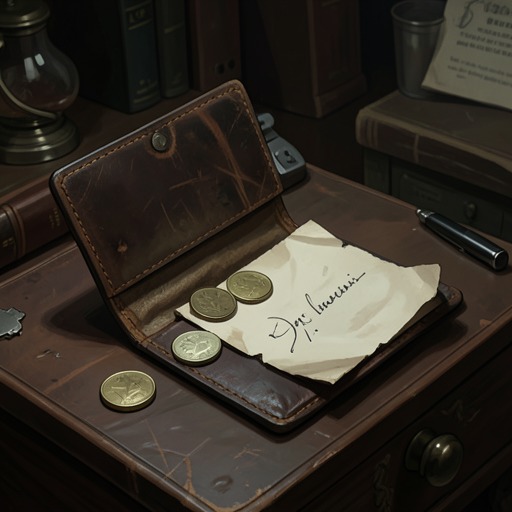
Portable property
Great ExpectationsWemmick’s expression “portable property” turns a lawyer’s practical instinct into a recurring comic creed. He applies it to rings, food, and pigeons, and even urges Pip to protect Magwitch’s possessions; its cheerful insistence on things that can be carried away exposes both Wemmick’s habits of mind and the limit of treating a person as property.## Meaning and First UseWemmick explains the phrase while discussing the mourning rings and other jewellery he has received from clients. He calls such objects curiosities and property, adding that they are portable and that his guiding principle is to get hold of them. The objects are not necessarily valuable in money: their importance lies in their material possession and the possibility of keeping them. The saying condenses a worldly prudence into a memorable formula, making Wemmick’s appetite for small, tangible benefits sound at once sensible and faintly absurd.The formula also reflects the world of his work. Wemmick presents himself as a collector of things that can be carried off, while his professional knowledge gives him an unusually concrete sense of what property means. A gift from a criminal client can become a ring in his collection; a meal obtained through a juror’s gratitude can be described in the same language. The expression makes no sharp distinction between a curious keepsake, a useful commodity, and an advantage secured through professional connections.## Gifts, Food, and the Walworth HomeWhen Wemmick invites Pip to walk to Walworth, he describes the supper awaiting them: a homemade stewed steak and a cold roast fowl bought from a cook’s shop. He explains that the shopkeeper had recently served as a juryman in one of their cases, and that Wemmick reminded him how easily the court could have kept him in the jury box longer. The man responded by offering the best fowl in the shop. Wemmick accepts the gift without hesitation and calls the fowl portable property. The phrase thus joins material possession to the small advantages Wemmick can obtain through his professional position.At Walworth, the same collecting instinct belongs to a home that contrasts with Jaggers’s imposing professional world. Wemmick’s little wooden cottage stands among gardens and is topped with a painted representation of a battery mounted with guns; its domesticated setting gives his accumulation of curiosities an intimate, almost playful context. Portable property is not only a principle for acquiring valuables. It helps characterize the private life Wemmick has made out of objects, a garden, a summer-house, and the comforts he offers Pip.## The Phrase as Practical AdviceThe creed becomes pointed when Wemmick advises Pip during the effort to protect Magwitch. Having explained that Herbert has successfully moved Magwitch under an assumed identity, Wemmick urges Pip to visit and make sure that he can lay hold of the fugitive’s portable property. He emphasizes the advice solemnly, laying his hands on Pip’s shoulders and warning him not to let anything happen to the property. Pip cannot make Wemmick understand that this is not the urgent matter on his mind. The mismatch makes the phrase comic, but also locates its limits: Wemmick’s familiar language of safeguarding belongings cannot express Pip’s concern for the person whose life is in danger.His advice nevertheless belongs to a real effort to help. Wemmick has already arranged assistance from his private, Walworth side and has helped conceal the route by which Magwitch was moved, reducing suspicion about Pip’s movements. The portable-property refrain does not cancel that loyalty; instead, it reveals how Wemmick’s practical and affectionate acts remain expressed through a language of assets, concealment, and material security. The phrase accompanies assistance while failing to name its deepest human stake.## Property, Loss, and Moral ValueWemmick’s distinction between property and its owner becomes explicit after Compeyson has been found to be ahead of them and Magwitch can no longer be saved. Wemmick acknowledges that Pip is sorry for the man and says he would contribute five pounds toward getting him out of danger. Yet he insists that the portable property could have been saved even if its owner could not. His reasoning is practical, and in the immediate circumstances it recognizes that Compeyson’s advance knowledge made Magwitch’s rescue unlikely. But the comparison is also a stark measure of the distance between the things Wemmick can imagine securing and the human life that cannot be recovered.The refrain’s earlier buoyancy therefore acquires a darker edge. Rings, a fowl, or a pair of pigeons can be accepted, stored, and carried away; Magwitch cannot be protected by the same logic. Wemmick’s lament over the loss of so much property remains characteristic, but Pip’s correction—that the man himself is the greater concern—marks a moral difference that the catchphrase cannot absorb.## A Comic Creed with a LimitIn another instance of the joke, Wemmick accepts a condemned prisoner’s offer of a ring in acknowledgment of his attentions, then asks instead for a pair of the man’s pigeons. The prisoner promises to arrange it, and Wemmick says the birds will be taken care of. As they leave, he explains that the man is a skilled coiner and is expected to be executed on Monday; he looks back at the man and considers what plant might replace him. The exchange makes portable property both a running joke and a habitual way of seeing: even as Wemmick deals courteously with a prisoner facing death, his attention turns to useful, retainable objects.At the office, the phrase takes on a further edge when Pip declines to accept help for himself from Miss Havisham. Jaggers says that each person should know his own business, and Wemmick’s lips silently form portable property. Wemmick then says, with reproach, that every man’s business is portable property. The remark turns his private maxim into a judgment about Pip’s refusal, but Pip’s answer is not simple greed or indifference: he has chosen not to ask Miss Havisham for anything for himself. The maxim is thus neither a neutral definition nor a complete moral principle. It is Wemmick’s persistent way of translating opportunity into possession, comic in its repetition and revealing in the moments when care, loss, and obligation exceed what possessions can hold.