Richmond
Great ExpectationsRichmond is the setting of Pip’s prolonged pursuit of Estella and a place where the appearance of fashionable ease intensifies the pain of unreturned affection. In the house of Mrs. Brandley, a friend of Miss Havisham from before her seclusion, Estella has a socially recognized place despite little shared feeling between her and the household. Pip, admitted to familiarity but not to favor, experiences Richmond’s pleasures as a succession of miseries—and later returns there in pursuit of Estella, carrying the story’s concealed family histories into the town’s respectable domestic world.
Estella’s Household
Estella is placed with Mrs. Brandley, a widow whose daughter is several years older than Estella. The household occupies what is called a good position and receives and visits many people, yet the residents and Estella have little community of feeling. Their arrangement rests instead on mutual necessity: Estella is understood to need them, and they to need her. Mrs. Brandley’s prior friendship with Miss Havisham links the household to the secluded world from which Estella came.
The social arrangement does not make Estella Pip’s relation to Miss Havisham any less mysterious. When he asks whether Estella is related to her, he learns that she is adopted, not a blood relation. The answer helps explain how Estella can be treated as Miss Havisham’s cherished charge while remaining outside her family by birth; it also makes the question of her origins, rather than a simple line of kinship, part of Richmond’s significance.
Familiarity Without Favor
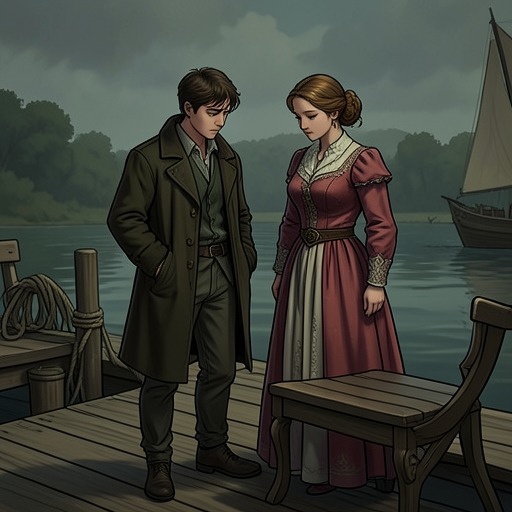
Pip sees Estella often in Richmond and hears of her in town. He takes her and the Brandley household out on the water and follows her through picnics, fête days, plays, operas, concerts, and parties. These are ordinary forms of public amusement, but his account reverses their expected pleasure: he never has an hour of happiness in her company, even while his mind circles continually around the imagined happiness of having her with him for life.
Their intimacy sharpens rather than eases his longing. Estella uses Pip to tease other admirers and turns their familiarity into a way of slighting his devotion. He can call her by her name and hear her use his, but that privilege brings him no closer to the favor he hopes for. Her other admirers are numerous, and Pip’s jealousy makes the company around her feel still more crowded. The contrast between social access and emotional exclusion makes Richmond a setting where closeness repeatedly confirms distance.
Estella’s Warning
Estella habitually speaks as though her association with Pip has been forced upon them. At a darkening window one evening, however, she abruptly breaks from that tone and asks whether he will ever take warning of her. When he asks what warning, she answers: of her. The moment does not resolve his attachment; it makes the danger within it explicit. Her brief show of pity sits beside her habitual coldness, revealing a tension that Pip can recognize but does not act upon.
That warning belongs to a larger conflict over who made Estella what she is. In a later confrontation, she tells Miss Havisham that she is the product of Miss Havisham’s making and that responsibility for her success and failure belongs there. Estella also insists she was no party to the arrangement imposed on her as a child, while acknowledging that Miss Havisham had been good to her and that she owes her everything. When Miss Havisham asks for love, Estella answers that she has it. The exchange complicates the easy description of Estella as simply hard: gratitude and attachment coexist with her refusal to claim responsibility for a childhood bargain she could not choose.
Return and Revelation
Richmond remains part of Pip’s pursuit even after its period of everyday visits. When Estella is at Miss Havisham’s house, Pip explains that he went to Richmond the previous day to speak with her and followed when he learned she had gone elsewhere. His return toward her is therefore also a return to the person who has long represented his expectations, even as he says he is already as unhappy as Miss Havisham could have meant him to be.
The revelations surrounding Estella’s origins finally overturn Pip’s assumptions about that pursuit. Miss Havisham recounts that, after a long confinement, she asked for an orphan girl to rear, love, and save from her own fate. A man she had previously employed to lay waste to the house promised to find such a child; one night he brought a sleeping girl, then about two or three years old, and Miss Havisham named her Estella. Estella herself knows only that she was left an orphan and adopted.
The concealed history connects Estella’s adoption to the lives of her biological parents, who remain alive and live near one another without knowing each other’s identities. When Pip tells the dying Magwitch that he once had and lost a child, then tells him that she survived, became a lady, and is beautiful, he adds that he loves her. Richmond’s story of Estella’s social placement thus stands within a much wider history of separation and undisclosed kinship. The town’s respectable household is not the end of that history, but one of the settings through which Pip experiences its consequences.