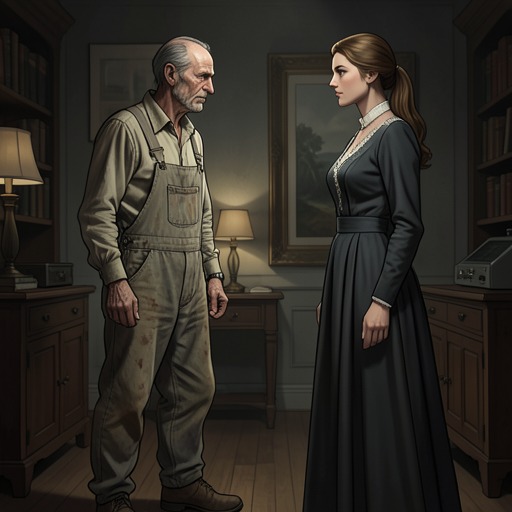
Social Class and Gentility
Great ExpectationsSocial Class and Gentility is the novel’s account of status as both a social performance and a mistaken measure of human worth. Pip’s desire to become a gentleman begins in humiliation about his origins and in his longing to please Estella; money and fashionable clothes appear to offer a route out of that shame. His later recognition of the cost of distancing himself from Joe, and his eventual life built through work, debt repayment, and friendship, expose the difference between rank and real gentility.
Origins of the Aspiration
Pip’s sensitivity to injustice has roots in childhood. His sister’s harsh upbringing leaves him with a lasting awareness that a child can feel small wrongs intensely, and he understands that her authority over him did not make her treatment fair. That experience helps explain his moral timidity and sensitivity, but it does not prevent him from turning shame outward: the social world gives him a language in which his home and trade seem to mark him as inferior.
The change becomes explicit after his visits to Miss Havisham’s house. Pip once saw the front room as a grand saloon and the forge as a path toward manhood and independence; within a year, he regards the household as coarse and common and dreads Estella and Miss Havisham seeing it. He recognizes that his changed feelings may owe something to his own failings, Miss Havisham’s influence, or his sister’s treatment, but the decisive point is that his sense of home has been altered. Shame is not simply a judgment about poverty: it estranges him from a place Joe had helped him value.
Gentility as a Desired Identity
During a quiet walk on the marshes with Biddy, Pip confides that he wants to be a gentleman. He says he has particular reasons, then admits that the beautiful young woman at Miss Havisham’s house is the reason: he admires Estella and wants the status for her sake. Biddy asks whether he hopes to spite Estella or win her over; Pip cannot say. His ambition is therefore emotionally unsettled from the start, less a considered vocation than a wish shaped by love, wounded pride, and the hope of changing how he is seen.
When Pip learns that he has come into a handsome property and is to go to London, he immediately translates wealth into visible gentility. He asks the tailor Mr. Trabb for fashionable clothes and emphasizes that he will pay in ready money. Mr. Trabb’s manner changes as soon as Pip discloses his new fortune: deferential service replaces ordinary familiarity. The contrast is sharpened by Trabb’s boy, who sweeps over Pip and then uses the broom to assert an equality with a blacksmith. Pip’s new position alters how others treat him, but the scene also shows how readily social recognition follows money and clothing rather than any demonstrated change in character.
Learning the Social Performance
Pip’s movement into gentlemanly society does not immediately give him confidence in its conventions. When he meets Herbert Pocket, he explains that he was raised as a blacksmith in the country, knows little of polite behavior, and would welcome correction if he makes a mistake. He also tells Herbert that he has been forbidden to ask who his benefactor is. Herbert answers warmly, invites Pip to use his Christian name, and predicts that he will need few hints. Their exchange places gentility beside friendship: Pip expects to be judged for his background, while Herbert responds with openness rather than condescension.
The episode also shows that Pip’s self-consciousness is not the same as a settled capacity for social ease. He approaches polite conduct as something to be learned, while his new clothes and money can announce a status he does not yet know how to inhabit. Herbert’s frankness offers a different standard of welcome, one that does not depend on Pip concealing his origins.
Status Reversed
The fortune that seemed to confirm Pip’s rise proves unstable. When news reaches his home district that his high fortunes have fallen, the Blue Boar, formerly assiduous in cultivating his good opinion, becomes cool toward him and gives him an inferior room. The inn’s changed service makes the dependence of respect on property plain: Pip’s identity in the eyes of others shifts with his financial prospects.
Mr. Pumblechook’s behavior supplies a sharper contrast. Pip recalls the servile way Pumblechook offered his hand during prosperity and compares it with the conspicuous air of benevolence with which he later presents the same hand. The repeated gesture exposes the self-interest beneath his public display of kindness. Against this performance, Pip experiences Joe and Biddy’s forbearance as more precious, not because they possess status, but because their care remains when his fortune disappears.
Work, Responsibility, and a Revised Measure
Joe’s visit during Pip’s illness brings the emotional cost of Pip’s earlier ambition into view. Joe treats him with the old affection, calling him by familiar names, but as Pip recovers Joe grows less easy. Pip comes to understand the change as a consequence of his own conduct: he has given Joe reason to fear that prosperity will make him cold and that he will cast his friend off. The gentility Pip once pursued has thus damaged a relationship founded on constancy, while Joe’s tact and Biddy’s understanding offer a form of moral care unavailable through social advancement.
Pip’s later course replaces display with work and obligation. He sells what he owns, sets aside what he can toward settling with his creditors, and joins Herbert. Within a month he has left England; within two, he is a clerk at Clarriker and Co.; within four, he takes sole responsibility for the Eastern Branch while Herbert is away. He lives frugally, pays his debts, and maintains regular correspondence with Joe and Biddy. In time he becomes a partner in the firm, which is respectable and successful without becoming a grand business. Pip also learns that his earlier judgment of Herbert as unsuited to success was mistaken: the supposed incapacity may have belonged to Pip’s own assumptions.
The novel’s final image gathers this changed understanding into a relationship rather than a title. Pip and Estella leave the ruined place together as evening mists rise, and he sees no shadow of another parting. The conclusion does not make social rank the measure of fulfillment; it joins gentler understanding to the life Pip has built through labor, repayment, and fidelity. Gentility is no longer the costume he hoped would make him worthy of love, but a quality measured by how he treats others and what responsibilities he accepts.