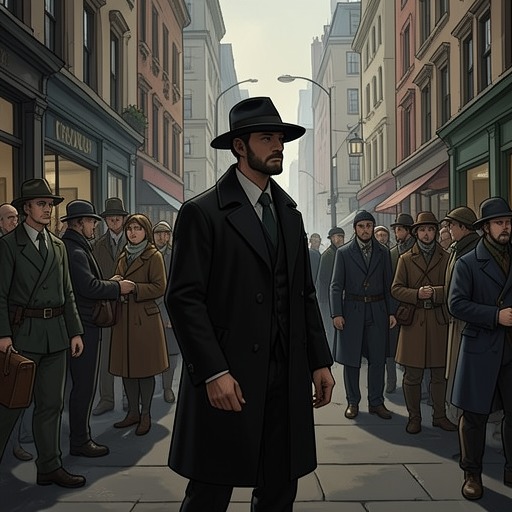
Wemmick's separation of professional and private life
Great ExpectationsWemmick’s separation of professional and private life is both a personal rule and a recurring contrast between the lawyer’s public work and his domestic world. He asks Pip not to bring private knowledge into professional conversation, and the boundary resonates with the novel’s wider account of how legal facts, social judgments, and personal loyalties shape lives.
The Office and the Castle
Wemmick explains the rule while speaking with Pip about the Castle and the Aged: the office is one thing, private life another. When he enters the office, he leaves the Castle behind; when he returns to the Castle, he leaves the office behind. He asks Pip to observe the same separation and not to speak of the private world professionally. Pip accepts the request as a matter of good faith.
The distinction is expressed through Wemmick’s two settings and their different routines. At the Castle, Pip shares a quiet evening with him; as nine o’clock approaches, Wemmick turns to the Aged’s nightly ceremony, in which a heated poker is used to fire the small cannon. The episode makes the private sphere a lived practice, not merely an idea: Wemmick protects its customs from the claims of his professional identity.
A Boundary Beside Legal Secrecy
The rule has a counterpart in the way legal business is conducted. When Pip learns that he has a benefactor, Jaggers tells him that the person’s identity is to remain secret until the benefactor chooses to reveal it. Pip is prohibited from making inquiries or even alluding to a suspected individual in his communications with Jaggers. This is not Wemmick’s own office-and-Castle rule, but it shows a related division between private knowledge and professional dealings: information is controlled, and the terms of its disclosure are explicit.
Jaggers later emphasizes that he has adhered to what he calls the strict line of fact in communicating with Magwitch. He had warned Magwitch that he was exiled for life, unlikely to obtain a pardon, and liable to the extreme penalty of the law if he returned to England. The contrast is significant: Wemmick’s boundary shields private life from professional intrusion, while Jaggers’s professional adherence to fact cannot shield Magwitch from the consequences of the law.
Private Loyalty and Public Judgment
Magwitch’s account of his partnership and trial with Compeyson reveals how public judgment can be shaped by social presentation. Compeyson appeared well brought up, dressed as a gentleman, and supported by witnesses who could speak to his respectable associations. Magwitch, by contrast, was poor, repeatedly known to prisons, and more readily identified in the transactions. Their defenses were separate; the prosecution’s evidence appeared to weigh more heavily against Magwitch, and Compeyson’s counsel presented the contrast in age, upbringing, visibility, and character to the court.
The result made that contrast consequential. Compeyson was recommended to mercy, while Magwitch was convicted and sentenced to fourteen years, twice Compeyson’s seven. Magwitch’s telling shows that a formal legal proceeding is not insulated from social distinctions: the courtroom translates clothing, education, prior reputation, and public speech into judgments about credibility and guilt.
Wemmick also tells Pip how Jaggers won an acquittal for Molly in a murder case. Jaggers built the defense around the limits of the evidence, including the possibility that the marks on Molly’s hands came from brambles rather than fingernails. The jury accepted the case, and Molly entered Jaggers’s service immediately after her acquittal. Here, professional advocacy turns on constructing a persuasive account from evidence; the episode complements the novel’s less favorable picture of how social character can affect a defendant’s treatment.
The Boundary’s Limits
The rule separating private and professional life cannot divide Magwitch’s personal hopes from legal consequences. Although Jaggers had warned him against returning to England, Magwitch came back and was eventually arrested while trying to escape. At the Police Court, his identity could not immediately be established by the expected witness: the prison officer had to be brought from the prison ship from which Magwitch had escaped, while Compeyson, who might have testified, was dead. Jaggers represented the prisoner but would admit nothing on his behalf; he told Pip that once the required witness appeared, the case would be over quickly and would go against them.
Pip also learns that Magwitch’s property is liable to forfeiture. He has no recognized legal connection to Magwitch and no prior written settlement in his favor, so he resolves not to pursue a hopeless claim. Magwitch, however, remains unaware that the inheritance he hoped Pip would receive is no longer secure. The separation between legal fact and private feeling becomes painful: Pip chooses to spare Magwitch that knowledge, while the law determines the outcome regardless of the personal bond between them.
Magwitch is sentenced to death alongside thirty-one other men and women. The sentence recalls the rule that returning to England after lifelong exile exposes him to death, while the crowded public ceremony places his case within a broader procession of condemned prisoners. Wemmick’s office-and-private-life boundary is therefore not a solution to the novel’s conflicts. It clarifies one way a character keeps distinct spheres apart, while the surrounding plot shows how law, social judgment, and personal loyalty repeatedly cross those lines.