
A Body Between Two Armies
Grey BeesThe unidentified soldier’s exposed corpse reveals how competing claims over territory can make basic human decency dangerous and conditional.
increasing Bearing strength in each event
 decreasing
Bearing strength in each eventdecreasingNo One Claims Him
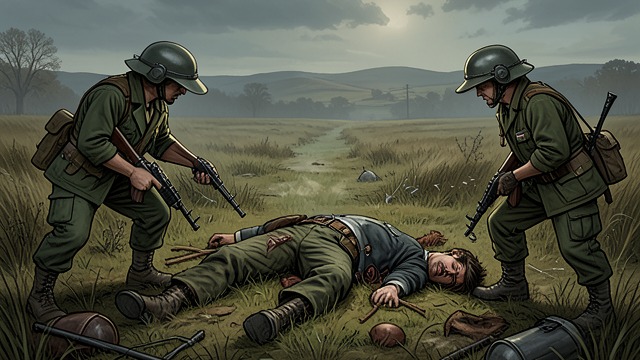
No One Claims Him
Identity as a battlefield problem
Pashka and Petro each reason about which side the dead soldier may have belonged to, but neither can confirm it. Their uncertainty determines whether anyone will risk crossing the field.
A stalled recovery
The body remains exposed because both sides fear mines, snipers, and traps. The dead man becomes an emblem of a conflict in which even retrieving a casualty requires negotiation.
A Civilian Crosses Over
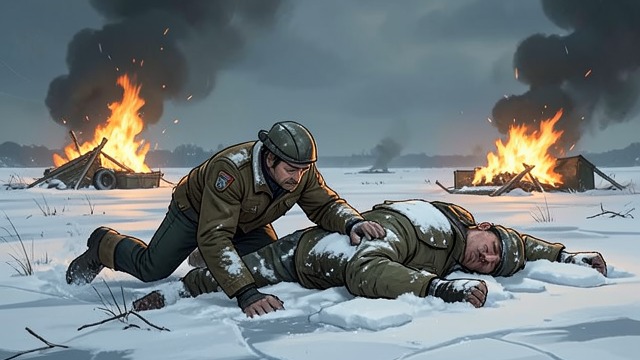
A Civilian Crosses Over
A private moral choice
Sergeyich crawls beyond the safer edge of his garden, risking fire to inspect the corpse. He finds no identification and cannot bury it in the frozen ground.
Improvised protection
He covers the body with slabs of snow crust, shielding it from sight without resolving its status. His small act contrasts with the armed groups’ inability or refusal to retrieve the dead.
The Family Receives Him
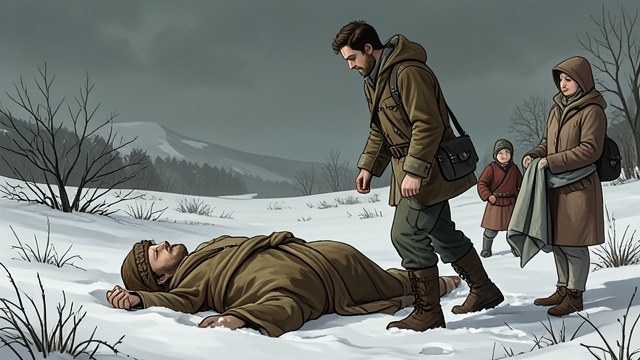
The Family Receives Him
A delayed identification
Petro later tells Sergeyich that recovery workers took the body away before further bombardment. The dead man proves to have been a volunteer from Dnipro, not the combatant either side expected.
A human ending
The body is returned to its family, giving the long-exposed casualty a destination beyond the field. Sergeyich’s relief marks the difference between a political claim and a family’s need to bury its dead.
mid-February, while the body lies in the field
the day Sergeyich covers the body
during Sergeyich’s return journey
