
The Weight of a Name
Grey BeesNames and labels shape Sergeyich’s understanding of belonging, from his disputed official identity to the renamed streets and competing claims to Crimea.
increasing Bearing strength in each event
 decreasing
Bearing strength in each eventdecreasingA Name Against a Passport

A Name Against a Passport
Official identity and lived speech
Sergeyich explains that his passport names him Serhiy Serhiyovych while he calls himself Sergey Sergeyich. Petro’s name, by contrast, matches the form he uses.
Identity resists paperwork
The exchange introduces a recurring tension between personal identity and state classification. Sergeyich does not reject his documents, but he refuses to let them fully define how he understands himself.
Street Names Reordered
Street Names Reordered
A symbolic reversal
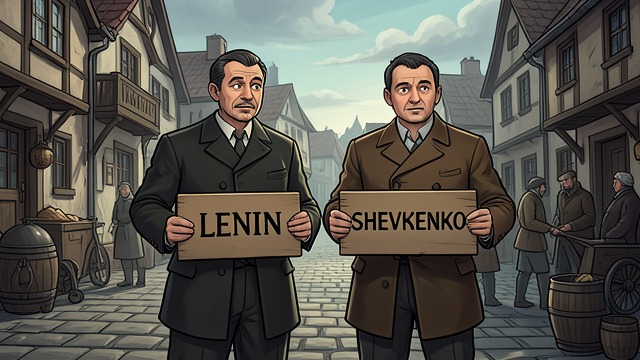
Sergeyich swaps the Lenin and Shevchenko signs in his village. The act is playful, but it also responds to the national debate over Soviet names and Ukrainian cultural memory.
Consent at tiny scale
He and Pashka vote to accept the new arrangement, standing in for a nearly absent population. Their choice cannot settle the larger dispute, but it gives local names a human scale.
Whose Land Is Crimea
Whose Land Is Crimea
History asserted as authority
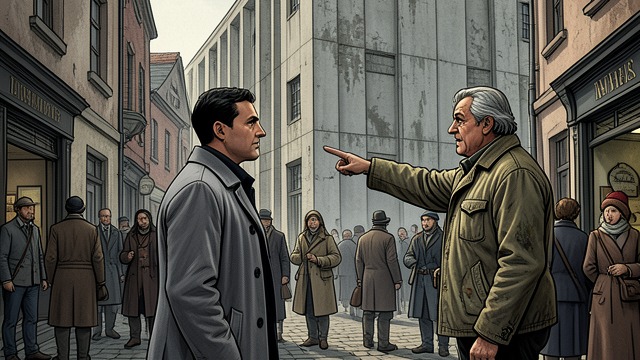
A shopkeeper says that Putin’s account proves Crimea is sacred Russian land and dismisses the Tatars’ claim. Sergeyich cannot answer with a settled history, but quietly notes that the land belongs to its Tatar residents.
Competing belonging
The exchange reveals how historical narratives can legitimize exclusion. Sergeyich’s uncertainty does not make the competing claims equal; it shows how difficult it is for an ordinary newcomer to challenge a powerful story.
Sergeyich’s first conversation with Petro
the late-winter night of the sign exchange
during the conversation in the village shop
