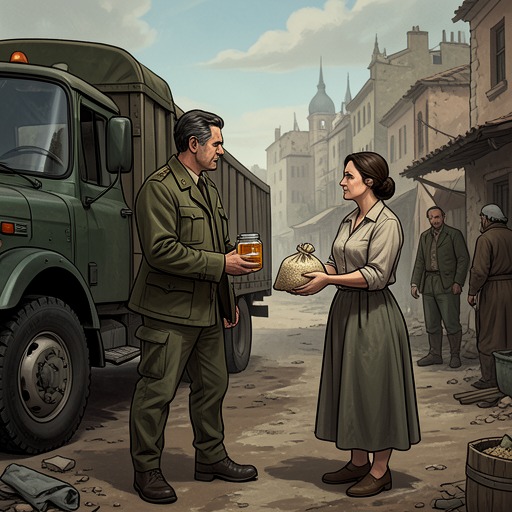
"Honey is also money"
Grey Bees“Honey is also money” names a principle Sergey Sergeyich puts into practice as he carries his apiary away from the war: honey can preserve value when ordinary supplies and dependable markets cannot. It is at once the product of his work, a commodity he can price and sell, and a means of securing food and help. Its changing forms of exchange connect survival to the relationships he builds on the road and in his new home.
Honey as stored value
Before leaving, Sergey Sergeyich plans to load jars of honey alongside his beehives. He reasons that honey holds its value more reliably than sausages or clothing, whose worth can fluctuate, and compares it to the dollar. This is not an abstract economic theory: for a man departing a village where necessities are difficult to obtain, jars of honey are portable reserves he can trade for what he needs.
The contrast with his winter household makes the principle tangible. When Pashka mentions lard, Sergey Sergeyich discovers how readily a reminder of a missing pleasure can sharpen want. His own stores are comparatively easy to enumerate: honey, vodka, tinctures, and remedies made from bee products. The many absences in the cellar cannot be filled simply by possessing honey, but honey gives him something useful to offer when other goods are unavailable. It can turn the beekeeper’s specialized labor into access to food and supplies.
From a payment offer to a working exchange
During the journey, honey becomes a proposed payment for practical assistance. Sergey Sergeyich asks people he encounters to help unload his hives from the trailer, offering honey in return. His offer is not accepted by everyone; one group refuses. When he explains the need to a shopkeeper near the place where he has settled, however, she agrees to help move the hives and proposes that she pay for honey in groceries.
The arrangement gives the principle a concrete, local form. Sergey Sergeyich first offers two one-litre jars, exactly three kilograms, and asks whether the shopkeeper might take more for resale. She instead suggests exchanging honey for provisions. He returns to the shop for bread, sausage, and water, and receives a line of credit worth 560 hryvnias, redeemable in groceries. The credit feels to him like money and, more particularly, like access to a stocked refrigerator: a measure of security after displacement. The exchange does more than settle a price; it gives him a dependable way to eat and a reason to return to the village.
A currency that builds relationships
Honey’s usefulness is not limited to the first barter. Sergey Sergeyich brings a dozen or so jars on the road because he expects they may help finance the journey. At his new site, the jars are still “sweet currency,” though he recognizes that their value depends on what others will give in return. He worries that he may be paid in bread and sausage rather than cash, and that honey cannot pay for petrol. Its exchangeability is real but conditional: it depends on people, places, and the goods available there.
The shopkeeper’s initial grocery credit eventually runs out. After selling her first batch, she begins paying Sergey Sergeyich in cash in advance. The shift from provisions and credit to money does not turn their relationship into a merely commercial one; their dealings remain warm and friendly. In this way, the honey sustains both an income and a connection. It allows Sergey Sergeyich to buy food while giving the shopkeeper a product she can sell, and their repeated exchange makes the new settlement feel more stable.
Scale, value, and return
As trade develops, the honey acquires a clearer market price. Sergey Sergeyich’s shopkeeper contact successfully promotes it with a claim that it is “anti-alcoholic,” and customers in neighbouring villages buy it. Cash accumulates in the glove compartment of his green Lada, which serves as a lockable wallet. He no longer relies on the original grocery credit: after the first batch sells, she pays in advance for further supplies. A local beekeeper later helps him extract almost a hundred kilograms of honey, underscoring the scale of the work behind this currency.
On a later return journey, Sergey Sergeyich barters honey directly for groceries at a roadside village. The woman values it at seventy hryvnias per kilogram; he takes more than a thousand hryvnias’ worth of buckwheat, barley, millet, and other provisions, as well as eggs. The transaction supplies him for the journey home and restores the familiar satisfaction of returning with food. Honey is therefore more than a convenient metaphor for money: it is a stored harvest he can convert into cash, credit, or necessities, depending on what a particular exchange makes possible.
Limits and significance
The phrase does not mean that honey can replace every kind of money or guarantee safety. Sergey Sergeyich explicitly recognizes that petrol cannot be paid for in honey, and the value he can realize varies with buyers and local circumstances. Nor does the principle erase the social dimensions of exchange. Help unloading hives, a shopkeeper’s willingness to extend credit, and the later advance payments are relationships as well as transactions.
Across displacement and return, the bees’ product carries the results of Sergey Sergeyich’s care into a world where familiar forms of stability have been disrupted. Honey can feed him, finance supplies, and make his labor intelligible to strangers; by being traded, it also helps him establish a place among them. “Honey is also money” is thus both a practical calculation and a measure of how he rebuilds a livelihood from the work he knows.