“No-one can bring Donbas to its knees!”
Grey BeesThe slogan “No-one can bring Donbas to its knees!” is recalled by Sergeyich as he joins villagers kneeling beside the road for a funeral procession. Once a declaration of regional defiance, it becomes painfully unstable in the scene: he submits to a communal act of mourning and fears that, in doing so, he has lost his pride and even his name.
Origin and Recall
Sergeyich remembers seeing the words written on a bus stop in Karuselino three years earlier. Their blunt certainty returns while a dark-green minivan approaches, carrying the dead man, followed by khaki-coloured jeeps. The phrase belongs to an earlier moment, but its meaning is tested in the present, where kneeling is both a local gesture of grief and, to Sergeyich, an image of defeat.
The Slogan Against the Scene
Before he kneels, Sergeyich resists the gesture. His childhood memory of being forced onto his knees by his father for fighting at school makes it feel like punishment; his limited experience of kneeling in church offers a different logic, since everyone is weak before God, though he says he never liked it much. Galya nervously tugs at his trouser leg, then calls to him in a tense, angry voice. He sighs and sinks down beside her as hostile looks from across the road bear on him.
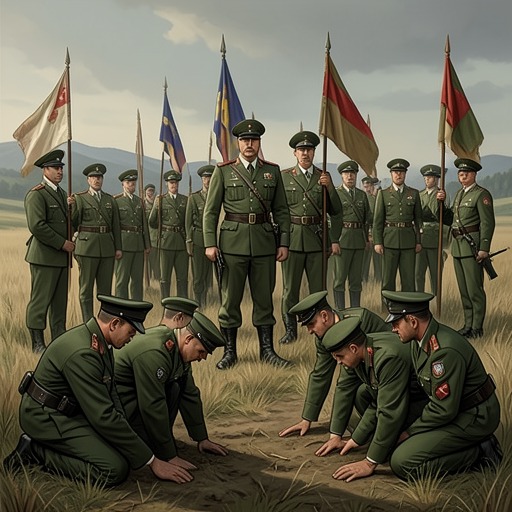
When the minivan arrives, the people lower their heads toward the tarmac, and Sergeyich does the same. The slogan flashes back into his mind, now contradicted by the sight of himself and the villagers on their knees. He tells himself that those who brought Donbas to its knees have finally succeeded, then immediately recoils from the thought as alien and dangerous. The passage does not let the slogan settle into either simple patriotic reassurance or a final verdict of defeat: Sergeyich questions his reaction, recognizing that the people around him are grieving.
Meaning and Narrative Role
The words acquire their force through the contrast between an emphatic public claim and Sergeyich’s private bodily shame. His remembered distinction between submission to God and submission before other people cannot resolve the moment; he feels his strength drain away and imagines himself reduced to nobody, stripped of name and pride. The episode makes the act of kneeling carry several meanings at once: punishment from childhood, religious humility, shared mourning, and the humiliation he associates with political defeat.
The procession ultimately complicates his judgment. The villagers remain kneeling as the minivan carrying the dead man moves toward the village; Sergeyich watches it go with them, and they are in no hurry to rise. Their stillness makes the gesture communal rather than merely personal, even as the recalled slogan insists on the language of resistance. The phrase is not erased, but its certainty is unsettled by grief, solidarity, and Sergeyich’s fear of what submission might mean.