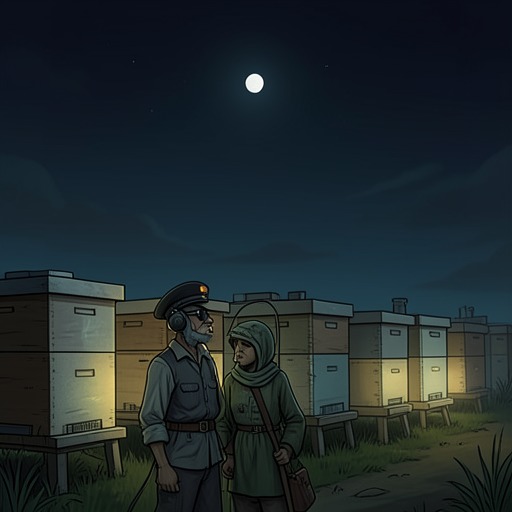
“The future war”
Grey Bees“The future war” is the unsettling phrase Pashka uses to explain a victory whose war has not yet begun. Spoken during an ambiguous encounter on Sergeyich’s bee-bed, it brings together fireworks, war dreams, and the quiet persistence of the bees: for a moment, victory seems to arrive, but waking life restores the distance still separating Sergeyich from peace.
The phrase in the fireworks scene
After receiving dollars from the governor, Sergeyich hides them in the sideboard, climbs onto the bee-bed, and falls asleep. His dream is heard rather than seen. Neighbours sing after dinner, then argue about the old war and whether Hitler escaped to Argentina; the argument gives way to dishes being cleared, and then to explosions drawing nearer. Their sound crosses the boundary of the dream, making Sergeyich shiver as the bees grow nervous and the hives warm beneath him.
The dream’s interruption is itself a small struggle. Sergeyich shifts from his back to his side and then his stomach, listening to the bees through his chest and abdomen as the explosions seem to spread over the orchard and the world. When he rolls onto his back again, he regrets that the noise is driving the dream away. Opening his eyes, he sees coloured light in the sky and recognizes fireworks. The transformation from approaching explosions to celebration does not immediately settle the scene: the same spectacle that offers a vision of victory first makes him fear that a rocket’s sparks will fall onto him.
Pashka’s declaration
Sergeyich senses someone beside him and sees Pashka, his frenemy. Pashka joyfully cries, “Victory!” and insists that the war is over. But when Sergeyich asks who won, Pashka answers that he does not know and that it does not matter; the important thing is victory. The declaration supplies certainty about the ending while withholding the most basic information about the conflict and its victor.
Sergeyich’s question, “But which war?” carries the argument about Hitler from the dream into the apparent conversation. Pashka answers, “The future war.” The phrase makes the scene’s celebration deliberately unstable: it names an ending before the war in question has taken place. Victory is voiced as an accomplished fact, but its object remains ahead, inaccessible and unexplained.
Dream, disappearance, and waking
As Sergeyich rises from the bee-bed and turns toward Pashka, Pashka is gone; the narration leaves open whether he was ever there. Sergeyich then understands that he is lying on his back and that he had dreamed himself sitting up after speaking with Pashka. The encounter is thus framed as a dream within the larger dream, or as a dreamlike apparition that waking interpretation absorbs without fully explaining.
That uncertainty does not make the victory prophecy literal. Sergeyich can lift his left arm, and he takes this as evidence that the bees have cured him: he is two-armed again, no longer disabled, and life can continue as before. He concludes that victory was only dreamed and remains a long way off. The personal recovery is real within the scene, but it does not resolve the war. Once fully awake, he feels burning on his cheeks and discovers that they sting and need shaving; the sun has scorched him while he slept on the hives. The bees’ quiet buzzing is the final sound, replacing both the imagined explosions and the fireworks.
Meaning and narrative effect
“The future war” condenses the gap between a desired ending and the condition of living through conflict. Pashka’s joyful announcement briefly turns an unknown future into a celebration, but his inability—or refusal—to say who won deprives victory of a concrete political or military meaning. Sergeyich’s question restores the missing uncertainty, and the paradoxical answer makes the promised end recede rather than arrive.
The scene also leaves two explanations in tension without requiring the phrase to settle them. Fireworks account for the coloured sky and falling sparks; sleep accounts for Pashka’s disappearance and Sergeyich’s mistaken sense that he sat up. Yet the dream’s sounds have been shaped by the war and by the bees’ bodily presence under him. When Sergeyich wakes, his arm has risen, but the war remains ahead. The phrase therefore holds together a modest, immediate hope of healing and a much larger victory that Sergeyich knows is not yet his.