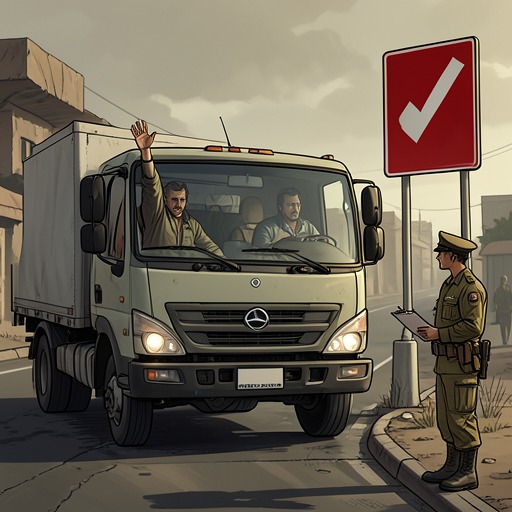
90-day limit on foreign visitors’ stay in Russia
Grey BeesThe 90-day limit on foreign visitors’ stay in Russia is the stated boundary on Sergey Sergeyich’s ability to remain in Crimea, and it becomes more than a routine immigration condition. Officials invoke the limit while questioning his reasons for entering, discourage him from speaking freely, and later give him eleven days to leave on pain of detention. The rule measures his stay, but also exposes how tightly his movements and choices are governed by the authorities controlling the border and territory.
The Rule and Its Enforcement
At the Federal Security Service, a guard studies the document recording Sergeyich’s entry into the Russian Federation and tells him that he will not be granted asylum: “Ninety days and that’s it. Got it?” The warning precedes Sergeyich’s explanation that he is not seeking asylum and has come for another reason. Later, Ivan Fyodorovich describes the entry as humanitarian: Sergeyich is a foreigner from a war zone, admitted because the authorities took pity on him and his bees. He urges him to watch his words and not appear ungrateful, then repeats that he may stay no longer than ninety days.
The deadline is thus presented alongside a conditional account of refuge. Sergeyich has been allowed in, but that permission is explicitly temporary and accompanied by a demand for caution. When he asks about Akhtem, Ivan Fyodorovich tells him to speak to the police and says the case lies with either Crimean Self-Defence or the Cossacks. He then mistakenly refers to Akhtem’s wife as a widow before correcting himself. The ninety-day rule does not resolve Sergeyich’s inquiry; it marks the limit within which he must pursue it, while the authorities warn him against challenging the terms of his stay.
A Deadline Tightened into a Threat
The limit becomes immediate when a detective returns Sergeyich’s Ukrainian passport and its insert. The detective says that if he does not leave Russia in eleven days, he will be brought back—not to an office, but to a cell. The remaining time is no longer an abstract allowance of ninety days: it is a short countdown, delivered in the course of an inquiry that has failed to establish what happened to Akhtem.
That warning also shapes Sergeyich’s conduct after the meeting. Driving back to Albat with Aisha, he wonders whether to tell her what he has learned; neither speaks during the journey. When he later reports his conversation to Aisylu, she struggles to hold back her tears. The stay limit therefore bears on more than Sergeyich’s legal status: the threat of removal and detention surrounds his attempts to pass information to Akhtem’s family, while leaving the family’s questions unresolved.
The Journey Out
As the deadline approaches, the border turns the rule into a sequence of documents, inspections, and measured days. At the checkpoint, Sergeyich presents his papers himself. A guard unfolds the insert he had crumpled and calculates that he has stayed eighty-nine days, remarking that he took the longest rest he could. A civilian man then appears behind the guard, looks at Sergeyich, and leads the guard away from the booth. The delay leaves Sergeyich waiting and checking the time, while Aisha proceeds separately through the pedestrian crossing with her green suitcase.
After being told to travel safely and not stop in the buffer zone, Sergeyich drives through it, looking among the people walking toward the Ukrainian border for Aisha. The rule’s countdown is thus embedded in a divided crossing: she travels on foot, while he follows by car, and both move through spaces where authorities inspect passports and restrict how travelers may proceed. His eighty-ninth day is confirmed at the Russian checkpoint; on the Ukrainian side, a guard notices his sunburnt face and makes an ironic remark about his holiday. The contrast underscores the ordinary, bureaucratic language of the border even as Sergeyich’s stay has been bound up with danger, investigation, and forced departure.
Consequences and Significance
The rule sets a firm outer limit on Sergeyich’s presence, but the evidence shows its force through successive encounters rather than through a detached legal explanation. First comes the warning that he cannot stay longer than ninety days; then the reminder that his admission was granted for humanitarian reasons; then the threat of a cell if he fails to leave within eleven days; finally, a border guard counts his stay as eighty-nine days. Together, these moments convert time into an instrument of control.
For Sergeyich, the limit coincides with unfinished responsibilities. Akhtem has been missing, and Sergeyich learns that his body has been found and that the authorities returned him after Sergeyich went to Simferopol. The bees also require care: their honeycombs are nearly full, while Sergeyich worries that Bekir has not visited the apiary since his father’s funeral. Yet the rule does not grant him more time to settle either matter. It makes his presence provisional, and his departure is measured not by the completion of mourning or beekeeping but by the terms imposed at the border.