Aisha
Grey BeesAisha is the daughter of Aisylu and Akhtem, and the younger sister of Bekir. Introduced chiefly through Sergey Sergeyich’s visits to her family’s home, she initially speaks little and remains at the edge of his conversations with her mother. Her eventual departure for Ukraine changes that quiet position: she becomes the person for whom Aisylu asks help, and the reason Sergeyich turns a border-crossing journey into an act of care.
Identity and Family
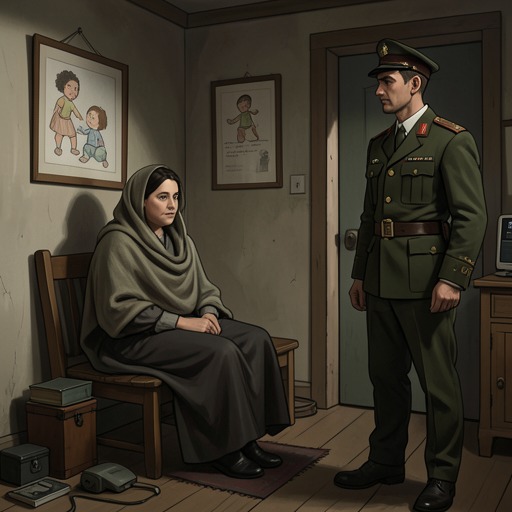
Aisha belongs to a Crimean Tatar family whose circumstances are transformed by Akhtem’s disappearance and death. When Sergeyich first visits the household, Aisha and Bekir maintain a polite silence at dinner while Aisylu explains the food and talks about domestic matters. The family’s reserve leaves Sergeyich unsure what to say about himself, and the absent Akhtem is not openly discussed at the table. Aisha is present in this constrained family setting before the narrative gives her a more direct role in its future.
By the time Sergeyich returns after Akhtem’s body has been found, the household is in mourning. Aisylu appears unwell, a mirror is covered with dark cloth, and a church candle burns in the sunlit room. Aisha sits down with the others only briefly before taking her cup and leaving. Her small withdrawal marks her presence in a scene organized around her mother’s grief and Sergeyich’s condolences, rather than giving her an account of her own response.
From the Household to a Possible Future
The situation at home makes Aisha’s prospects part of Aisylu’s urgent concern. Akhtem is dead, and Bekir has been arrested; Aisylu tells Sergeyich that she wants to get Aisha away and proposes that the girl live with him in Ukraine. She sees education as part of that possibility. Aisha’s departure is therefore not presented as an independent adventure but as a plan shaped by the family’s losses and the limits of their circumstances.
When Sergeyich explains the request to Vitalina, he says that the daughter of a Tatar he knew needs help: her father is dead, her brother is in custody, and her mother wants her to live in Ukraine and study. He estimates that Aisha is about sixteen or seventeen and says that money is available, but she will need someone to meet her and help her find her way around a university. Vitalina’s response shifts from irony to concern as she asks Aisha’s age. The conversation establishes that practical assistance, not simply a place to stay, is central to the proposed move.
Departure Through the Border
The journey depends on arranging a crossing through multiple controls. Aisylu advises Sergey Sergeyich to travel on Wednesday, when the queues are shorter, and to drive Aisha to the exit so that she can pass the Russian and Ukrainian checks on foot. He can then collect her on the Ukrainian side. The plan makes the border a practical obstacle the family must negotiate, not merely a line on a map: the two must separate during inspection and trust that they will find each other beyond it.
At the border, Aisha walks with a green suitcase through the stream of pedestrians while Sergey Sergeyich drives through the buffer zone and looks for her. He later parks beneath the canopy and presents his own documents at the checkpoint window. Once the crossing is complete, they continue to the station. There, he tells Aisha to remain on the platform when she reaches Vinnytsia, where his wife Vitalina will meet her, and gives her Vitalina’s number in case she needs it. The arrangements connect Aisha’s journey to a family relationship Sergey Sergeyich himself has not repaired: he entrusts her arrival to the very person whose presence he has struggled to seek out.
Photographs, Farewell, and Aftermath
At home, Aisha brings out a photograph album when Sergey Sergeyich speaks abstractly about photographs as a way of remembering. She retrieves it from the sideboard’s bottom drawer and shows him the family pictures, including photographs of her father. The album gives Akhtem a place in the present household after his death: he appears not only as the missing man whose fate drove the family’s crisis, but as a father preserved in images Aisha can share with a guest.
At the station, Aisha loads her suitcase and backpack onto the train, then steps back onto the platform. Sergey Sergeyich tries to reassure her about the journey and tells her that his wife will meet her in Vinnytsia. When the conductor urges her aboard and the train prepares to leave, he releases her. The train departs for Lviv, and Sergey Sergeyich remains behind, overcome by bitterness and regret. He calls Vitalina with the arrival time and carriage number, describing Aisha again so that she will recognize her. Aisha’s departure thus also prompts a direct act of communication between the estranged couple.
After putting Aisha on the train, Sergey Sergeyich tells Vitalina that he is driving home and explains that he has sent his friend’s daughter away. When Vitalina asks whether he will visit, he hesitates and invokes the Baptists’ winter coal distribution, which requires recipients to be present. His answer leaves the question of a visit unresolved. Aisha’s crossing has succeeded, but the ending does not claim that the help offered by Sergey Sergeyich has resolved the larger estrangement or secured her future beyond the journey and planned meeting in Vinnytsia.