Aisylu
Grey BeesAisylu is Akhtem Mustafayev’s wife and the mother of Bekir Mustafayev and Aisha. She welcomes Sergey Sergeyich into her home when he arrives in Crimea with his bees, then entrusts him with a request that reshapes his stay: as a Ukrainian from Donbas, she believes he may be able to ask the FSB in Simferopol what happened to her missing husband. Her household’s hospitality and her persistent care for her children stand against a sequence of losses and uncertain official answers.
Identity and first meeting
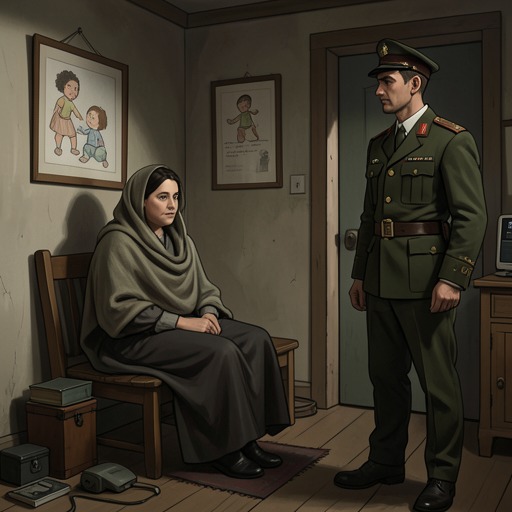
Aisylu first appears at the door of her home in a black sweater and long black skirt, with a purple scarf tied around her head. When Sergeyich asks about Akhtem, her response makes clear that he does not know what has happened: Akhtem has been gone for twenty months. The gap between Sergeyich’s hope of finding his friend and Aisylu’s knowledge of the disappearance turns an intended visit into an encounter with a family living through prolonged uncertainty.
At first she asks where Sergeyich has come from and what he wanted from Akhtem. He explains that he had hoped to set his hives nearby, where his bees could fly in peace, and to stay with them in a tent. Aisylu answers first with a practical offer: there is an apiary behind the vineyards near the mountain, and Sergeyich can put his hives beside it. She invites him to stay and offers him lunch, then agrees to show him the way herself when he says he needs to release the bees as soon as possible.
Family, home, and memory
The apiary belongs to Akhtem. Aisha and Bekir look after its bees, though Aisylu says that Bekir does most of the work. Her offer connects Sergeyich’s immediate need for somewhere to keep his hives with the family’s existing livelihood and with the absent man whose bees are still being cared for. The household does not know Sergeyich, yet Aisylu makes room for him beside Akhtem’s apiary.
As they drive, Aisylu directs Sergeyich toward the mosque and introduces their neighbour Savie, an older woman walking with two goats. The passing exchange about names leads Aisylu to explain that her mother named her after a younger sister who died during the deportation, when that sister was still very small. The family’s present life is thus marked not only by Akhtem’s disappearance but also by an older history of loss that Aisylu carries in her own name.
Aisylu tells Sergeyich that three people were taken on the day Akhtem disappeared. They had travelled together by car to the mosque in Bakhchysarai; afterward the car was found empty. A little boy had seen them being pushed into a minibus. Aisylu says the Cossacks seized them and that, for all she knows, they may have been sent to Russia. The account gives Sergeyich a concrete last-known sequence, but no confirmed destination or explanation. His protest that they could not do this cannot undo the uncertainty she describes.
Asking Sergeyich to seek answers
At a meal with Aisylu and her children, she addresses Sergeyich with unusual seriousness and asks him to go to the FSB in Simferopol to inquire about Akhtem. She thinks the authorities may speak to him because he is Ukrainian and from Donbas, while she would be turned away at the door. Her request depends on the difference between how the family expects its own appeal to be received and the access it imagines a visitor may have.
Sergeyich hesitates, and says quietly that he is Ukrainian, not Russian. Aisylu’s request nonetheless sends him to the office, where an official tells him to stay no longer than ninety days and suggests that Akhtem’s wife should speak to the police. The official then calls her a widow, before retracting the word and saying the case is not closed. Sergeyich remembers that slip. It confirms neither Akhtem’s death nor the authorities’ knowledge of his fate, but it sharpens the fear already sustained by Aisylu’s long wait.
When Sergeyich returns, Aisylu thanks him for going to Simferopol and says that without his visit Akhtem would not have been returned. Sergeyich explains that the person he spoke to had called her a widow, a word he had not wanted to tell her earlier. The exchange shows how the visit matters to the family even though the information Sergeyich brings is incomplete: his presence has helped, but it has not made the earlier uncertainty disappear.
New losses and Aisha’s departure
The family’s relief is followed by another crisis. After the Berkut have left Aisylu’s street, she tells Sergeyich that Bekir has been arrested. The detective claims Bekir robbed a church and stole candles. Aisylu disputes the accusation: the candles had been left at the family’s door during a power outage, and Bekir was away in Qarasuvbazar on the day in question. The arrest adds a new strain to a household that is already dealing with Akhtem’s disappearance and return.
Aisylu’s next request is not about herself. She wants to get Aisha away from Crimea and asks Sergeyich to take her to his home, believing that people in Donbas have it better. She later gives him a practical plan: they should leave on Wednesday, when border queues are shorter. Sergeyich can drive Aisha to the exit; she will walk through the Russian and Ukrainian controls, and he can collect her on the Ukrainian side. He agrees, while noting that he will need help loading his hives onto the trailer.
Aisylu’s role is defined by these acts of care under pressure: she provides Sergeyich a place beside Akhtem’s apiary, tells him what the family knows about the disappearance, asks him to seek information that she expects she cannot obtain herself, and arranges a route for Aisha to leave. The narrative does not make those efforts a resolution to every danger. Instead, her household’s welcome and practical planning persist alongside unresolved grief, Bekir’s arrest, and the separation required to send her daughter to safety.