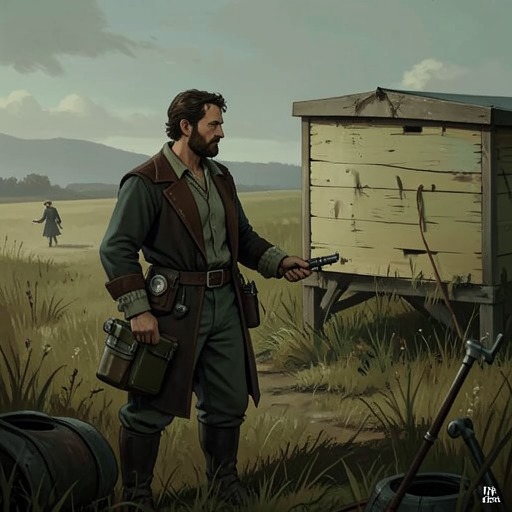
Akhtem Mustafayev
Grey BeesAkhtem Mustafayev is a Crimean Tatar beekeeper and friend of Sergey Sergeyich, first known through a beekeepers’ convention and later through the unanswered questions surrounding his disappearance. In the novel, he is present both as a remembered companion—sociable, courteous, and wry—and as a missing man whose fate draws Sergeyich into contact with the pressure facing Crimean Tatars under the new authorities. His eventual discovery, buried in the woods and killed long before, turns a personal friendship into a confrontation with political violence and its aftermath.
Identity and Background
Akhtem is a beekeeper from Crimea, near Bakhchysarai, and a Crimean Tatar. Sergey Sergeyich has not yet visited Crimea when he speaks of Akhtem to Petro, a young soldier: they met at a beekeeping convention, and Akhtem had repeatedly invited him south. The invitation gives Sergeyich a personal reason to imagine a visit beyond the familiar wish to swim in the sea and spend time on a beach.
At the convention, Akhtem shares a room at a boarding house with Sergeyich and Grisha, a beekeeper from Bila Tserkva. Their farewell picnic by a river and the evening bonfire become an important memory for Sergeyich. The small room had felt companionable rather than cramped; even after the war makes participation in a beekeeping society uncertain, Sergeyich keeps the men’s addresses and telephone numbers in his notebook and imagines meeting them again when the fighting is over.
Character and Recollection
Sergeyich remembers Akhtem as polite and sociable, able to sit with other beekeepers while they drank honey vodka without drinking himself. He explained that Islam forbade him to drink, but he ate the boiled sausages. When Grisha tried to tease him by warning that the sausages were pork, Akhtem answered with a joke: “You really believe they put meat in sausages? It’s all starch and Dutch food colouring!” The joke turned the teasing back on Grisha, who lost his appetite, while Akhtem continued eating.
This recollection is more than comic relief. It gives Sergeyich a vivid, individual memory to hold against the later, uncertain reports of Akhtem’s fate. It also establishes the ease of their friendship: their shared life as beekeepers crosses religious and regional differences without erasing them. Akhtem’s refusal of alcohol is remembered as an ordinary expression of faith, while his humor lets him meet provocation without surrendering his good humor.
Friendship and the Journey to Crimea
When Sergey Sergeyich finally considers calling someone, he thinks first of his wife, Vitalina, but doubts that she would welcome a call. He then thinks of Pashka, though the two neighbors have never telephoned one another. His thoughts return instead to the convention and to Akhtem, whom he recalls as “Such a polite fellow.” The choice makes the old acquaintance a point of connection beyond the strained relationships of home and the isolation of the grey zone.
Sergeyich finds Akhtem’s number in his notebook and dials it, only to hear that the number is no longer in service. That failed call is his first direct sign that the invitation and the friendship belong to a changed world. In the novel’s opening account of the journey south, Sergeyich goes to Crimea hoping to arrange a proper holiday for his bees; the trip becomes an ordeal as he encounters the oppression of Crimean Tatars by the new authorities. His sympathy for them attracts suspicion from the Russian security service and puts his bees at risk. Akhtem’s friendship provides a personal point of entry into this larger reality, rather than allowing it to remain distant political news.
Abduction and Disappearance
Akhtem’s wife, Aisylu, tells Sergeyich that Cossacks took her husband. Three men were seized on the same day after they had travelled together by car to the mosque in Bakhchysarai. The car was left empty, and a small boy saw the men being pushed into a minibus; after that, the families received no news. Aisylu says she does not know whether Akhtem was sent to Russia. The account gives Sergeyich neither a confirmed location nor a way to intervene, only a report of disappearance and the traces left behind.
Two years after the kidnapping, Sergeyich goes to ask about Akhtem. He tells a guard that the man has been missing for two years and was kidnapped, and explains that Akhtem’s wife asked him to come. When the guard asks for the missing man’s name, Sergeyich answers, “Akhtem Mustafayev.” Asked whether he is a Tatar, he nods. The exchange makes plain that Sergeyich is acting not as a relative or official representative but as a friend who has accepted Aisylu’s request. His visit cannot itself undo the disappearance, but it refuses to let Akhtem become only an unrecorded absence.
Discovery and Narrative Significance
Sergeyich eventually learns from a Tatar at Aisylu’s home that Akhtem’s body has been returned. The man says that Akhtem was found buried somewhere in the woods and had been killed long ago. Sergeyich guesses at first that the returned body might be Akhtem; confirmation makes the missing friend’s fate concrete. The discovery does not provide a full account of what happened during the two years of silence, but it establishes that the disappearance ended in death.
Aisylu later brings out a photograph album and pushes it toward Sergeyich as a record of her family, including her father. Its first photograph shows Akhtem and Aisylu as young newlyweds: Akhtem wears a blue suit and white fez, while Aisylu wears a white dress with a blue belt and a blue fez taller than his. The album restores his life to the narrative in a form distinct from the reports of his abduction and death. He is not only a name Sergeyich gives to a guard, or a body reported found in the woods, but a husband whose earlier life is preserved in shared photographs.
Akhtem’s story also clarifies what Sergeyich’s sympathy costs him. In Crimea, a woman assumes that because he is friendly with Tatars and avoids Orthodox people he may have converted to Islam. Sergeyich denies converting to anything. His response does not deny his connection with Akhtem and his family; instead, it shows how association itself becomes visible and politically legible in a suspicious environment. Akhtem’s friendship thus links private loyalty to the novel’s wider depiction of coercive rule, while the unanswered call, the wife’s testimony, the inquiry, and the returned body mark successive stages in the movement from memory to loss.