Bachkizarai
Grey BeesBakhchysarai is the Crimean town through which Sergeyich travels toward Kuybyshevo and later returns while trying to help Bekir. Its significance lies in this double role: it is a waypoint in a forced migration undertaken for the sake of his bees, and a practical center where the consequences of Russian control, detention, and separation become immediate. Roads leading into the town carry him toward refuge; roads leading out carry Aisha away from her family.
Setting and Routes
Sergeyich’s intended destination is not Bakhchysarai itself but Kuybyshevo, the nearby village where Akhtem lives. When questioned about his plans, he explains that he has an address for a fellow beekeeper near Bakhchysarai and insists that he is making the journey for his bees, so they can fly peacefully and make honey. At a checkpoint, the distinction between destination and route is also political: a soldier questions why Sergeyich is entering through territory described as the O.R.D.L.O., and Sergeyich answers that Petro had advised him it was safer. His passport and mobile phone are taken for inspection before they are returned with a paper to show at the next checkpoint.
As he nears his goal, a sign points toward Sevastopol and Bakhchysarai. The first city brings him pleasure simply because of its legendary name, but Bakhchysarai is the practical end of the road: he is heading for the village where Akhtem lives. A Tatar seller of samsa gives him directions to Albat, explaining that he should drive through Bakhchysarai, follow the sign for Yalta, and continue for about twenty kilometres. The guidance links the town to the surrounding villages while also revealing the names by which places are known: the seller identifies Kuybyshevo as Albat.
Arrival and Encounters
The journey into the area unfolds through ordinary roadside details that acquire weight in Sergeyich’s unfamiliar surroundings. He buys and eats samsa beside his car, then asks the seller for directions. As Bakhchysarai comes into view, a bee enters the Lada, carrying yellow pollen on its legs. Sergeyich reaches instinctively for the window handle, then laughs when he remembers that the window is gone. The brief encounter makes the migrating beekeeper’s world follow him: even on a road toward a different home, a bee remains a familiar presence, while the absent window marks the damage and hardship of his journey.
The route also brings him close to the layered histories of the region. Near Mangup, Akhtem’s wife tells him that her grandfather hid there during the German occupation, was caught by Soviet soldiers after the war, and was shot near a clinic. She explains that the clinic had treated drug users from other cities, and that its doctor moved to Kyiv after the Russians came and would not let him continue treating them. The conversation places individual family memory beside the political changes shaping the present-day landscape.
A Base for Seeking Help
Bakhchysarai becomes more than a passage through the peninsula when Sergeyich learns that Bekir has been taken to its police station. With Aisha beside him in the passenger seat, giving directions, he drives there the same day and asks to speak to the chief about the young man from Albat. His arrival turns the town into a place where the family’s concern must meet official procedure; seeking help means approaching the institution that holds Bekir.
The town’s history is also present in the food shared with Sergeyich. When Bekir explains that the bakery stands on the site of an old cemetery, Sergeyich responds with a drawn-out acknowledgment, then dips bread into honey and eats with pleasure. The ordinary meal joins hospitality to a difficult fact about the ground beneath the town: daily life continues in a place where earlier burial sites have been built over.
Departure and Significance
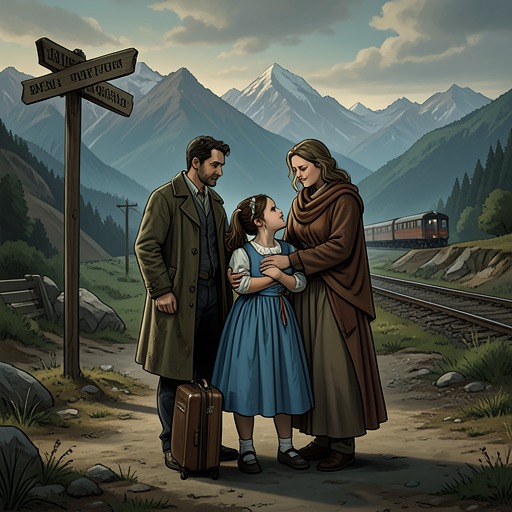
Bakhchysarai is also where Aisylu and Server follow Sergeyich and Aisha before the final separation. At the exit from the Tatar capital, they signal for him to pull over. Aisylu embraces her daughter for the last time and whispers to her in Tatar; Server stays in his car, while Sergeyich gets out and watches the mother and daughter part. Akhtem’s widow nods for him to go on, then looks toward the hives on his trailer. Sergeyich understands her concern: the plank marked by an axe on one hive has come loose, and the previous night he had pressed it back into place to keep the bees from escaping.
The town’s narrative role is therefore defined by movement and thresholds rather than by a single arrival. It is where directions turn a distant refuge into a reachable village, where officials make borders tangible through documents and inspections, and where a family’s parting takes place beside a trailer carrying living colonies. The bees are not merely cargo: Sergeyich closes their entrances, secures the hives, plans for the weather, and takes honey as a store of value because their survival is the purpose of his flight. Bakhchysarai gathers these strands—migration, political scrutiny, memory, care, and departure—into the lived geography of a town that is at once a route onward and a place where urgent human ties are confronted.