Beeswax Conference Group Photo
Grey BeesThe beekeeper’s convention photograph is a group image in Aisha’s family album that allows Sergey Sergeyich to recognize both his missing friend Akhtem and his own younger face. The discovery begins with a familiar building and ends with Sergeyich comparing the man in the photograph to his reflection: a modest picture becomes an unexpected bridge between past and present, and between two people whose lives have been changed by time and separation.
Appearance and Discovery
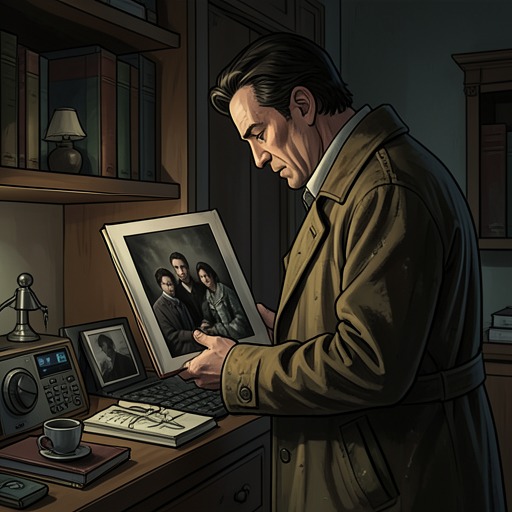
Aisha brings out the album after Sergeyich asks whether her family takes photographs. She presents it as a record of their family, including her father, and Sergeyich turns through its pages. One picture shows young people leading a horse through a field, but he cannot identify Akhtem by face; he knows him only by his position beside Aisylu. The image quietly establishes a limit to photographic memory: a face can be preserved and still become unrecognizable.
Flipping more quickly, Sergeyich thinks he has passed something familiar. He returns to a group photograph showing about fifty people, perhaps more, arranged in three rows on the colonnaded steps of an old white building. He recognizes the building before he can account for why it matters. Then the setting resolves into Sloviansk and the beekeepers’ convention, an event he attended himself. The photograph is not merely a family keepsake: it unexpectedly connects Aisha’s family archive to Sergeyich’s own history.
Finding Akhtem and Sergeyich
The faces in the group image are so small that they blur as Sergeyich leans closer. He asks Aisha to point out her father. She confidently identifies Akhtem in the second row, on the left, but Sergeyich still cannot make out the face. A magnifying glass sharpens it: Akhtem was slim, with high cheekbones and a neatly trimmed moustache. The instrument makes recognition possible, but the recognition also depends on Aisha’s knowledge of where to look.
Sergeyich then realizes that he, too, must be somewhere in the image. He asks Aisha to help find his face. She looks from the photograph to him, then indicates a man in the upper row, on the right. Through the magnifying glass he sees a younger version of himself: short-haired, round-faced, clean-shaven, and dressed in grey. The face is materially present in the photograph, but it takes another person’s attention and guidance for him to reclaim it.
The Image and the Present
The recognition does not end at the table. In the bathroom, Sergeyich holds the album beside the mirror and examines his unshaven, weathered face, then directs the magnifying glass toward the younger man in the photograph. He whispers that it is indeed him. The paired surfaces—the mirror reflecting the present and the album preserving the past—make the change visible without explanation: the man looking back is continuous with the young delegate, but age has made that continuity difficult to feel until the two faces are placed side by side.
The scene also turns an abstract question about photographs into a physical act of looking. Aisha’s album preserves family history, yet its group portrait holds more than its owners may initially know: Sergeyich’s own past is folded into it. His recognition depends on a shared convention, a remembered building, a magnifying glass, and Aisha’s help. The picture restores a connection not by making time disappear, but by letting a face in the past become legible to the person he has become.