Berkut
Grey BeesBerkut are the security personnel stationed outside Aisylu’s home during Akhtem’s funeral. Seen first in an unthreatening posture and later beside armored vehicles in body armor, they form the visible perimeter around a private mourning gathering; their presence also prompts Sergey Sergeyich’s pointed comparison between human police and the social order of bees and ants.
Presence at the Funeral
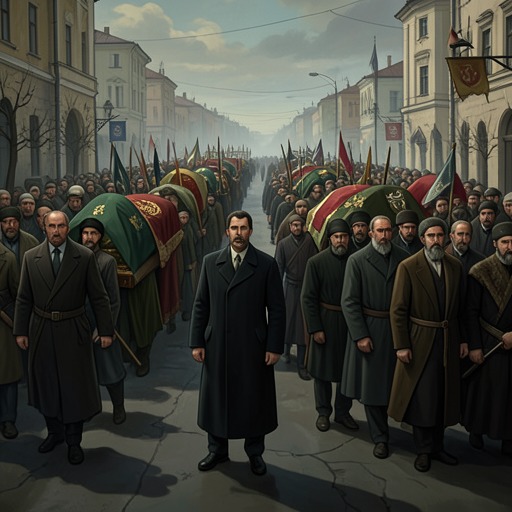
The morning after the police vehicles had arrived, Sergey Sergeyich found the scene changed. A blue four-wheel-drive vehicle stood outside Aisylu’s home, while a single towering black Kamaz remained near the place where the police cars had pulled up. Three Berkut officers stood nearby in uniform but without helmets, chatting and looking bored. Their black rubber batons swayed from their belts as they moved. The details make the security presence conspicuous but not actively confrontational: the officers are on duty at the edge of the funeral, yet appear to be waiting rather than intervening.
People gathered in Aisylu’s yard and moved quietly in and out of the open house, speaking softly in Tatar. Sergey Sergeyich stood between the gate and the house, searching for Bekir or Aisha; he was too frightened to approach the house itself. He eventually spotted Bekir on the threshold and hurried over. The contrast places Berkut at the gathering’s outer boundary while the mourners’ attention remains inside, among family and guests.
Reinforced Security and Sergeyich’s Response
When Sergey Sergeyich left the house, the security arrangement had grown more substantial: two minibuses were parked by the fence, and Berkut officers in the nearer one wore black bulletproof vests over their uniforms. The shift from three helmetless men beside a Kamaz to officers in body armor inside a minibus gives the funeral’s perimeter a harder visual presence, although the narrative does not describe the officers taking action against anyone.
Walking past the vineyards, Sergey Sergeyich continued to think about the armored police. He set their role beside the guards of bee and ant colonies, which protect their families and maintain order against incursions from outside. In his reflection, bees have achieved communism through orderly labor, while ants have reached a natural socialism of order and equality. People, by contrast, possess neither; even their police seem useless, merely loafing by the fence. Berkut thus become more than funeral security in Sergey Sergeyich’s thoughts: their idle posture supplies the immediate human example against which he measures the organization of insects. His reflection ends when a group of mountain-bike tourists comes downhill and one rider greets him, returning his attention to the road and the apiary.