Church candles
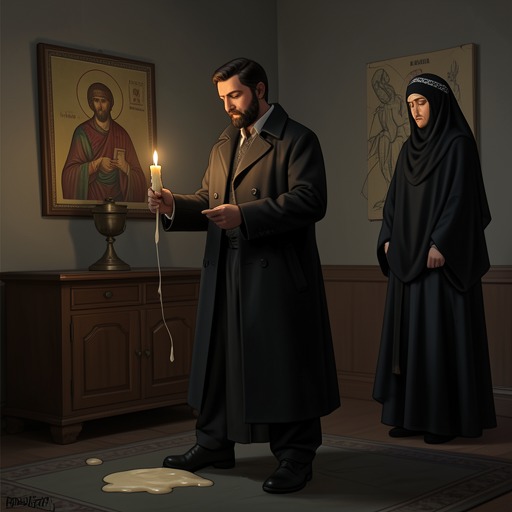
Grey BeesThe church candles are both a source of light during a power outage and the object at the center of a mistaken theft accusation against Bekir Mustafayev. Sergey Sergeyich brings them to Aisylu's household as a gesture of help, then identifies himself as their source when police accuse Bekir of stealing them. Their changing role—from church property removed from a bombed building, to a gift, to supposed evidence of a crime—connects the material aftermath of war with grief and the risks of helping across religious lines.
Discovery and intended use
While speaking with Pashka Khmelenko, Sergey Sergeyich finds Nicholas the Wonderworker in the boot of his car and sets the icon in the far-left corner of his tent, before a candle jar. He also comes across two thick bundles of church candles and hides them behind the pillow in his sleeping bag. The candles are thus kept alongside his private religious objects, but they are also a practical reserve in a place where the electricity may remain off.
Remembering Aisylu and her children, Sergey Sergeyich decides that he will bring them candles because no one knows when the power will return: perhaps the next day, perhaps a week later. He takes one bundle, about fifty candles, and carries it towards the village. The number and weight make the gift substantial rather than symbolic alone: it offers the household a supply of light through an uncertain outage.
A gift in a darkened village
On the way to Aisylu's home, Sergey Sergeyich walks through Albat-Kuybyshevo, where the windows and street lamps are dark. The village's silence makes the journey feel threatening, and at Aisylu's door he hesitates, reluctant to knock because he expects that hospitality may mean being invited inside. The candles therefore arrive not as a detached donation but through a wary, personal visit in a community shaped by fear and disrupted daily life.
Later, when Sergey Sergeyich enters Aisylu's living room, he sees that the mirror is still draped and that a candle is burning before it. The candle is made of stearin, a detail that places it in a household observance rather than simply treating it as illumination. After another visit, he notices that the burning candle is now a cheap grey one. He reasons that Aisylu's family may have used up his better candles or be afraid to light them, and suspects the police may have taken the candles they found during their search. The altered candle in front of the covered mirror registers both ongoing mourning and the uncertain availability of the gift.
The candles and Bekir's arrest
When the Berkut officers are no longer on Aisylu's street, Sergey Sergeyich hurries to her house. Aisylu tells him that Bekir has been arrested: a detective says that he robbed the church and stole candles. She points to the small flame in front of the mirror and explains why she rejects the accusation. The candles had been left at their door when the power went out, while Bekir was away in Qarasuvbazar; she asks how he could have robbed the church when he was not there.
Sergey Sergeyich then reveals that he brought the candles himself. He explains that his own church had been bombed back home and that he entered it and took the candles. He has brought another bundle, which he sets on the table and unwraps. The admission settles the immediate question of where Aisylu's candles came from and gives her the witness she needs: she asks him to tell the authorities that he brought them and that Bekir did not rob a church. The object that had made the family appear connected to a theft now becomes the means by which Sergey Sergeyich can speak on Bekir's behalf.
At the police station, Sergey Sergeyich says he wants to speak about a young man from Albat named Bekir and explains that he gave them the candles. The policeman challenges his description of Bekir as being from Albat, calling him Mustafayev and saying he is from Kuybyshevo, then asks what Bekir is to Sergey Sergeyich. He answers that Bekir is no one to him; he simply wants to make clear that he supplied the candles and that Bekir did not rob any church. The testimony is presented as an act of help rather than a claim of kinship or personal obligation.
Mourning, religious custom, and material care
The candles recur in connection with the covered mirror and the family's mourning for Aisylu's father. Aisha tells Sergey Sergeyich that the candles will be lit for forty days. When he asks how the period is counted, given that the date of her father's death is unknown, she says it begins from the date of his funeral, as the imam instructed. She also says the imam scolded her mother for lighting the candle. The passage distinguishes the family's practice of keeping a flame before the draped mirror from the religious guidance they have received; the candles are part of an observance whose timing and acceptability are not simply a matter of custom.
Across these scenes, the church candles pass between damaged religious space and a Muslim household's mourning ritual. Their presence does not erase the differences between those settings: the church was bombed, the candle gift is tied to an accusation of church theft, and Aisha recounts the imam's instruction about her family's observance. Instead, the candles make those differences concrete while showing how a practical act of care can cross them. Their light is useful during the outage, but their presence also carries the question of who brought them, who is blamed for them, and what responsibilities follow from giving them.