Donbas
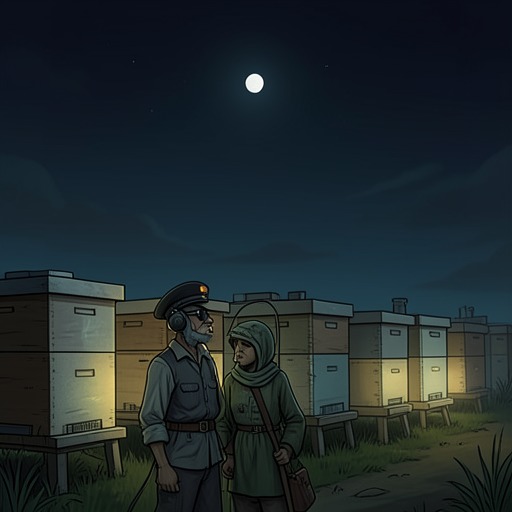
Grey BeesDonbas is the coal-and-metallurgy region of eastern Ukraine that contains Donetsk, Luhansk, and the grey zone. The novel presents it not as a distant battlefield but as a home whose ordinary inhabitants endure war, grow accustomed to its presence, and struggle to remain unobtrusive. Through disabled pensioner and beekeeper Sergey Sergeyich, the region’s identity travels with its people: his bees become both a practical responsibility and a measure of what war threatens to take from him.
Industrial Identity and Ordinary People
The novel’s foreword situates Donbas among coal mines and metallurgical plants, a landscape that shaped the self-image of people accustomed to playing an inconspicuous part in a larger industrial whole. In the Soviet era, this modest place within collective production could be a source of pride. Russians gave the region’s inhabitants the designation “the people of Donbas,” a phrase that made them seem like children of mines and slag heaps, with no ethnic roots. The label captures a tension in the novel’s portrait: belonging is deeply local, yet outsiders describe it as if it were defined by industry alone.
The book’s author explains that three journeys through Donbas, beginning in the winter of 2015, informed the novel. The journeys brought a gradual change into view: fear of war and possible death giving way to apathy, and war becoming part of daily life, like a rowdy, drunken neighbour whom people try to ignore. The novel accordingly turns away from military operations and heroic soldiers toward ordinary people whom the war has not driven from their homes. Their apparent facelessness is not an absence of character so much as a means of remaining unnoticed by the conflict.
A Region at War
The grey zone is part of the lived geography of Donbas, and its boundaries enter daily life through soldiers, documents, and checkpoints. When Sergey Sergeyich says he is from Little Starhorodivka, near Karuselino, soldiers examine his passport and check by radio whether the village lies in the Donetsk People's Republic. They question why he is entering through territory described as the occupied districts, and he explains that Petro told him that route was safer. A later inspection takes his mobile phone and passport while directing him to pull over and make room for another car. The border is thus not merely a line on a map: it is an encounter that can suspend a traveller’s movement and make the status of his home a matter for armed officials to verify.
The journey onward to Crimea makes that unsettled geography visible in the road itself. At the Chonhar crossing, Sergey Sergeyich recalls a transformer box marked “18 KM TO THE RUSSIAN OCCUPIERS”; after crossing the bridge, he reaches the Russian checkpoint beneath a canopy bearing the words “RUSSIA. DZHANKOY CHECKPOINT.” Between these points he passes people walking with carts, suitcases, bags, and backpacks, some looking at him with pleading or compassionate expressions. Later, while driving slowly through the buffer zone, he overtakes pedestrians and searches the stream of border-crossers for Aisha. Documents, vehicles, waiting queues, and the buffer zone turn regional division into a sequence of practical constraints and anxious acts of looking.
Sergey Sergeyich and the Bees
Sergey Sergeyich embodies the novel’s image of a person rooted in Donbas but unwilling to make war the whole meaning of his life. He is a disabled pensioner, a devoted beekeeper, and a resident of the grey zone who hopes to take his bees south for a proper holiday. His coughing fit at a checkpoint makes his silicosis audible as the soldiers question him, bringing the bodily cost of his life into the same encounter as the documentary scrutiny of his origins. The bees, meanwhile, make displacement more than a matter of choosing a safer place: he must consider what happens to the living creatures in his care.
Even away from home, Sergey Sergeyich cannot remain wholly outside Donbas’s conflict. In Crimea, he witnesses the oppression of the Crimean Tatars by the new authorities. His sympathy for them raises the suspicion of the Russian security service and puts his beloved bees at risk. The novel’s journey south therefore does not cancel his connection to Donbas; it reveals how war and political power follow him beyond the region, reaching both his conscience and his apiary.
The Region’s Meaning in the Novel
Donbas is at once a physical place, an industrial inheritance, and a condition of life shaped by prolonged conflict. The novel’s attention to residents who keep living in their homes changes the scale of the war story: its measure is not only military action, but also the shrinking space for ordinary movement, the habituation to danger, and the effort to preserve daily responsibilities. Sergey Sergeyich’s route through checkpoints makes borders palpable, while his bees carry the possibility of another landscape—fields of buckwheat or wildflowers, rather than cratered ground—without making escape a simple resolution.
The foreword’s final image is the honey of Donbas retaining a bitter aftertaste of gunpowder. It brings the region’s natural and human worlds into one figure: the bees continue their work, but the war has entered what they produce. Donbas remains the source of Sergey Sergeyich’s identity even as he seeks temporary safety elsewhere, and its defining conflict is the pressure to live as an ordinary person in a place that violence has made impossible to ignore.