Donetsk People's Republic
Grey BeesThe Donetsk People’s Republic is the separatist-controlled territory that presses against the villages of the grey zone and repeatedly complicates Sergey Sergeyich’s journeys. In the novel it is both a political claim and a practical obstacle: a place glimpsed across fields, identified through a residence stamp, and approached through checkpoints where soldiers decide which papers and routes will let a person pass.
Territory and Setting
In the book’s opening account of the conflict, the Donetsk People’s Republic and the Luhansk People’s Republic are described as breakaway entities on the eastern front line between Ukrainian troops and pro-Russian separatists. The grey zone lies between the opposing sides; its width varies from several hundred metres to several kilometres with the terrain and intensity of fighting. Many residents have fled, leaving homes, farms, shops, post offices, and police stations behind, while a small number remain amid shellfire and shrapnel. The setting is not a cleanly drawn border but a sparsely inhabited space whose authority and safety can change from one stretch of road to another.
That uncertain geography becomes visible on Sergeyich’s half-kilometre walk towards Svitle. From the straight road, with bare maple, linden, and apricot trees beside it, he can see fields extending towards Zhdanivka and, farther on, the hamlet of Zayachy. Zayachy lies in the Donetsk People’s Republic, which Sergeyich calls “Deepee-aria”; it appears to contain only five or six houses and seems deserted. Yet Svitle itself is quiet and almost unchanged. There are no separatists or Ukrainian soldiers there, and most people have stayed, concentrating on making a living rather than on politics. A few men have joined the Donetsk side, while the district police officer and school headmaster have enlisted in the Ukrainian army, reportedly out of fear that local authorities might be attacked. The contrast between nearby territorial control and the village’s quiet routine makes the boundary palpable without making it secure or simple.
Everyday Life Across a Contested Line
The novel’s account of the grey zone emphasizes survival and careful relations rather than allegiance. The remaining villagers encounter both Ukrainian soldiers and separatist fighters, who enter in search of the enemy or out of curiosity. Locals treat either side with diplomacy and unassuming friendliness because their immediate aim is to endure. In this landscape, political control is experienced less as a distant declaration than as the presence or absence of armed men, the safety of a road, and the difficulty of reaching another settlement.
The ordinary material details of civilian life sit alongside these uncertainties. When Sergeyich visits Nastasya, she offers eggs, a tin or two of stewed pork brought by volunteers, and pickled cucumbers; he accepts, confident that the return journey home will be easier than the outward trip. In a conversation with Petro, news from Ukraine turns to the renaming of towns and streets. Petro complains of the work and sabotage involved, including people refusing to remove street signs or wanting the flag reversed, and jokes uncertainly that the country might first be renamed the Ukrainian People’s Republic. These exchanges locate the contested territory within everyday concerns—food, travel, signs, and political language—rather than presenting it only as a military map.
Postal service offers another measure of how the territory’s isolation can briefly be interrupted. Pashka tells Sergeyich that the day after tomorrow will bring a one-day “postal ceasefire,” when accumulated mail will be delivered to villages in the grey zone whose local post offices have stopped working. Sergeyich rises early for the occasion, cooks two eggs, and goes to meet the van. When its UKRPOSHTA sign comes into view, he stares at it with joyful surprise. The return of a state postal service is a small, practical event, but its unusualness reveals how thoroughly the war has disrupted communication and how meaningful even a temporary delivery can be.
Checkpoints, Documents, and Routes
The Donetsk People’s Republic is also encountered through the bureaucratic scrutiny that accompanies travel. When Sergeyich says he is from Little Starhorodivka, near Karuselino, a soldier examines his passport while another checks by radio whether the village is in the D.P.R. The first soldier then asks why Sergeyich is entering through the area described as O.R.D.L.O. Sergeyich explains that Petro told him this route was safer. The question makes clear that residence and route are not neutral facts: each can be read as a claim about which authority governs the traveller and which dangers he is willing to face.
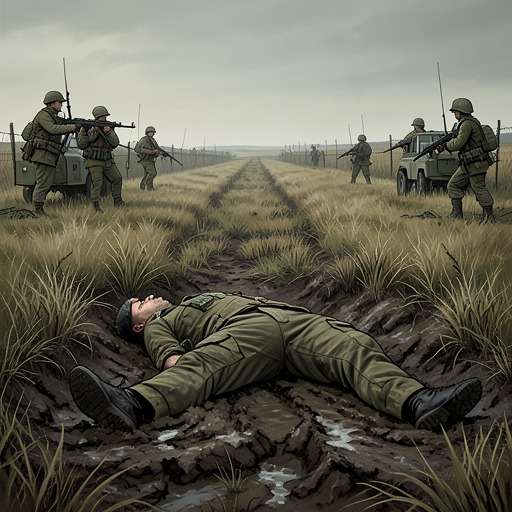
The inspection continues when a stern soldier takes Sergeyich’s mobile phone and passport, while his partner orders him onto a concrete-blocked shoulder to make room for the next car. Night has fallen; headlights illuminate a queue that stretches into the distance, and the yellow-lit windows of a military van make the checkpoint a stark interruption to the road. Sergeyich listens anxiously to his hives, whose buzzing sounds tired and despairing. The soldier eventually returns his documents and phone and gives him a piece of paper to show at the next checkpoint. That paper does not settle the political status of the village; it grants a limited, contingent ability to continue.
The same dependence on routes and documents shapes Sergeyich’s later crossing towards Russia. At the Dzhankoy checkpoint, he passes people walking in both directions with carts, suitcases, bags, and backpacks. The sight recalls a transformer box at the entrance to Chonhar marked “18 KM TO THE RUSSIAN OCCUPIERS.” The sharp distance between that warning and the formal border canopy captures how political boundaries are encountered through both official installations and improvised signs. After Aisha walks ahead towards passport control, Sergeyich goes to a window with his documents; officials question his paperwork, and he is warned not to stop in the buffer zone. He drives through slowly, searching the pedestrians for Aisha, while the rules governing movement determine when he may stop and where either of them can go.
Narrative Significance
The Donetsk People’s Republic matters in the novel not simply as a named territory but as one element in a lived geography of uncertain authority. It appears beyond Svitle’s fields, in the residence stamp a soldier checks, in the question of which road is safer, and in the chain of checkpoints that separates one destination from another. These encounters make borders actions performed by people with radios, passports, mobile phones, and permits, rather than fixed lines that civilians can ignore.
The book places that procedural pressure beside the rhythms that help people remain in place: a quiet village, food offered to a visitor, a calendar crossed off, and a postal van arriving after local offices have closed. The postal ceasefire briefly makes a route serve connection rather than military control, while checkpoint delays expose how fragile such ordinary passage remains. Through this contrast, the Donetsk People’s Republic is represented as part of the material conditions of civilian life in the grey zone: it shapes movement and risk, but it does not erase the stubborn local routines by which residents continue to live.