Honeybees
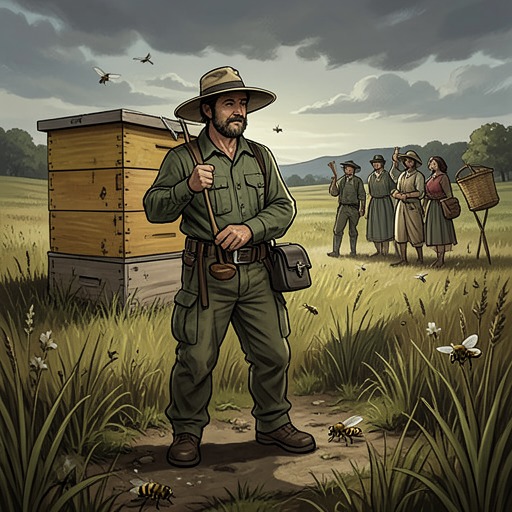
Grey BeesHoneybees are not merely the cargo that Sergey Sergeyich carries away from the war: their needs determine when and how he travels, give structure to his displaced life, and make him answerable to lives beyond his own. The novel follows them as living colonies with their own warmth, work, boundaries, and vulnerabilities, even as Sergeyich reads their behavior against the violence and disorder of human society. Their journey ends in an act of care and destruction together: he sacrifices a hive he fears has been militarized, then discovers that a surviving bee cannot simply be welcomed into another colony.
A colony with its own needs
The bees’ physical requirements place limits on Sergeyich’s choices. In winter, they keep their hives at thirty-seven degrees by remaining active; they cannot sleep through the cold as a person might. Their warmth is collective and self-produced, but it depends on constant work. When Pashka asks about heating the shed, Sergeyich explains that the bees need no stove, because they generate the necessary heat inside their hives themselves. In his comparison, the difference between human and bee is not that one works and the other rests: the bees cannot stop without risking their lives.
The colonies’ seasonal life also guides their movement. Sergeyich plans to bring the hives into an orchard, leaving the bees free to forage wherever they choose, rather than assigning them to one side of the front. His preparations for leaving Little Starhorodivka are correspondingly exact. He must close the entrances so the bees do not scatter on the road, load the hives one at a time onto a flatbed trailer, cover them with a tarpaulin, and secure them. Cool, rainy weather suits the journey: agitation on a bumpy road could raise the temperature inside the hives, and excessive heat could kill the bees. Their safety dictates the timing and conditions of his escape.
Sergeyich also treats the bees’ work as distinct from his own. He calls himself the representative of their legitimate interests, but recognizes that their interest is simply to gather nectar and pollen. He watches their health, drives wasps from the hives, uncaps combs with a metal scraper, and collects honey, wax, and pollen. He does not claim to direct their society: worker bees and drones have their own relations, and the bees neither seek nor need his permission. His care is practical and attentive, but it does not make the colonies extensions of his will.
Displacement and a new routine
After reaching a quieter place, Sergeyich makes his campsite between the hives and the trailer. He sets an icon of Saint Nicholas the Wonderworker inside his tent, puts a candle before it, and begins breakfast with bread and sausage that Galya has given him in exchange for honey. The bees’ wing-ringing accompanies this ordinary meal. He understands their sound as proof that the colonies are alive and, by extension, that he too is still present. His new life is not independent of them: he is close to the hives, and their activity gives the day a structure that the war has interrupted elsewhere.
That dependence is practical as well as emotional. Sergeyich has brought jars of honey as portable value, reasoning that honey keeps its worth more reliably than clothing or sausages. The bees thus sustain both his livelihood and his movement away from the front. When he realizes he has no honey extractor, Galya introduces him to a local beekeeper. The man brings an extractor to the campsite on a flatbed trailer and helps process nearly a hundred kilograms of honey. Sergeyich pays him, but the beekeeper accepts only fifty hryvnias for petrol, offering a handshake and sympathy without asking about the newcomer’s life. The exchange shows how the apiary connects Sergeyich to a local community without turning the bees’ care into a merely commercial transaction.
By summer, their sound has become part of his sense of time. Birds grow louder, yet the ringing of bee wings remains audible. Sergeyich takes it as evidence of the colonies’ health and of his own presence in the world. He is not only an owner: he sees himself as their representative, responsible for protecting them while leaving their internal life to them. That balance gives his work meaning. Most of the labor is performed by the bees, and they do not need his advice; his responsibility is to safeguard the conditions in which their work can continue.
Social order and human comparison
The bees’ behavior repeatedly invites Sergeyich to compare their society with human life, though the comparison remains his interpretation rather than a claim that the two are identical. At the hive entrances, he watches returning foragers bring pollen and push past bees lingering in the way. On another morning, guard bees force drones out of a colony. The drones fall onto the grass, weakened after being denied food, while the guards shove them away from the entrance. Sergeyich watches without much pity: workers gather pollen and build combs throughout their lives, while drones consume the stores, and the colony expels them before cold weather rather than waste honey and syrup.
He regards this as nature’s intelligible wisdom and measures human arrangements against it, usually to humanity’s disadvantage. The scene does not make the bees into simple moral exemplars; it shows how their visible organization becomes a language through which Sergeyich thinks about labor, dependence, and exclusion. Their lives are governed by seasonal needs, and the colony’s actions preserve its resources. His reflections expose both the attraction of that clarity and the limits of using it to judge human society.
The novel also gives the colonies lives that exceed Sergeyich’s analogies. A swarm gathers on a pear-tree trunk, its thousands of bees warming their wings before flight. Sergeyich sprays them with water until the droplets weigh down their wings and quiet the buzzing, then climbs the tree and sweeps them into a trap with a dustpan. Nearly a hundred remain on the trunk, but they crawl into the trap themselves, afraid of being left without their swarm and queen. He watches their descent with concern and lifts the trap to make it easier for them. Here the bees are not an illustration of human politics: their collective movement, dependence on the queen, and vulnerability during capture are the immediate facts that command his attention.
The grey hive and the grenade
The greatest threat to the colonies comes from Sergeyich’s growing fear that one hive’s bees have been drawn into the war. During a roadside stop in the heat, he eats the food Aisylu prepared for two and falls asleep among sunflowers. In his dream, the confiscated-and-returned hive stands apart in a field. Enormous grey bees crawl out of it, then more follow, wearing what seem to be military camouflage and moving like scouts toward his home in Little Starhorodivka. He wakes sweating, and the vision makes the grey bees appear less like ordinary foragers than a force recruited into the conflict.
The dream’s terror attaches itself to a real hive marked by an axe blow. When Sergeyich checks the trailer and notices that a plank at its base has come loose, a bee crawls into the gap; he blows it back inside and tries to secure the board. A heavy object rolls within the hive. He opens it and finds a green grenade, the one Petro had given him the previous winter, lying among the combs with bees crawling over it. The discovery binds the bees’ fragile, working world to a weapon that has passed through the checkpoints with him. His immediate concern is no longer only how to protect the hives on the journey, but what the grenade and the grey colony might mean.
He considers the danger of carrying the grenade farther, but also remembers the dream of the grey, hunched-over bees emerging on a military mission. He reads the dream as a warning from God. The hive appears to him to contain bees made strange by war—perhaps even a threat to the bees he is trying to bring home. He carries it about a hundred metres from the car, opens it, and sees that some of its bees look grey. His suspicions turn toward imagined biological weapons and hidden surveillance equipment, fears shaped by what he has heard and seen rather than by anything he finds inside the hive.
Sergeyich pulls the pin and throws the grenade at the hive, dropping to the ground. The blast leaves a crater where the third hive had stood; wood chips and a fragment of comb lie at his feet. A bee flies away from the explosion, and he initially takes its survival as evidence that not all of them have died. Yet when it reaches a neighboring hive and tries to enter, the resident bees drive it back out and push it off the landing. The scene sharply separates survival from belonging: a bee can escape destruction and still be refused by another colony.
Care, loss, and the limits of protection
Even after destroying the grey hive, Sergeyich remains concerned with the other hives and with the ordinary demands of the journey. He has to get the locked-up bees home quickly so they can stretch their wings before the cold arrives. Earlier, when the board on the damaged hive comes loose, he repairs it using pliers and a spark-plug wrench because he has no hammer, taking care not to frighten the bees with the blows. His small gestures—blowing a bee back through a crack, apologizing before striking the wood, watching the swarm’s last members enter a trap—make protection a repeated practice, not an abstract declaration.
The bees cannot be shielded from every consequence of war, however. The grenade has been hidden among combs, a working hive has become inseparable in Sergeyich’s mind from a frightening military dream, and the surviving bee is rejected by a neighboring colony. His care does not give him control over the colonies’ fate, just as his earlier efforts to protect them from explosions and cold could not control the war around them. The final image of him saying that he will hide the grenade with the bees rests on his confidence that inspectors will not put their hands into the hives; it also returns the story to the uneasy proximity between the bees he protects and the violence he carries. They remain living communities, not a sanctuary untouched by human conflict.