Ivan Fyodorovich
Grey BeesIvan Fyodorovich is an FSB officer in Simferopol whose encounters with Sergey Sergeyich turn polite procedure into a display of coercive power. He first receives the beekeeper’s questions about the missing Akhtem, then later arrives at his apiary with a colleague and takes a hive for testing. His manner remains controlled and courteous, but his words and actions remind Sergeyich that permission to remain in Russia—and even the safety of his bees—depends on authorities who will not give him a clear account of his friend’s disappearance.
Identity and Introduction
Ivan Fyodorovich appears as the occupant of a spacious office at the end of a corridor lined with tall wooden doors. A guard brings Sergeyich to him, announces the visitor, and closes the office door behind them. Dressed in a dark-blue suit, light-blue shirt, and red tie, Ivan invites Sergeyich closer and displays his passport, which had been taken at the entrance. The passport is in his hands, a small but immediate sign that this apparently courteous meeting takes place on terms set by the authorities.
Sergeyich has come to ask about Akhtem. Before reaching that subject, he recounts a beekeepers’ convention in Sloviansk: the boarding-house room and the evening gatherings where he and Akhtem became acquainted. Ivan listens while watching his computer monitor, then interrupts to ask whether Sergeyich also knows a man named Petro. The question catches the beekeeper off guard, making clear that the officer has information beyond the story Sergeyich has chosen to tell.
The Conversation About Akhtem
Ivan tests the political implications of Sergeyich’s connections by asking whether Petro belongs to the separatists, since separatist forces are shelling him. Sergeyich begins to answer, then stops himself: he recognizes that a fuller explanation could expose a truth that would be unwelcome to those around him. He says Petro simply lives there and insists that this is not why he came; he wants to know why Ivan is questioning him.
Ivan denies that the meeting is an interrogation and calls it a conversation. But his explanation makes its unequal terms explicit. Sergeyich is a foreigner who has arrived from a war zone, Ivan says, and the officer points to the monitor’s record that he was admitted for humanitarian reasons. He reminds Sergeyich that Russia took pity on him and his bees, urges him to watch his words, and warns against appearing ungrateful. The tone is courteous; the substance is a demand for caution backed by the power to control the beekeeper’s status.
Ivan tells Sergeyich he may stay, but no longer than ninety days. On Akhtem, he advises him to tell the man’s widow to speak to the police, adding that the case might concern Crimean Self-Defence or the Cossacks and that at least two dozen such cases are with the police. The word widow overwhelms the surrounding qualifications. Sergeyich breaks into a cold sweat and asks whether Akhtem’s wife is a widow. Ivan says he misspoke, insists the case is not closed, and says such matters are outside his office’s hands before returning Sergeyich’s passport and sending him away. The correction does not erase the implication: the officer has let slip a possible outcome that the official uncertainty around the case cannot comfortably contain.
Return at the Apiary
Sergeyich later recognizes Ivan during a nighttime encounter, though the man’s face is partly hidden by darkness. Ivan identifies himself by recalling the visit in Simferopol, and Sergeyich remembers the endless corridors and the office. The formal setting has changed, but the earlier meeting now shadows an encounter among the beekeeper’s tent and hives.
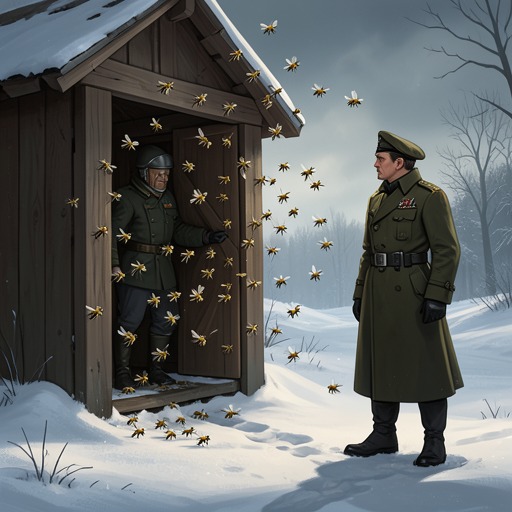
Ivan arrives in a windowless minibus bearing a military emblem, accompanied by Vasily Stepanovich, whom he introduces as a man pressed into driving because there is too much work and too few people. Ivan asks where the bees are. Vasily switches on a torch and lifts the roofs of the hives to look inside, alarming Sergeyich, who nervously explains that he has already extracted the honey. Ivan replies that this is precisely why they waited and says they must take one hive for a couple of days to run tests. When Sergeyich asks what tests, Ivan invokes a failure to obtain health-and-sanitation clearance on entry and the risk that bees might transmit disease to local Crimean bees.
The health rationale gives the seizure an administrative form, but it does not make the power imbalance disappear. Ivan and his companion inspect the hives at night, and Sergeyich can only watch as the authorities select one of them. The bees are at once the object being tested and the means by which Sergeyich makes a precarious life: losing a hive, even temporarily, is not an abstract inconvenience.
The Hive’s Return and Narrative Significance
When the minibus later draws level with Sergeyich, he calls out and asks whether Ivan has brought back his hive. Ivan looks through the lowered window with calm curiosity and confirms Sergeyich’s identity before the beekeeper approaches. At the tent, Ivan and Vasily are smoking beside the vehicle. Sergeyich asks whether the bees are healthy; Ivan answers that they are, and says they will bring out the hive after finishing their cigarettes. Relieved at the bees’ return, Sergeyich offers them tea, but they decline, saying they are pressed for time and that he will have to kindle the fire.
Ivan’s role is defined less by open violence than by the controlled uncertainty he can impose. He can discuss a disappearance without resolving it, suggest that Akhtem is dead and then retract the suggestion, warn Sergeyich about gratitude and permitted length of stay, and remove a hive under the authority of testing. The eventual return of the hive offers practical relief, not an explanation of Akhtem’s fate or a change in the conditions under which Sergeyich lives. Across the office and apiary, Ivan’s courteous manner accompanies a system in which official attention can reach from a passport to a beekeeper’s most vulnerable livelihood.