Karuselino
Grey BeesKaruselino is a frontline settlement and a contested passage through which the novel makes the war’s shifting geography tangible. For Sergeyich, it is at once a defensive position, a perilous stretch of road, and a necessary route between the grey zone and the territory beyond it: a place where military labels do not settle who belongs, and where even ordinary travel depends on negotiation and risk.
Position and Military Significance
Pashka identifies the armed men Sergeyich has seen as “our boys” on reconnaissance, then describes their target in the hostile language of the front. The exchange places Karuselino within the everyday vocabulary of military patrols and enemy identification. Its surroundings are not a distant battlefield but ground visible and reachable from the village, where movement can expose a person to armed observers.
The uncertainty becomes sharper when Pashka studies a man lying in the open through binoculars. The man’s orientation cannot establish whether he was crawling away from or toward the fighters; that distinction would determine whether he was an enemy or one of their own. Pashka says that if the man were certainly one of theirs, they could ask the fighters in Karuselino to retrieve him at night. The dead or possibly dead body is thus not simply a human emergency: its recovery is constrained by location, allegiance, and the danger of crossing exposed ground. Pashka also connects a blast heard the previous night with the cemetery, extending the threat from the military position to the village’s place of burial.
A later discussion confirms that the body remains where it fell. A young soldier says the wind has blown snow from the camouflage-clad man, but sending people to retrieve him would be too dangerous: tripwires might be hidden under the snow, and the body itself could be booby-trapped. He proposes that the separatists retrieve their own dead. Sergeyich challenges the arrangement by asking whether the other side would be allowed to crawl out only to be shot; the soldier answers that unarmed men carrying a white rag would be permitted to take the body. Karuselino’s military boundary is therefore negotiated through a narrow, conditional possibility of recovery, while the dead remain exposed between the forces.
A Route Across the Front
The settlement’s position also shapes the movement of civilians and supplies. When Ukrainian mail is due to reach Little Starhorodivka, Pashka says the mail carriers have only just arrived at Karuselino, so the villagers may have to wait. Sergeyich learns that Karuselino lies in the grey zone on the map, though Pashka describes it as belonging in practice to the Donetsk People’s Republic. He speculates that some arrangement, perhaps a payment, has made the delivery possible, since everyone wants mail. The uncertainty of the boundary does not stop the service, but it makes its continuation depend on understandings that remain informal and unclear.
The approach of the postal van gives the route a temporary, almost improbable promise. Karuselino is only two kilometres from Little Starhorodivka as the crow flies, but three and a half kilometres by road. The road’s channels require slow, careful driving, and the seasonal conditions make a funereal pace safest. After watching a moving dot beneath the horizon for several minutes, Sergeyich recognizes a van painted yellow and blue, the colours of the Ukrainian flag, coming from the direction of the separatist-held side. Its appearance is strange, then cheering: it seems capable of bringing peace along with the mail, although Sergeyich wonders whether that is really a task for a van rather than a tank. Pashka, meanwhile, asks what should happen to parcels addressed to people who have died. Their brief exchange sets the fragile renewal of ordinary postal life against deaths that have already made the mail obsolete.
A Crossing for Sergeyich and His Bees
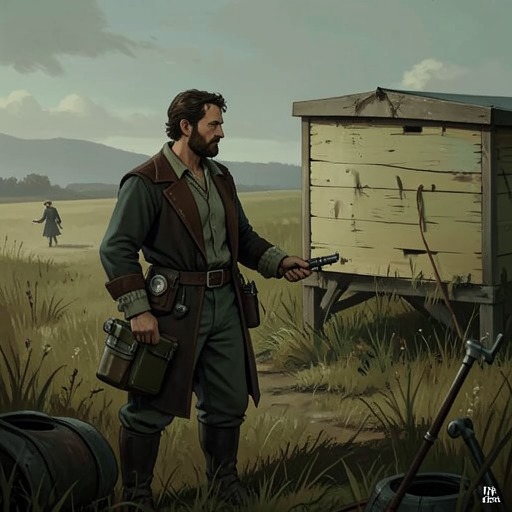
Karuselino becomes essential to Sergeyich’s own departure when he impulsively decides to take his bees away for a while. Petro advises him to use the road through Karuselino, then pass the Donetsk People’s Republic checkpoint, the checkpoint at the line of contact, and the Ukrainian checkpoint. The route sounds counterintuitive to Sergeyich because it runs through the very forces he fears, but Petro explains that the separatists think Sergeyich is one of their own. He cannot pass through Ukrainian positions directly; alternatives through Svitle and Gnutivka would still require him to turn toward Horlivka. For the beekeeper and his hives, Karuselino is not a scenic detour but the viable opening through a divided landscape.
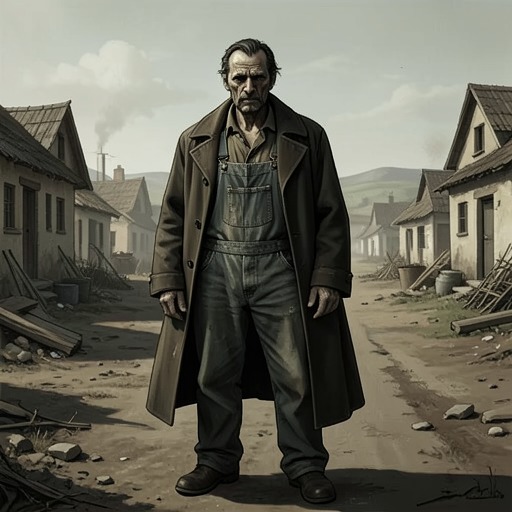
The departure unfolds at a deliberately cautious pace. Sergeyich leaves Karuselino behind while driving slowly so the bees on the trailer will not be disturbed. The settlement seems almost empty, though freshly washed linen flutters in one yard, an ordinary domestic sign that complicates the impression of abandonment. Soon a man in camouflage emerges from behind an old bus stop and points a rifle at Sergeyich’s green Lada. The beekeeper brakes about twenty metres away; his drowsiness disappears. When challenged, he says he is coming back because he lives there, and offers to show his passport. The armed man recognizes him and admits that he stopped him because he had no one to talk to. The encounter briefly turns a checkpoint-like threat into a lonely conversation, without making the road safe.
The man directs Sergeyich toward Zaitseve, advising him to head toward Vuhlehirsk, turn before reaching the city limits, continue past the mines, and ask for directions there. He mentions that another villager left the previous day to collect a pension and could have been followed. Sergeyich drives away thinking that he could not have known: until the day before, he did not know he would be leaving, and he still cannot know where he will be tomorrow. The route through Karuselino offers passage, not certainty. Its streets and directions lead onward, but do not restore a settled sense of home.
Threshold, Return, and Narrative Significance
Karuselino gathers together the novel’s recurring tension between borders on maps and conditions on the ground. Pashka distinguishes the settlement’s mapped status in the grey zone from its practical control; the mail van crosses from the separatist-held direction under an uncertain arrangement; and Petro’s route depends on how each side identifies Sergeyich. A person’s apparent allegiance can determine whether a body is retrieved, whether a vehicle is stopped, or whether a beekeeper can get his hives through. Political geography is experienced not as an abstract line but as a sequence of exposed fields, checkpoints, road channels, and encounters with armed men.
For Sergeyich, leaving the settlement does not amount to a clean break. After parting from Galya, he drives along an empty road past possible places where he might stop and settle with his bees. The road’s apparent freedom carries him onward instead; a sign for Simferopol startles him with the realization that he is nearly in Crimea. He then remembers Akhtem, the Crimean Tatar beekeeper he befriended at a convention years earlier, whom he had recently tried to call. Karuselino belongs to the earlier stage of that journey, where the route out of the grey zone becomes possible. Its significance lies in the gap between movement and arrival: it allows Sergeyich to leave, but neither the road nor the shifting front can tell him where he will finally belong.