Lenin Street
Grey BeesLenin Street is one of only two proper streets in Little Starhorodivka, and the street where Sergey Sergeyich lives alone amid the village’s wartime abandonment. Its name first locates his precarious home between opposing military presences; later, Sergeyich removes and redistributes the street signs in a nocturnal exchange with Shevchenko Street, turning the village’s map into a small, purposeful intervention in the Soviet names that remain around him.
Setting and wartime geography
The village’s streets are few enough to make a passing car legible by its route. Lenin Street runs alongside Shevchenko Street, with Ivan Michurin Lane also among the village’s limited roads. When Sergeyich hears a car stop nearby, he reasons that it must have come down Shevchenko: Pashka Khmelenko is the only other resident left in that part of the village. The small street plan is not merely a matter of navigation. It places the two elderly, long-standing adversaries within a nearly emptied settlement where each man’s house and garden face a different direction in a divided landscape.
Sergeyich’s garden on Lenin Street slopes toward a field and the rise behind which Zhdanivka is hidden. Ukrainian army dugouts and trenches occupy that rise, and he remains aware of their presence even when he cannot hear the soldiers. The army has been there for three years. Beyond Pashka’s street, gardens, and the remnants of a Soviet-era apricot grove, local men and Russian military personnel occupy dugouts on the other side. The fields around both streets have lost their workers to the war. Lenin Street thus belongs to an everyday geography whose nearest features—trenches, fields, and neighboring gardens—also register the front line.
The house on Lenin Street
The house’s isolation acquires a physical edge in Sergeyich’s preparations to admit Pashka. Before opening the door to the unexpected visitor, he places a broom in front of the safety axe by the entrance. He imagines Pashka may have a pistol or a Kalashnikov for self-defence, while the axe is all Sergeyich has to protect himself. At night he keeps it under his bed, a precaution that sometimes lets him sleep deeply. The house is a refuge, but not a place where the war can be shut out: bombardment is nearly inaudible indoors, yet reaches him outside from the east.
The village’s abandonment makes the street feel more empty than its modest length would suggest. After the first shell hits the church, residents leave in stages: fathers send their wives and children away, then depart themselves, some becoming separatists and others refugees; the elderly are taken last, weeping and cursing. Following a night of cannon fire, the quiet presses on Sergeyich as he walks down Lenin Street, looking over fences. Doors have been boarded shut and windows covered with plywood. He reaches the church, less than a kilometre from home, crosses to Shevchenko Street, and continues back on unsteady legs. Hearing Pashka cough from a garden fence reassures him that he is not entirely alone. The encounter begins with the two men acknowledging one another after a lifetime in the same village without even exchanging greetings.
A childhood enemy across the street
Lenin Street’s nearest human counterpart is Pashka’s home on Shevchenko Street. The men are almost exactly the same age and have been enemies since their first days at school. Their school had seven girls and only the two boys, leaving Sergeyich without a male friend and with Pashka as his persistent rival. He remembers Pashka’s dirty fighting, tattling to teachers, and refusal to let him copy answers in exams. Decades have not erased the resentment: Pashka’s appearance brings back the old grievances, though Sergeyich also recognizes that “enemy” is too severe for what they are. The Ukrainian diminutive “vrazhenyatko” captures the uneasy mixture of antagonism and familiarity: a harmless little enemy, one no one fears.
That history lends the parallel streets a social meaning beyond their names. Sergeyich lives on Lenin; Pashka, on Shevchenko, is one street closer to Donetsk. The pair’s separate homes preserve their old opposition, while their shared survival in an emptied village draws them into an involuntary companionship. Their neighborhoods are not equal in relation to the front: Pashka’s garden faces Horlivka, while Sergeyich’s looks toward Sloviansk and the Ukrainian positions near Zhdanivka. Yet the two men remain linked by the narrow distance between the streets and by the war that has reduced their village to a handful of residents.
The night the names change
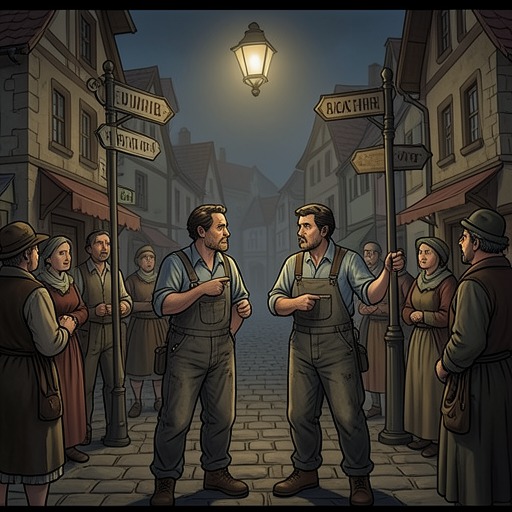
Sergeyich’s nighttime renaming begins with a practical choice of tools. After deciding how to occupy himself until dawn, he dresses warmly, goes to the garage, and packs tools into a backpack that belonged to a man with an earring. He walks to the point where the church can no longer be seen and uses a claw hammer to remove the blue-and-white LENIN STREET sign. Moving methodically along the road, he finds further signs fixed to fences and houses; one is so firmly nailed to a wall that it takes about five minutes to prise off, bending it slightly in the process.
He carries the signs to his own home and installs SHEVCHENKO signs: first on his fence beside the gate, then at the beginning of the street, and finally outside the last house on the right, nearest the church. His explanation to himself is historical and plain: in Soviet times Lenin mattered more than Shevchenko; Lenin’s name was known throughout the world, while Shevchenko’s was known only locally. He dismisses the distinction by deciding that poets are harmless, unlike politicians, and that he will live on Shevchenko Street.
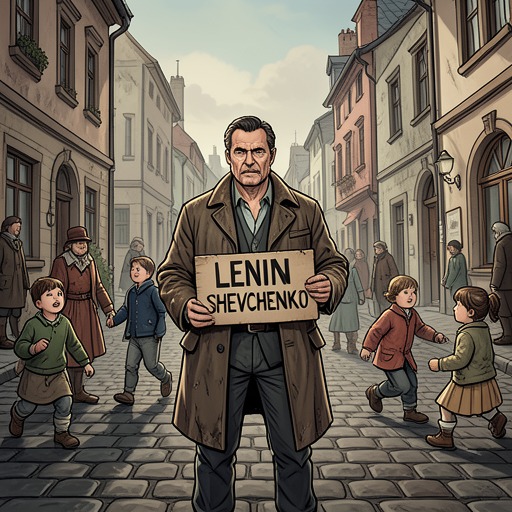
Before dawn, he returns to the street formerly called Shevchenko with the hammer, nails, and Lenin signs. He puts one on either side of Pashka’s gate, then distributes the remaining ten along the street, including signs at both ends. Pashka’s own house is therefore marked by Lenin’s name, while Sergeyich’s is reassigned to Shevchenko. Sergeyich does not consider that his hammering might wake his neighbor. He comes home pleased with the work, despite the protesting legs; his right knee, notably, is silent, as if it approves of the cause.
Names, memory, and the altered map
The exchange is small in scale but deliberate in form: instead of leaving Lenin’s name where it was, Sergeyich transfers it to the street of the man who has been his rival since childhood, and adopts the poet’s name for his own home. The signs make public labels into objects that can be removed, carried, bent, and nailed elsewhere. Their meaning depends on their contrast—Lenin against Shevchenko, politician against poet, Sergeyich against Pashka—and on the labor of placing each name at a particular gate and street end.
The final gesture toward Pashka’s street is also a gesture toward the remains of Soviet history. Its far end is described as pointless, like the end of that history; there stand the dilapidated cowsheds of the shuttered Iona Yakir collective farm and buildings stripped of roofing slate, window frames, and even bricks. The renaming does not restore the village or undo its abandonment. It alters the local map through which its remaining inhabitants understand home, rivalry, and the political past, while the war continues to define the fields beyond their gates.