Little Starhorodivka street signs
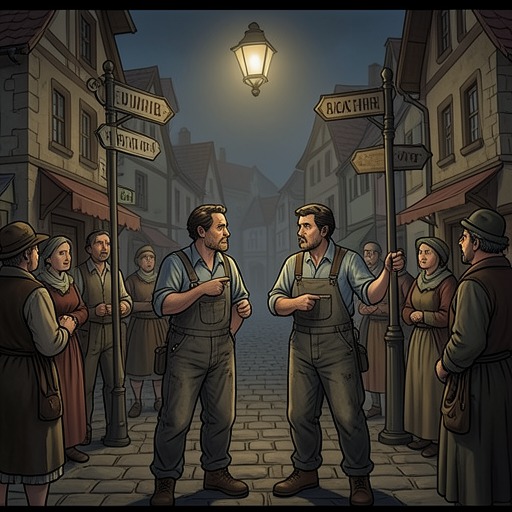
Grey BeesThe Little Starhorodivka street signs are more than markers of where one road ends and another begins: in a nearly emptied village, they become portable pieces of public history. During one winter night, Sergeyich removes the signs identifying Lenin Street and Shevchenko Street, then reinstalls them on the opposite roads. By dawn, a private rearrangement of names has become a comic, pointedly provisional act of civic decision-making, affirmed by Sergeyich and Pashka while the rest of the village is absent.
A nocturnal collection
With war making daylight work dangerous, Sergeyich decides to occupy himself at night. After tea with honey, he dresses warmly, gathers tools from his garage, and puts them into a backpack that belonged to a dead soldier. The claw hammer, heavy among the tools, will serve both to prise the signs from their fastenings and later to nail them up again. An ordinary job of street maintenance is recast as furtive labor: in daylight, someone watching from the horizon might mistake him for a target.
Sergeyich walks to the point where the village church can no longer be seen, even though it has already been destroyed, and begins with the Lenin Street sign at the road’s entrance. He follows the street from fence to fence, discovering that the signs are not fixed consistently: some are attached to fences, while another is nailed directly to a house. That one resists the hammer’s claw. Its owner has secured it with ten-millimetre nails, and Sergeyich spends about five minutes levering it loose, bending it slightly in the process.
By the time he reaches the bombed-out church, the backpack holds twelve signs as well as the tools, and its weight is telling. Back in his yard, Sergeyich lays the signs on the snow, one atop another. His hoarse laugh escapes before he covers his mouth; he realizes he has completed only half the work. The pile is at once a practical inventory and a temporary image of the village’s public geography, detached from the houses and fences that gave each sign its place.
Reversing the names
Sergeyich crosses to Pashka’s street and removes six Shevchenko signs. He finds no more, although the two streets have nearly the same number of houses. He explains the imbalance to himself through Soviet history: Lenin, he reasons, mattered more in Soviet times, and his name was known around the world, whereas Shevchenko was known only locally. The signs thus register an uneven distribution of historical authority as well as the physical layout of the village.
He dismisses his own political accounting by deciding that poets are harmless, unlike politicians, and that he will live on Shevchenko Street. He nails a Shevchenko sign to his own fence, to the left of his gate, then puts signs at the beginning and the far end of that street. The first change makes the new arrangement personal: the name on his home’s street is one he has chosen rather than merely inherited.
At half past four, still hours before dawn, Sergeyich goes back out with the hammer, nails, and Lenin signs. On what had been Shevchenko Street, he places a Lenin sign on each side of Pashka’s gate, then distributes the remaining ten along the road, including one at either end. He gives no thought to the hammering waking Pashka. The route ends among the derelict cowsheds of the closed Iona Yakir collective farm and buildings stripped of roofing slates, window frames, and many of their bricks. Against this landscape of abandonment, the signs look like an attempt to restore order, but their neat succession also carries the history of a Soviet past whose physical surroundings have fallen away.
An improvised public vote
Pashka later visits Sergeyich and jokes that he came because he was bored and wanted to see his friend. His gratitude reveals that he has understood the overnight exchange as a favor: he had been fed up with Shevchenko Street and is delighted to have Lenin Street instead. What Sergeyich performed alone in darkness is therefore not simply an act of renaming imposed on an unsuspecting neighbor. Pashka welcomes the result, turning the signs into a subject of shared, if casual, agreement.
Their talk makes the arrangement’s uncertain authority part of its humor. Pashka asks what will happen if people return and demand that the signs be put back as they were. Sergeyich answers that streets, villages, and cities are being renamed throughout the country, and says the important thing is for the residents to agree. He asks whether Pashka agrees; Pashka says he does, and Sergeyich immediately raises his hand to hold a vote. Pashka’s hand shoots up too, his uneven teeth visible in a smile. Two absent residents have, in this improvised procedure, supplied a unanimous result.
Sergeyich concludes that anyone who did not attend the meeting is responsible for missing it, and that they will inform the government of their decision when it returns. The joke depends on the gap between the language of official procedure and the village’s actual circumstances: there is no assembled community, only two neighbors at the stove, and no formal authority is present. Yet the agreement is not wholly empty. Pashka’s delight and Sergeyich’s participation make the reversal a small negotiation between them, even as the absent population leaves open whose consent the decision can represent.
Names, history, and the empty village
The signs make political history tangible by reducing it to objects that can be lifted, stacked, bent, and nailed to a fence. Lenin and Shevchenko do not appear only as names in a debate: their unequal presence is counted in the twelve signs from one street and six from the other, then rearranged through hours of strenuous work. Sergeyich’s private explanation—Lenin’s global fame against Shevchenko’s local recognition—shows how the old naming order persists in his way of measuring importance, even while he chooses to live under Shevchenko’s name.
The exchange also refuses a simple, clean break with the past. Sergeyich transfers the names rather than erasing either of them. His dismissal of politicians sits uneasily beside the effort he spends redistributing Lenin’s name, and Pashka, who appreciates the change, had been dissatisfied with Shevchenko rather than with Lenin. The signs’ new locations therefore alter the village’s symbolic map without settling what its competing names mean. Their portability makes inherited history available for revision; their reuse shows that revision still works with the materials history has left behind.
The deserted street, the ruined church, the closed collective farm, and the dismantled buildings give the act its scale. There is no full village assembly to authorize a new map; many residents are absent, and the streets themselves lead into material traces of decline. In that setting, the signboards are unusually consequential because they remain among the few public markers Sergeyich can physically change. His labor cannot restore the houses or call their residents back, but it produces a visible alteration and, for a moment, a shared decision with Pashka. The final authority of the new names remains uncertain; the fact of their exchange, and the two neighbors’ agreement to claim it, does not.